


The Civic District in Singapore is one of the easiest places in the city to explore entirely on foot. Grand colonial-era buildings, modern arts venues, green riverfront promenades and major MRT lines all meet within a compact, walkable area. This guide sets out a practical self-guided route starting from City Hall MRT and connecting the Padang, National Gallery Singapore, St Andrew’s Cathedral, Victoria Theatre and Concert Hall, the Arts House at the Old Parliament, the Asian Civilisations Museum, the Esplanade and the Singapore River, with clear suggestions on what to see for free, which museums are worth a paid ticket, where to cool off in air conditioning, and how to continue on to Marina Bay or Clarke Quay afterward.
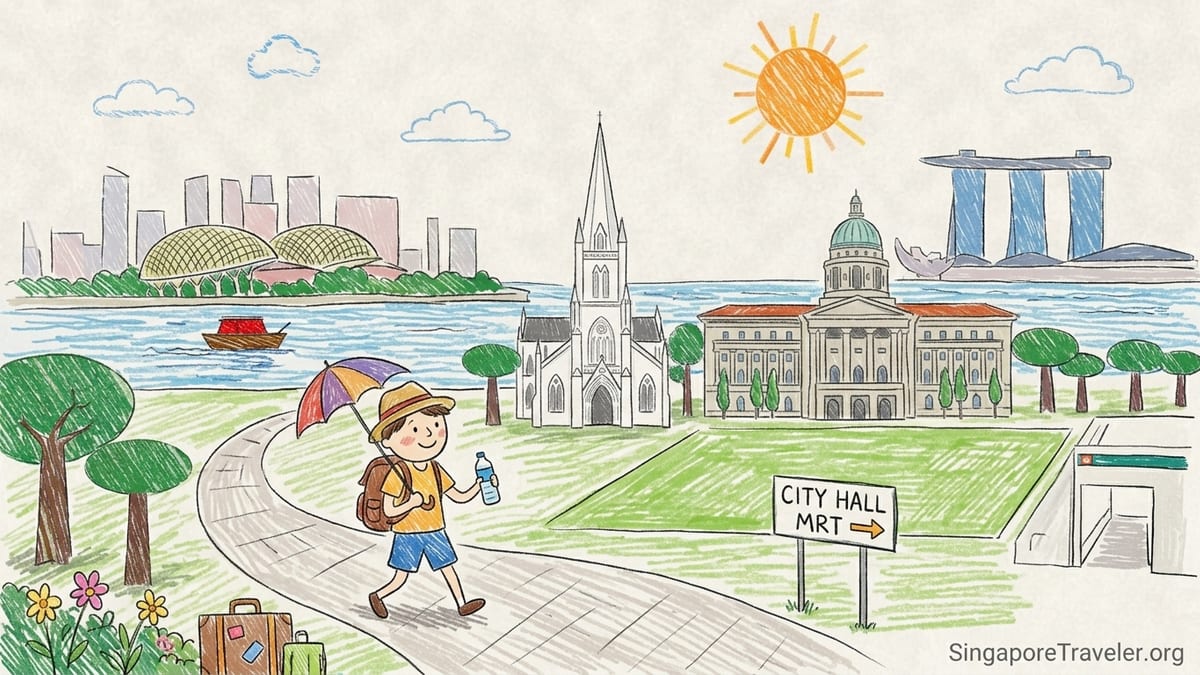
Getting Oriented: MRT Gateways and How This Walk Works
Singapore’s Civic District sits between Marina Bay and the Singapore River, framed by City Hall, Esplanade and Marina Bay MRT stations. Most visitors will find it quickest to start at City Hall MRT, which lies directly underneath Stamford Road near the junction with North Bridge Road and opens into underground malls and walkways that put you within a few minutes’ walk of the Padang, St Andrew’s Cathedral and the National Gallery. Esplanade MRT on the Circle Line and Marina Bay MRT on the North South and Circle lines sit at the southern edge of the district and make convenient exit points when you have finished your walk or want to connect to Gardens by the Bay.
This walking route assumes you have half a day and reasonably good fitness. In pure distance it is not far, but you will spend time exploring interiors, lingering on the riverfront and possibly adding a museum visit or two. The core loop begins and ends within a short stroll of City Hall or Esplanade MRT, so you can cut it short at any point and duck back underground to the air conditioning and trains. Wear light clothes, bring a small umbrella for the equatorial sun and occasional downpours, and carry a refillable water bottle; many of the museums and malls on this route have drinking water points and clean toilets.
Many of the big-ticket sights here can be appreciated at no cost from the outside. The classical façade of the former Supreme Court, the stately columns of the old City Hall, the Gothic spire of St Andrew’s Cathedral, the iconic durian-shaped domes of the Esplanade and the low riverside profile of the Arts House are all fully visible from public streets and open spaces. You can enjoy impressive views and photographs without necessarily buying a single ticket, which makes this district ideal for budget-conscious travelers or those with only a short layover in the city.
Start at City Hall MRT: Cathedral, Padang and Old City Hall
Begin inside City Hall MRT and follow the signs to Exit B or C toward St Andrew’s Cathedral and the Padang. As you emerge to street level you will almost immediately see the white spire and louvered shutters of St Andrew’s Cathedral rising above the trees. The cathedral grounds are open to the public, and there is no charge to walk the perimeter paths, photograph the exterior and step into the airy, Gothic Revival nave when services or private events are not in progress. It is one of the quickest and most atmospheric ways to step back into Singapore’s 19th-century history within minutes of leaving the train.
From the cathedral, cross towards the broad green field of the Padang. This huge lawn has hosted everything from cricket matches to National Day parades and New Year’s Eve celebrations. The field itself is freely accessible when not cordoned off for events, and you can stroll across the grass to appreciate the grand civic buildings around its edges. Facing the Padang is the imposing façade of the former City Hall and Supreme Court, which together now house National Gallery Singapore. Their twin colonnades and domes are among the most photographed pieces of architecture in the city, and you can enjoy them entirely from outside if you are short on time.
Walk the length of the Padang, stopping for photos with the skyline of Marina Bay Sands and the financial district in the background. If you are visiting in the heat of the day, this is a good moment to plan your first air-conditioned break. The undercroft of National Gallery Singapore, accessed via the steps and ramps facing the Padang, offers a cool, shaded plaza with cafes, a visitor information desk and clean restrooms. Even if you do not intend to pay for full gallery admission, you can step into these common areas for a break and, depending on current policies, often access selected public spaces, such as the lobby and certain viewing terraces, without a ticket.
National Gallery Singapore: When to Pay and Where to Cool Down
National Gallery Singapore is the largest visual arts institution in the country, spread through the restored former Supreme Court and City Hall buildings. For architecture and history enthusiasts, the building alone justifies an extended visit: glass and metal walkways link old courtrooms and council chambers, and rooftop terraces offer panoramic views across the Padang toward Marina Bay. Singapore citizens and permanent residents typically enjoy free or discounted general admission, while visitors from overseas pay a standard adult ticket for access to the main galleries, with separate pricing for certain special exhibitions. If you have time for only one major indoor attraction on this walk and enjoy art or architecture, this is a strong candidate for your paid stop.
Even without purchasing a ticket, parts of the Gallery work well as practical cooling stops. The ground-floor atrium, selected shop areas and some cafes are accessible to the public and are fully air conditioned. You can pick up a paper map or ask staff about current free spaces, then decide whether to upgrade your stop into a full visit. Travelers with limited time might concentrate on the former City Hall Chamber, where important speeches in Singapore’s journey to self-government were made, and on one of the rooftop terraces with views across the Civic District and Marina Bay. Families may appreciate the dedicated children’s spaces and activity stations that appear during large-scale programmes, which can keep younger travelers engaged while adults rest.
Plan at least 90 minutes for a quick, focused look at one or two permanent galleries and a featured exhibition. If you are a serious art fan you could spend half a day here, in which case consider splitting the broader Civic District walk into two segments, with the Gallery as your central anchor. When you are ready to move on, exit the Gallery on the side closest to the river and Victoria Theatre. The route leads you through sheltered walkways and plazas that gradually open onto the rear of the theatre complex, keeping you shaded for most of the transition.
Strolling via Victoria Theatre, the Arts House and Parliament
From the river-facing exit of the National Gallery, follow signs to Victoria Theatre and Concert Hall. The complex is recognisable by its white clock tower, classical columns and central lawn. Access to the lawn and the exterior colonnades is free, and it is common to see office workers taking a quick break here during the week or couples using the space for wedding photos on weekends. Step into the entrance foyers where open; these are usually air conditioned and feature heritage panels and portraits that explain the building’s role as one of Singapore’s earliest public performance venues.
A short walk along the side streets brings you to the Arts House at the Old Parliament. This low, pale building dates from the early 19th century and is believed to be one of Singapore’s oldest surviving structures. Today it serves as an arts and events venue, and when there are no closed-door functions you can usually wander into the lobby, browse small exhibitions or photos about its past as Singapore’s first courthouse and later its Parliament, and enjoy the air conditioning. The front lawn and sculpture installations are always free to access and give good photo angles across to the river and the skyscrapers of Raffles Place beyond.
Modern Parliament House stands just behind the Arts House. You cannot simply wander into parliamentary chambers, but you can walk the paths around the building’s exterior and along Parliament Place, which offers clear views back toward the National Gallery and over to the Asian Civilisations Museum across the road. This part of the route is very compact; you can easily loop from Victoria Theatre to the Arts House and Parliament House and back to the river in under 20 minutes without hurrying. If the weather is particularly hot, consider timing this section for late afternoon, when the sun is lower and the colonnades and trees give more consistent shade.
Asian Civilisations Museum and the Riverfront Promenade
Cross Old Parliament Lane toward the low, light-coloured building of the Asian Civilisations Museum, set just back from the river. Housed in the historic Empress Place Building, this museum focuses on the artistic heritage of Asia, with a special emphasis on how different cultures and trade routes shaped the region. Admission policies change occasionally, but in recent years Singapore citizens and permanent residents have typically enjoyed free general admission to permanent galleries, while standard tickets for international visitors remain comparable to other major museums in the city. If you are choosing between several paid sites in the Civic District, the Asian Civilisations Museum is an especially good choice if you are interested in Asian art, religion and maritime history.
Non-ticketed public areas of the museum, including the shaded arcade and ground-floor lobby, make pleasant, air-conditioned breaks even if you do not opt for a full visit. There is often a cafe or small outlet on the ground floor where you can pick up coffee, cold drinks or a light meal, and the restrooms here are convenient if you are midway through your walk. Check the museum’s current notices at the entrance for any temporarily closed galleries or special exhibitions that might interest you; for example, certain themed rooms or wings can close for refurbishment for a few months at a time, so your visit may focus more on other sections.
When you exit the museum, turn your attention to the Singapore River itself. A wide promenade runs along the water, offering unbroken views of Cavenagh Bridge, Anderson Bridge and the riverside facades of Boat Quay and the financial district. Walking a few minutes toward Cavenagh Bridge gives you one of the most characteristic Civic District scenes: the suspended bridge in the foreground, the stately Asian Civilisations Museum and Empress Place buildings on one side, and glass office towers on the other. This entire riverfront stretch is free to access, open day and night, and cooled by breezes that can make it one of the more comfortable parts of the walk even in the early afternoon.
Esplanade and the Waterfront: Free Icons and Air-Con Respite
From the Asian Civilisations Museum, follow the river downstream toward Anderson Bridge and the open spaces around the Esplanade Park. Cross to the Marina Bay side using either Anderson Bridge or the pedestrian paths that feed into the Esplanade. Within 10 to 15 minutes on foot you will see the distinctive domes of Esplanade – Theatres on the Bay, often compared to durians for their spiky sunshades. The waterside plaza and outdoor terraces are completely free to enjoy and are a favourite spot for both photographers and families out for an evening stroll.
Inside, the Esplanade’s main concourses and foyers are air conditioned and open to the public. You do not need a theatre ticket to walk through the central atrium, browse the arts-themed gift shop, or visit cafes and casual dining options that range from bakeries and coffee bars to simple Asian eateries. On many evenings and weekends, free performances take place at the outdoor theatre by the water or at indoor public stages, so it is worth checking event boards as you pass through. Even a brief wander around the upper levels can reward you with framed views across Marina Bay toward Marina Bay Sands, the Merlion and the financial skyline.
The Esplanade also acts as a practical transit node. Esplanade MRT on the Circle Line is reached by following clear signs from within the complex, and nearby underpasses link to City Hall MRT and to underground malls leading toward Suntec and Marina Square. If you have had your fill of walking for the day, this is one of the most comfortable places to end your tour. Before you do, consider taking a final loop along the waterfront promenade directly in front of the Esplanade, where you can look back toward the Civic District skyline and reflect on how compact and walkable the area really is.
Combining the Walk With Marina Bay or Clarke Quay
One of the strengths of the Civic District is its flexible connections to other popular parts of central Singapore. If you turn left from the Esplanade waterfront and follow the curve of Marina Bay, you can easily continue walking to the Merlion Park in about 10 minutes, then on to the Helix Bridge and Marina Bay Sands in another 15 to 20 minutes. This extended route is fully free to walk and mostly along wide, paved promenades with occasional shade. As you go, you will pass photo points with reflections of the National Gallery and old Supreme Court domes mirrored in the Bay’s water, linking the colonial core with the futuristic towers across the way.
Alternatively, from the Asian Civilisations Museum you can angle inland along the river toward Boat Quay and Clarke Quay instead of heading to the Esplanade. The paved riverfront path will take you past alfresco bars and restaurants, many of which begin offering happy-hour deals in the late afternoon and early evening. While this section is more commercial than the civic core, it offers a lively contrast and gives you a feel for how the historic working river has become an entertainment strip. Clarke Quay MRT on the North East and Downtown lines sits directly behind the cluster of brightly painted warehouses, so you can end your day there with an easy train connection.
If you prefer to shorten the walk, consider a compromise: complete the Civic District loop as far as the Esplanade, then use the underpasses and sheltered links to reach Marina Bay MRT or City Hall MRT for a quick ride to Bayfront or Promenade stations. This is often the best approach in bad weather or if you are traveling with young children or older relatives who may tire before reaching Marina Bay on foot. The key is to treat the Civic District as a central hinge in your day: do the compact historic walk first, then decide whether to open the hinge toward Marina Bay or up the river toward Clarke Quay depending on the time and energy you have left.
Practical Tips: Free Sights, Paid Entries and Cooling Breaks
For travelers watching their budget, it helps to be clear about what you can see for free. The exteriors and surrounding grounds of St Andrew’s Cathedral, the Padang, National Gallery Singapore, Victoria Theatre and Concert Hall, the Arts House, Parliament House, the Asian Civilisations Museum and the Esplanade are all freely accessible and visible from public streets, parks and promenades. You can build an entire walk focusing purely on the architecture and river views without spending anything more than your MRT fare. This makes the Civic District a good choice on arrival day or for those trying to keep costs down while still enjoying some of Singapore’s signature sights.
When you are ready to spend on admission, prioritise one or two museums or galleries instead of trying to enter everything. As a rule of thumb, art and culture fans often choose between National Gallery Singapore and the Asian Civilisations Museum as their main paid stop in the district, with some adding the National Museum of Singapore, slightly uphill near Fort Canning, as a separate visit on another day. Before you travel, check current ticket prices and any free-entry schemes for Singapore citizens, permanent residents, students or seniors, as well as special exhibitions that might influence your choices. If you are visiting with children, consider whether an art-focused gallery or a broader cultural museum will hold their interest better.
Think of air-conditioned spaces as part of your route planning rather than afterthoughts. At City Hall MRT you can use the underground malls for a quick coffee or snack before you start. Near the Padang, the lobby and cafes of National Gallery Singapore offer one of the most comfortable mid-route breaks. Around Empress Place, the Asian Civilisations Museum lobby and its cafe work well for lunch or a cold drink. At the far end, the Esplanade provides multiple indoor seating areas, food options and restrooms. Spacing your day so you step indoors every 30 to 60 minutes in the middle of the day will make the walk feel much more manageable in Singapore’s year-round heat and humidity.
The Takeaway
Walking the Civic District is one of the most efficient ways to experience Singapore’s blend of colonial heritage, modern nation-building and contemporary arts within a compact area. Starting from City Hall MRT, you can move in an easy loop that takes in St Andrew’s Cathedral, the Padang and its grand civic buildings, National Gallery Singapore, Victoria Theatre, the Arts House at the Old Parliament, Parliament House, the Asian Civilisations Museum, the Singapore River and the Esplanade, all without tricky navigation or long gaps between sights.
Along the way, you can decide how much depth you want. Those interested in architecture and history can invest in tickets to one or two carefully chosen museums, while casual strollers content themselves with free exterior views and riverfront promenades. Air-conditioned lobbies, malls and cultural venues act as built-in rest stops, ensuring that even in the tropical climate the walk stays comfortable. When you finish, the same streets and waterfront paths lead naturally onward, whether you choose to circle Marina Bay with its famous skyline or drift up the river to Clarke Quay’s lively bars and restaurants.
However you structure your day, the Civic District rewards unhurried exploration. Look up at the domes and spires, pause under the trees by the river, step briefly into a gallery or cathedral when the sun grows too strong, then emerge again into the open spaces of the Padang or the waterfront. In a few hours on foot, you will have traced the outline of Singapore’s civic heart and created a flexible base for the rest of your time in the city.
FAQ
Q1. How long does the Civic District walking route from City Hall MRT usually take?
Most visitors spend about three to five hours on this route, depending on how many museums they enter. A brisk loop with only exterior views can be finished in around 90 minutes, while adding a full visit to the National Gallery or Asian Civilisations Museum can easily extend the walk to half a day.
Q2. Is it possible to enjoy the Civic District without paying any admission fees?
Yes. You can see the exteriors of St Andrew’s Cathedral, National Gallery Singapore, Victoria Theatre and Concert Hall, the Arts House, Parliament House, the Asian Civilisations Museum, the Esplanade and the whole riverfront entirely for free. Many people choose one or two paid sites and keep the rest of the walk focused on open spaces and architecture.
Q3. Which single museum is best if I only want to pay for one admission?
If you like art and architecture, National Gallery Singapore is often the top choice because it combines major regional art collections with dramatic interiors and rooftop views. If you are more interested in Asian history, religion and trade, the Asian Civilisations Museum is a strong alternative and sits directly on the riverfront route.
Q4. Are there plenty of air-conditioned places to rest along the walk?
There are multiple cooling stops. City Hall MRT connects to underground malls, National Gallery Singapore and the Asian Civilisations Museum have public lobbies and cafes, and the Esplanade offers large indoor foyers, shops and dining. You can plan to step indoors roughly every 30 to 60 minutes, especially during the hottest midday hours.
Q5. Is the Civic District walk suitable for children and older travelers?
Yes, provided you pace the day and use shaded paths and indoor breaks. The walking distances between major sights are short, benches and seating are common, and MRT stations at City Hall, Esplanade and Marina Bay give options to stop whenever anyone in the group is tired.
Q6. What time of day is best for doing this walking tour?
Early morning and late afternoon into evening are usually the most comfortable, with softer light and lower heat. Many travelers start between 8 and 9 am, break indoors around midday, then continue from mid to late afternoon for riverfront and bay views as the city lights begin to come on.
Q7. Can I combine the Civic District walk with Marina Bay on the same day?
Yes. After reaching the Esplanade or Merlion Park, you can follow the waterfront promenade to Marina Bay Sands and the Helix Bridge. Allow an extra one to two hours to walk this extension and stop for photos, more if you plan to visit an observation deck, shopping mall or Gardens by the Bay afterward.
Q8. How do I connect the Civic District walk with Clarke Quay?
From the Asian Civilisations Museum, simply follow the Singapore River upstream past Boat Quay’s restaurants to Clarke Quay’s restored warehouses. It is an easy 15 to 20 minute stroll, and Clarke Quay MRT at the far end provides fast train access back to other parts of the city.
Q9. Do I need to join a guided tour, or is a self-guided walk enough?
A self-guided walk is enough for most visitors, especially with basic background reading or a simple offline map. Guided tours, however, can add more context about architecture, World War II history and Singapore’s independence. If you are particularly interested in these stories, consider scheduling a guided Civic District or colonial heritage tour on a different day.
Q10. Is the Civic District walk still enjoyable in wet or very hot weather?
Yes, with adjustments. In heavy rain or intense midday heat, shorten the outdoor stretches and spend longer inside the National Gallery, Asian Civilisations Museum or the Esplanade. Use underground links between City Hall and Esplanade MRT to stay sheltered, and watch for brief dry windows to enjoy the Padang and riverfront views.