


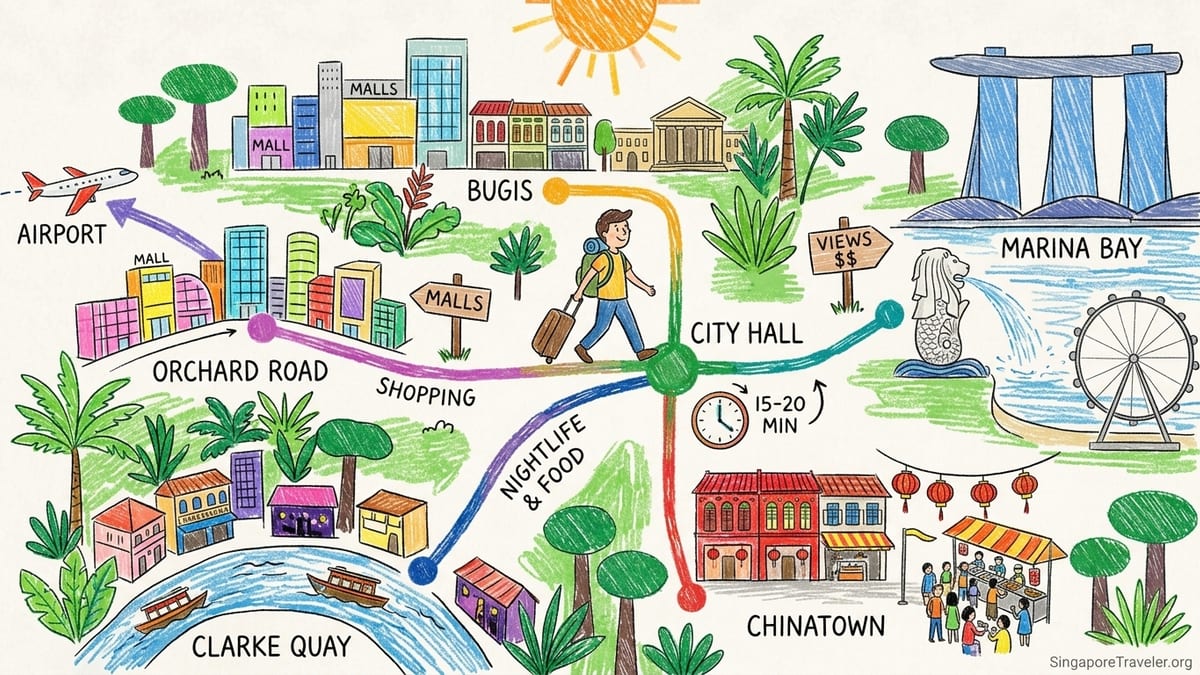
Choosing a hotel in central Singapore is rarely about finding the absolute cheapest room. It is about trading view for convenience, nightlife for quiet, shopping for culture, and deciding whether you want to be beside a major MRT interchange or directly facing the bay. This guide compares Marina Bay, City Hall and the Civic District, Clarke Quay and the Singapore River, Orchard, Chinatown and Tanjong Pagar, and Bugis, with concrete examples of what you actually get for your money in each area.
How Central Is “Central” in Singapore?
Central Singapore is compact enough that you can cross the downtown core by MRT in roughly 15 to 20 minutes. Yet the feel of each neighborhood is very different. Marina Bay is dramatic and polished, City Hall is historic and practical, Clarke Quay runs late into the night, Orchard is about malls and brands, Chinatown and Tanjong Pagar are dense and atmospheric, while Bugis sits between traditional districts and the modern core. A hotel decision here is less about distance on a map and more about what you want to step out into each day.
For most travelers, the key factor is how close you are to a useful MRT interchange. City Hall and Raffles Place connect the North South and East West lines. Dhoby Ghaut, a short walk from Orchard, connects three lines. Chinatown combines two lines and offers quick access to both the traditional shophouse streets and the financial district. Staying within a five minute walk of one of these hubs can often be more valuable than paying a premium simply to face the water at Marina Bay.
Room sizes and prices also differ by area. A typical modern central hotel room in Singapore might be 14 to 20 square meters, with some budget places offering even smaller spaces. Travelers often comment that a mid range room near Clarke Quay at around 200 to 260 Singapore dollars per night can feel far more practical than a compact Marina Bay room that costs double, especially if they plan to be out exploring from morning to late evening.
Another real world difference is how walkable each neighborhood feels at street level. In Orchard you may find yourself moving from mall to mall in air conditioned walkways. Around Marina Bay, distances between sights can be longer than they appear on a map. In Chinatown and Bugis, alleys, hawker centres and small streets make it easy to wander and snack without a plan. Your ideal location is the one that matches how you like to move through a city.
Marina Bay: Iconic Views at a Premium
Marina Bay is the postcard side of Singapore, dominated by the famous hotel with the rooftop infinity pool, luxury towers, and the waterfront promenade curling around the bay. Expect some of the highest nightly rates in the country for rooms that look onto the skyline and the bay. It is common to see entry level rooms in major Marina Bay properties selling for several hundred Singapore dollars per night, and significantly more during peak periods, major conferences, or Formula 1 week.
The main advantage of staying here is the sense of spectacle and direct access to big ticket sights. Gardens by the Bay, the Singapore Flyer, and the waterfront light shows are close at hand. If you stay in a full service bayfront hotel you may find that you rarely need to leave the integrated malls and podiums for food and shopping. That convenience can be appealing for a short stopover, but it also means you are paying extra to be inside a largely self contained complex rather than in a traditional neighborhood.
In practical terms, Marina Bay’s MRT access is good rather than exceptional. Several stations on different lines ring the bay, but you will still often connect through City Hall, Raffles Place or Promenade when crossing the island. If you stay in a hotel that is directly above a station, getting around is painless, but do not underestimate walking times through large malls and underground passages, especially in hot weather. A trip to a hawker centre like Maxwell Food Centre or Lau Pa Sat will still require a short train ride or a longer walk.
For travelers who value convenience over spectacle, the main trade off is price. A Marina Bay room with a view can easily cost as much as a much larger room in City Hall or Orchard, or two connecting mid range rooms in Chinatown. Unless the rooftop pool or a specific bay facing property is the centerpiece of your trip, you may find better value just a stop or two away on the same MRT network.
City Hall & the Civic District: Interchange Convenience and Classic Hotels
The City Hall and Civic District area is one of the most strategically useful parts of central Singapore to stay in. City Hall MRT station is an interchange for the North South and East West lines, which means you can go directly to the airport on the East West line, up to Orchard on the North South line, or change easily toward neighborhoods like Bugis and Chinatown. Some large hotels sit directly above or beside this station, so you can roll your suitcase from the platform to the lobby in a matter of minutes without stepping into the heat.
The Civic District itself is lined with landmarks such as the former City Hall and Supreme Court buildings, now repurposed into cultural venues, as well as the Padang, historic bridges over the river, and the Esplanade performing arts centre. A stay here places you within walking distance of the National Gallery, several museums, and the waterfront. Hotels range from luxury properties housed in heritage buildings to more modern high rise towers integrated with malls, where you can expect broad city or bay views.
Price wise, City Hall often sits slightly below Marina Bay but above Chinatown and Bugis. A well known international hotel above the station might offer standard rooms around the mid 300s Singapore dollars per night at typical times, with rates rising for higher floors or views. Nearby, you will also find modern mid range options such as co living style properties inside malls that target younger travelers or business guests with compact but efficient rooms. For many visitors, the ability to walk to both the Civic District and the riverfront within 10 minutes justifies paying more than they would in Bugis or Little India.
From a logistics perspective, City Hall is an excellent compromise if you want to see both Marina Bay and the older quarters without changing hotels. You can walk to Marina Bay in around 15 minutes via underground passages connected through large developments, or ride the MRT one stop. At the same time, you are only a few stops from Orchard, Bugis and Chinatown. This is a clear example of where being above an MRT interchange can be more practical than paying extra for a direct bay view.
Clarke Quay & Singapore River: Nightlife and Mid Range Value
Clarke Quay and the Singapore River corridor appeal to travelers who like to walk by the water and enjoy nightlife. The riverside is lined with colorfully restored shophouses that now host bars, restaurants and live music venues. In the evenings, particularly on weekends, the area fills with both locals and visitors. If you stay in a hotel that faces directly onto the busiest part of the river, you should expect some noise late into the night, even if the property itself is mid or upper tier.
The hotel mix here runs from mid range international brands to simple budget hotels and hostels. A modern mid range riverside hotel might price standard rooms in the approximate range of 220 to 320 Singapore dollars per night depending on season and occupancy, while smaller older properties or capsule style setups can drop under 150 dollars. Travelers who want full service comforts but do not need a bay view often settle on this area as a sweet spot, especially when they find offers that bundle breakfast or include river facing rooms at modest premiums.
In terms of transport, Clarke Quay is served by an MRT station on the North East line, which connects quickly to Chinatown, Dhoby Ghaut, and Little India. Walking across the river brings you to the financial district in 10 to 15 minutes, and you can reach City Hall or Raffles Place by foot if you are comfortable with tropical heat. Many hotel guests report that they rarely need taxis if they plan their days around the MRT network, using stations at Clarke Quay, Fort Canning or nearby Chinatown to access almost anywhere in the city centre.
If you are noise sensitive or traveling with younger children, consider staying slightly upriver toward Robertson Quay rather than directly on the party strip. Here, you still have riverfront cafes and mid range hotels, but the atmosphere is quieter. For couples or groups who plan to be out late, on the other hand, staying right beside Clarke Quay can save both time and late night taxi costs while still keeping you only a short train ride away from Orchard or Marina Bay.
Orchard: Shopping Corridor With Wide Hotel Choice
Orchard Road is Singapore’s classic shopping avenue, lined with malls, department stores, and international brands. If your idea of a central stay involves moving between air conditioned malls, ducking into cafes, and browsing from high street fashion to luxury labels, Orchard is difficult to beat. Hotels range from long established five star properties with resort style pools to newer business oriented mid range hotels and a scattering of more affordable options on side streets.
Recent rate comparisons suggest that the average price for a three star hotel near Orchard can sit in the low to mid 200 US dollar range, while four star hotels often appear around the mid 200s, depending on dates and promotions. At the very top end, flagship five star properties on or just off Orchard can price standard rooms at 250 to 350 US dollars in quieter periods, rising significantly over holidays or major regional events. For travelers from countries with weaker currencies, this can feel expensive, but availability is wide and last minute deals are sometimes easier to find here than in Marina Bay.
Orchard’s MRT access has improved over the years. The main Orchard station anchors one end of the road, and additional stations such as Somerset and Orchard Boulevard extend coverage. From Orchard, you can ride the North South line directly to City Hall, Raffles Place and Marina Bay, so you are not isolated from the rest of the city. However, if you intend to visit cultural sights in the Civic District or eat frequently in Chinatown hawker centres, you may find yourself spending more time underground than if you had stayed closer to the river or Bugis.
In practice, Orchard is ideal for visitors who prioritize shopping and who appreciate larger rooms and full facilities. Many family travelers choose mid range hotels here that offer interconnecting rooms or family suites, accepting a slightly longer MRT ride to older quarters in exchange for reliable comforts and a higher probability of finding a pool, gym and spacious breakfast area within their budget.
Chinatown & Tanjong Pagar: Character, Food and Mixed Price Points
Chinatown and neighboring Tanjong Pagar provide one of the most atmospheric places to stay in central Singapore. Rows of preserved shophouses house temples, clan associations, cafes and traditional medicine halls at street level, while above them newer boutique hotels and budget hostels slot into narrow footprints. Side by side with these, taller business hotels serve the nearby offices in the financial district. The result is a mix of price levels and styles that can cater to backpackers, mid range couples and business travelers within a few blocks.
Chinatown is especially strong for food. You are walking distance from famous hawker centres like Chinatown Complex and Maxwell Food Centre, where local meals can cost a fraction of what they do in a mall food court. Many travelers report that they end up eating breakfast, snacks and late night bites within a few streets of their hotel, even if they venture out during the day to other districts. Budget hotels and hostels can start under 100 Singapore dollars per night for very compact rooms or shared spaces, while solid mid range hotels with private bathrooms may run in the 150 to 250 dollar band depending on location and season.
Two MRT lines intersect at Chinatown station, giving direct access to Clarke Quay, Little India, Marina Bay and several other central stops without need for complex changes. A short walk brings you to Tanjong Pagar on another line, which is especially convenient if you are joining or leaving a cruise at the nearby terminal. From many hotels here you can walk to the edge of the business district within 10 minutes, which can be useful if you are mixing leisure with meetings.
Compared with Marina Bay or City Hall, room sizes in Chinatown and Tanjong Pagar can be smaller at the same price level, especially in converted shophouses. It is common to find rooms under 18 square meters in modern budget hotels. Travelers who value character, food and quick MRT access over in room space usually accept that trade off. If you need a larger room or are traveling with family, look carefully at floor plans and consider business oriented hotels closer to the main roads around Tanjong Pagar, which tend to offer more generous layouts.
Bugis: Youthful, Flexible and Good for Mixed Itineraries
Bugis sits at the crossroads between the historic Kampong Glam area, the arts and university belt around Bras Basah, and the more corporate feel of City Hall. It is a practical base if your itinerary mixes shopping, culture and food, and you do not want to commit fully to either Orchard or Chinatown. The streets here are lively, with a mix of traditional textile shops, modern malls, and hip cafes that cater to both students and office workers.
The hotel scene in Bugis leans toward mid range and budget, including several large locally owned chains and newer boutique properties. Double rooms in compact modern hotels can often be found in the 130 to 220 Singapore dollar range outside peak dates, though room sizes are usually compact. Some properties nearer to the arts district position themselves as design hotels, charging slightly more but offering thoughtful interiors and rooftop pools. For price sensitive travelers who still want to be in the central area, Bugis is often one of the more cost effective choices.
Bugis MRT station connects two key lines, with additional stations such as Bencoolen and Bras Basah nearby on other lines. This cluster of stations makes it simple to reach Little India, Orchard, Marina Bay, and the airport with one or two changes. Walking from a Bugis hotel to City Hall can take 10 to 15 minutes, and you can reach both Kampong Glam and the National Museum area on foot. That centrality, combined with relatively lower prices, is why many repeat visitors choose Bugis once they realize how small the downtown area really is.
If you are particularly sensitive to room size, study hotel photos and measurements for Bugis properties before booking. The trade off for good prices and location is often tight layouts. Travelers on short stays who plan to spend most of their time outside often accept that compromise, especially if they can secure a slightly larger corner room or a higher floor with better natural light.
Location Trade Offs: MRT Interchanges vs Iconic Views
When you compare central Singapore hotel locations, one of the key strategic questions is whether to pay for an iconic view or prioritize direct access to an MRT interchange. Many first time visitors are tempted to allocate a large share of their budget to Marina Bay, picturing evenings by the rooftop pool and panoramic views of the skyline. After arrival, some discover that they spend most of their time away from the hotel in places like Chinatown, Little India, or the Botanic Gardens, and that they use the MRT far more than they had expected.
Consider a traveler with a four night stay. A bay view hotel might cost 550 Singapore dollars per night for an entry level view room, totaling 2200 dollars before taxes. A centrally located hotel above City Hall station could price standard rooms around 350 dollars per night in the same period, totaling 1400 dollars. The 800 dollar difference would be enough to cover several days of meals, entry tickets to attractions, and a few taxi rides, while still keeping that traveler within a short walk of Marina Bay itself.
There is also the time factor. If you stay directly above City Hall, Raffles Place, Dhoby Ghaut or Chinatown, you can often reach two or three different lines within the same complex. That can cut significant time from cross town journeys. For instance, someone staying in a mid range hotel near Chinatown station can move from hawker breakfast to a museum in the Civic District and then up to Orchard for shopping without ever needing a taxi. Over a multi day trip, those minutes add up and make the city feel smaller and more manageable.
In practical terms, the best compromise for many visitors is to treat the bay view as an experience rather than a base. You might book a single night in a Marina Bay property at the start or end of your trip, and spend the remaining nights in City Hall, Clarke Quay, Chinatown or Bugis. This way you capture the iconic skyline moment while also enjoying the day to day convenience, food access and lower average nightly rates of the more workaday central neighborhoods.
The Takeaway
If you have already decided to stay in central Singapore, the question is no longer whether to be central but which version of central suits you. Marina Bay delivers spectacle but commands the highest prices. City Hall and the Civic District offer classic hotels above a powerhouse MRT interchange. Clarke Quay balances riverside atmosphere, nightlife and mid range value, especially for couples and groups. Orchard prioritizes shopping and larger, full service hotels, while Chinatown and Tanjong Pagar provide character and food within quick reach of multiple lines. Bugis ties several of these worlds together at generally lower room rates.
Think first about how you actually travel. If you plan long days of sightseeing with frequent MRT use, a hotel above or beside an interchange station in City Hall, Raffles Place, Dhoby Ghaut or Chinatown is often more practical than paying a premium purely for a view. If your priority is shopping, Orchard is difficult to beat. If you care most about food and street life, Chinatown and Bugis are strong contenders. Once you align your hotel choice with your habits and budget, central Singapore becomes both efficient and memorable.
FAQ
Q1. Is Marina Bay worth the extra cost for a first time visitor?
For some travelers it is, especially if the rooftop pool or skyline view is a lifelong wish. However, many first time visitors are just as happy staying in City Hall, Clarke Quay or Chinatown, using the MRT to visit Marina Bay for a half day or evening and putting the savings toward food and attractions.
Q2. Which central area has the best MRT connections overall?
City Hall, Raffles Place, Dhoby Ghaut and Chinatown are all strong choices. Hotels above or beside these interchanges usually make it fastest to reach a mix of Marina Bay, Orchard, Little India, Bugis and the airport without using taxis.
Q3. Where should I stay if nightlife is a priority?
Clarke Quay and the nearby Singapore River are ideal if you plan late nights in bars and live music venues. Choose a riverside hotel if you want to step straight into the action, or stay slightly upriver toward Robertson Quay for a quieter atmosphere within walking distance.
Q4. Which area is best for food lovers on a mid range budget?
Chinatown and Bugis offer excellent access to hawker centres and casual eateries at lower prices than most mall food courts. Staying near Chinatown or Maxwell Food Centre, or around Bugis and Kampong Glam, lets you walk to many meals without relying on taxis.
Q5. What is the most convenient area for both sightseeing and shopping?
City Hall and the Civic District are hard to beat because they sit between Marina Bay and Orchard, with quick MRT links to both and easy walks to museums, malls and the river. From here, you can split days between cultural sights, shopping and evening strolls along the waterfront.
Q6. Are Orchard hotels too far from the main attractions?
No. Orchard is directly on the North South MRT line, so you can reach City Hall, Raffles Place and Marina Bay in a few stops. Travel times are slightly longer than from City Hall or Chinatown, but for many visitors the larger rooms and strong shopping options offset the extra minutes on the train.
Q7. Where can I find the best balance of price and central location?
Bugis and parts of Chinatown often provide the best combination of lower nightly rates and strong transport links. Rooms can be compact, but you are close to multiple MRT lines, hawker centres and a mix of traditional and modern streets.
Q8. Is it noisy to stay in Clarke Quay?
Hotels facing directly onto the busiest part of Clarke Quay can experience late night noise from bars and music. If you are sensitive to sound, ask for a room facing away from the river or stay slightly upriver around Robertson Quay, where the nightlife is more subdued.
Q9. How far in advance should I book a central Singapore hotel?
For peak periods such as major events, school holidays or Formula 1 week, it is wise to book several months ahead, especially for Marina Bay or popular mid range options. At other times, booking a few weeks in advance usually provides a good balance between price and choice.
Q10. Is it better to split my stay between two areas?
Splitting a stay can work well. For example, you might spend one night in a Marina Bay hotel for the skyline experience and the rest in City Hall, Clarke Quay, Chinatown or Bugis for better value and everyday convenience. This approach lets you enjoy the best of both worlds without paying premium rates for your entire trip.