


Central Singapore is compact enough to feel manageable on a first visit, yet varied enough that every few blocks the atmosphere changes completely. Within a few MRT stops you move from glassy waterfront promenades around Marina Bay to the colonial-era Civic District, riverside warehouses at Clarke Quay, dense shopping canyons along Orchard Road and the shrines, shophouses and street food of Chinatown and Kampong Glam. Planning your days around these natural clusters, rather than chasing a long checklist of disconnected sights, is the key to an enjoyable first-time itinerary in Singapore’s heart.
Understanding Central Singapore’s Layout
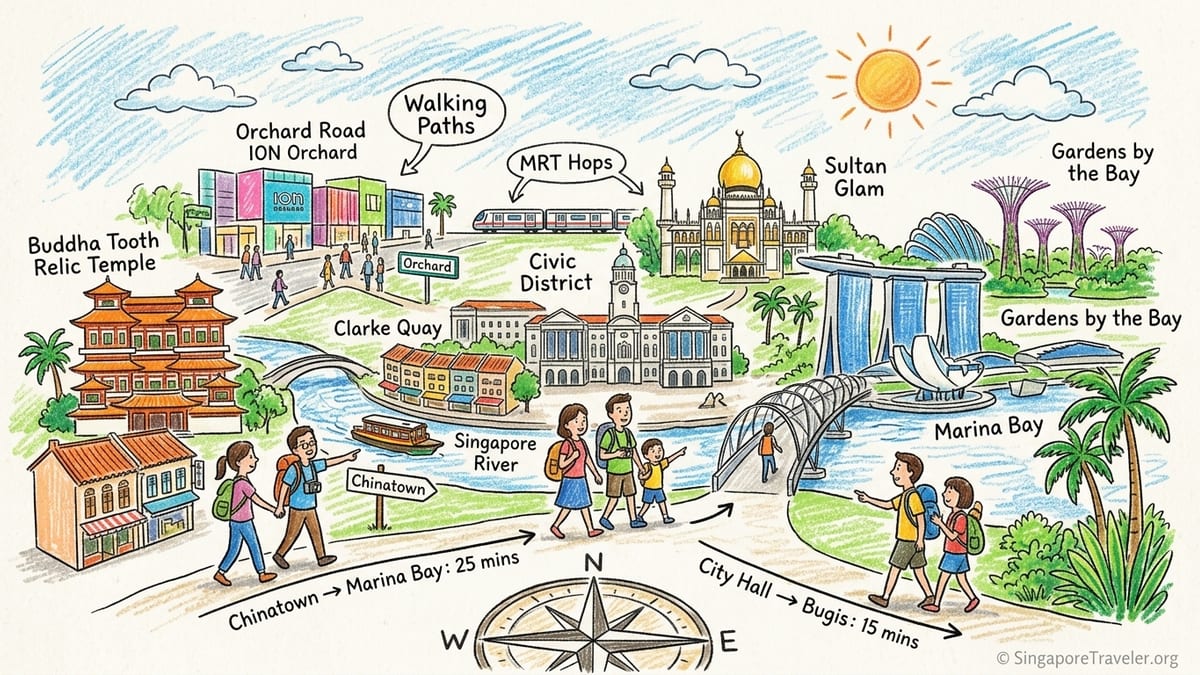
Most of Singapore’s central sightseeing core fits into a rough rectangle about 4 to 5 kilometres across. Marina Bay and the Civic District sit at the waterfront, with the Singapore River curving inland to Clarke Quay and Robertson Quay. Chinatown lies just southwest of the river, while Bugis and Kampong Glam spread northeast of the Civic District. Orchard Road, the main shopping boulevard, runs a short MRT ride inland from the bay. On a map these names may look like separate destinations, but in practice many of them link together via straightforward walks of 10 to 25 minutes.
For first-time visitors, it helps to think in terms of half-day clusters. Marina Bay naturally pairs with Gardens by the Bay and the lower Civic District. Chinatown links easily with the Singapore River and Raffles Place. Bugis, Kampong Glam and the National Museum form another compact grouping. Orchard Road stands slightly apart as a dense shopping and dining corridor that you might tackle on its own afternoon or evening. Grouping your time in this way limits backtracking and means you can move mostly on foot, using the MRT for longer hops when the heat becomes draining.
In practical terms, you can walk the loop from Merlion Park around Marina Bay to Marina Bay Sands and back in around 45 minutes at a moderate pace, without detours. A walk between Chinatown’s Pagoda Street and the civic museums around City Hall takes roughly 20 minutes on flat pavement. The distance from Orchard MRT to Dhoby Ghaut, at the lower end of Orchard Road and close to the Civic District, is about 2 kilometres, which translates to a 25 to 30 minute walk in cooler weather. Knowing these rough times makes it easier to decide when walking is reasonable and when to default to the air-conditioned MRT.
Singapore’s tropical climate is a crucial factor. Midday temperatures often sit around the high twenties to low thirties Celsius with high humidity. Even a 15 minute walk between Marina Bay Sands and the Merlion can feel taxing at 2 pm in the sun. That is where the city’s excellent MRT network helps: short hops between City Hall, Raffles Place, Bayfront, Chinatown, Bugis and Orchard usually involve rides of only a few minutes, with stations connected to shopping malls that offer food courts, supermarkets and abundant air conditioning.
Marina Bay and the Civic District: Waterfront Icons and Colonial Heritage
Marina Bay is the visual showpiece of modern Singapore. On one side of the water sit skyscrapers and the waterfront promenade; on the other stand Marina Bay Sands, the ArtScience Museum and Gardens by the Bay. For a first-timer, a logical starting point is Merlion Park, where the half-lion, half-fish statue faces the bay with Marina Bay Sands in the background. From here, many visitors do a simple circuit: cross Jubilee Bridge towards the Esplanade performing arts centre, follow the promenade past the “durian” domes, continue across the Helix Bridge and finish beneath the towers of Marina Bay Sands before dropping into Gardens by the Bay.
That entire route is walkable for most travellers and takes roughly 45 minutes of actual walking time if you do not stop frequently. In reality you will add pauses for photos, a cold drink or ice cream and perhaps a break inside the Shoppes at Marina Bay Sands, which is directly connected to the Helix Bridge and offers air-conditioned relief, clean restrooms and plenty of cafes. First-time visitors often combine this circuit with timed entries to the Flower Dome or Cloud Forest conservatories at Gardens by the Bay, or with an early evening ride on the Singapore Flyer across the water. With careful timing you can see the free Spectra light and water show on the bayfront and then cross to Gardens by the Bay for the Garden Rhapsody Supertree light show later in the evening.
The historic Civic District begins just behind the waterfront. From the Esplanade underpass or City Hall MRT, you emerge into a different era of architecture: the domed National Gallery Singapore housed in the former Supreme Court and City Hall, the neoclassical Asian Civilisations Museum by the river and the elegant Fullerton Hotel housed in the former General Post Office. These landmarks are all within a 10 to 15 minute walk of each other. You can easily spend half a day moving between the National Gallery, the National Museum of Singapore on nearby Stamford Road and the green slopes of Fort Canning Park without using any transport at all.
Because the Civic District and Marina Bay sit side by side, smart itineraries often combine them. One typical day for a first-timer might be to spend the morning at the National Gallery and a quick walk through the Padang and St Andrew’s Cathedral area, then head to City Hall MRT-linked malls for lunch in a food court, where a hawker-style meal might cost under 10 Singapore dollars per person. In the late afternoon you walk to Merlion Park, do the marina circuit as the light grows softer and end the evening at Gardens by the Bay. The only MRT rides required are getting to and from this cluster, usually using City Hall, Raffles Place or Bayfront stations.
Singapore River and Chinatown: Riverside Evenings and Historic Streets
Tracing the Singapore River inland from the bay takes you through yet another atmosphere shift. The stretch from Boat Quay past Clarke Quay to Robertson Quay is lined with conserved shophouses that now hold bars, restaurants and small hotels. The riverside promenade runs continuously, so you can walk from the Fullerton Hotel near Merlion Park to Clarke Quay in roughly 20 minutes, passing under bridges like Cavenagh and Elgin and watching bumboats shuttle tourists along the water. In the early evening the area becomes a popular place for al fresco dining, though prices here can be higher than in hawker centres; a simple main course might easily cost 20 to 30 Singapore dollars at a mid-range restaurant.
Chinatown sits directly southwest of this river corridor and is closely connected in practice. From Clarke Quay MRT, it is a short one-stop hop to Chinatown MRT, but many visitors simply walk: the route via New Bridge Road and South Bridge Road takes about 15 minutes and brings you past traditional shophouses and temples. Within Chinatown itself, attractions cluster tightly: the Buddha Tooth Relic Temple on South Bridge Road, Sri Mariamman Temple, the heritage streets of Pagoda Street and Sago Street, and the Chinatown Complex food centre. You can cross the whole district on foot in roughly 10 to 15 minutes, so it is easy to zigzag between temples, souvenir shops and food stalls.
Because of this compactness, a natural first-day or second-day plan for many visitors is to pair Chinatown with the riverfront. You might start your morning with a traditional breakfast of kaya toast and kopi at an old-school coffee shop near Chinatown MRT, spend a few hours exploring the temples and the Chinatown Heritage Centre-style exhibits, then head to a hawker centre such as Maxwell Food Centre or Chinatown Complex for a late lunch. After a rest at your hotel, you can walk or take the MRT to Clarke Quay, stroll the river as it lights up and either book a sunset river cruise or continue walking back towards the bay and the Merlion.
Walking between Chinatown and Marina Bay is realistic in cool parts of the day, and the change in character along the way is part of the appeal. For example, you can start at the Buddha Tooth Relic Temple, walk down South Bridge Road towards the skyscrapers of the Central Business District, pause to see the historic Thian Hock Keng Temple on Telok Ayer Street, then continue to Raffles Place and the river. That journey takes roughly 25 to 30 minutes and can be broken up with stops in air-conditioned lobbies or malls around Raffles Place. In the afternoon heat, most travellers find it more comfortable to ride two stops on the MRT from Chinatown to Raffles Place or Bayfront and then continue on foot along the shaded waterfront.
Orchard Road and Its Connection to the City Core
Orchard Road is Singapore’s most famous shopping boulevard and lies slightly inland from the bay. The stretch from Orchard MRT through Somerset to Dhoby Ghaut covers roughly 2.5 kilometres and is lined almost continuously with malls, from ION Orchard and Ngee Ann City at the upper end to Plaza Singapura and the Cathay near Dhoby Ghaut. Each mall contains layers of retail, food courts and cafes, and most are connected by sheltered walkways or underground passages. As a result, a lot of the walking you do on Orchard Road is indoors in air conditioning, making it a comfortable choice for a hot afternoon or a rainy day.
First-time visitors often underestimate how self-contained Orchard Road feels. You can easily spend half a day here without leaving the vicinity of the main metro stations. A typical visit might involve starting at Orchard MRT, exploring two or three large malls, having lunch in a basement food court where a noodle dish or chicken rice might cost around 6 to 8 Singapore dollars, then continuing down to Somerset’s youth-oriented malls and eventually Dhoby Ghaut. Because Dhoby Ghaut is a major interchange, from here it is only a short MRT ride to City Hall, Marina Bay, Chinatown or Little India, which makes Orchard an easy add-on to other central plans.
In terms of walking connections, Orchard Road does link physically to the Civic District, but the journey is long and often hot. Walking from Dhoby Ghaut to the Padang and the National Gallery takes around 15 minutes downhill along Bras Basah Road, which is reasonable in the evening or early morning. However, walking all the way from Orchard MRT to the Merlion via Orchard Road, Dhoby Ghaut and City Hall would take closer to 40 to 45 minutes. In practice, most visitors use the MRT: a ride from Orchard to Raffles Place or Bayfront with one quick transfer typically takes about 10 to 15 minutes, and the entire route is air-conditioned.
When you plan your days, it often makes sense to separate shopping time on Orchard Road from your heavier sightseeing clusters. For example, after spending a morning at the National Museum and Civic District, you can ride one stop from Bras Basah to Dhoby Ghaut or two stops from City Hall to Dhoby Ghaut, then continue to Orchard for an afternoon indoors. Alternatively, you might devote a cloudy or rainy day to Orchard, taking advantage of the sheltered environment when outdoor attractions like Marina Bay and Gardens by the Bay would be less appealing.
Bugis and Kampong Glam: Street Markets, Mosques and Hip Cafes
Bugis and Kampong Glam sit just northeast of the Civic District and form another compact, walkable cluster that contrasts strongly with the waterfront areas. Bugis is known for its shopping streets and mid-range malls such as Bugis Junction and Bugis+, while Kampong Glam, centred on the golden-domed Sultan Mosque and the former royal palace complex, preserves Malay and Arab heritage. Haji Lane, with its narrow alley of murals, independent boutiques and cafes, has become a popular photo stop. You can walk from Bugis MRT to the mosque in around 7 to 10 minutes, and from there to the Malay Heritage Centre or hipster bars along Bali Lane within a few more minutes.
Because of how close this area sits to the Civic District, first-time visitors often group them into a single day. One common pattern is to visit the National Museum or Peranakan Museum in the morning, have lunch in the Bras Basah or Bugis area and then walk or take one stop on the MRT to Bugis. From the National Museum, the walk along Stamford Road and Victoria Street to Bugis takes around 15 minutes and passes arts institutions such as the Singapore Art Museum. Once you reach Bugis, you can spend the afternoon wandering Kampong Glam’s lanes, perhaps stopping for Middle Eastern or Malay food at a casual restaurant where a main course might cost around 15 to 25 Singapore dollars.
Bugis and Kampong Glam are also convenient evening options if you are staying near the central core. Many hotels around Bras Basah, City Hall and Bugis allow you to walk to Kampong Glam in 10 to 20 minutes, avoiding the need for transport at all. The area’s compact layout makes it easy to combine practical errands, such as picking up SIM cards or basic supplies at Bugis Junction, with more atmospheric wandering. Compared with the polished promenade of Marina Bay or the big-brand focus of Orchard Road, this district feels more small-scale and bohemian, which is a pleasant contrast on a trip of several days.
In hot weather, the main walking challenge here is the lack of shade in certain stretches between the Civic District and Bugis. If you are visiting at midday, consider using the Downtown Line to ride from Fort Canning or Bencoolen to Bugis, then explore Kampong Glam in short bursts punctuated by cafe stops. In the early evening, when temperatures drop slightly and the call to prayer echoes from Sultan Mosque, the area is particularly atmospheric and walking becomes more comfortable.
When to Walk and When to Take the MRT
Singapore’s central core is more walkable than its glossy skyline suggests, but choosing your routes with the climate in mind is essential. As a rule of thumb, walks of 10 to 20 minutes between major clusters are pleasant in the early morning or after 5 pm, while the same routes at midday can feel punishing, especially for visitors not used to high humidity. Distances such as Merlion Park to Marina Bay Sands, Clarke Quay to Chinatown and City Hall to Bugis are practical to do on foot in cooler hours. Longer links, like Orchard to Marina Bay or Chinatown to Gardens by the Bay, are often better done by MRT at least in one direction.
The MRT offers several advantages beyond temperature control. Many central stations are integrated with malls, giving you access to food courts, supermarkets and restrooms without extra detours. For example, Bayfront MRT sits directly beneath Marina Bay Sands and connects by underground passages to Gardens by the Bay, allowing you to move between attractions almost entirely indoors. City Hall MRT links to Raffles City and CityLink Mall, creating a sheltered path towards the Esplanade and Marina Square. Bugis, Dhoby Ghaut and Orchard all have similar multi-mall connections, which are invaluable if you are travelling with children, seniors or heavy shopping bags.
For first-time visitors, using stored-value cards or contactless payment on the MRT keeps the process simple. A short central journey, such as Raffles Place to Orchard or Chinatown to Bayfront, typically costs only a few Singapore dollars or less. The trains are frequent, and most central journeys take under 15 minutes including platform waits. Buses can also be useful for shorter hops, but for unfamiliar visitors the clarity of MRT line maps and station signage usually makes the rail network the easiest choice.
One practical technique is to design your day as a rough walking loop with an MRT “escape hatch.” For example, you might start at Chinatown, walk to Clarke Quay and the Civic District, then on to Marina Bay and Gardens by the Bay in the late afternoon. If the heat or a sudden tropical downpour becomes too much at any point, stations like Clarke Quay, City Hall, Raffles Place and Bayfront lie along the way, allowing you to cut the walk short and ride back to your hotel. This flexibility prevents overcommitting to long outdoor stretches in unpredictable weather.
Planning Smart Day Combinations
Instead of treating central Singapore as a scatter of isolated highlights, it is more rewarding to think in terms of themed days that follow the natural geography of the city. One classic combination for first-time visitors is “Civic District plus Marina Bay.” You might begin with history and art at the National Gallery and nearby historic churches and government buildings, have lunch in an air-conditioned mall connected to City Hall MRT, then walk to Merlion Park and follow the waterfront loop to Marina Bay Sands and Gardens by the Bay. This day flows logically from colonial heritage to futuristic skyline, with distances that are manageable on foot and MRT connections available if needed.
Another natural pairing is “Chinatown plus Singapore River.” Start with temples, shophouses and hawker food in Chinatown during the day, when the streets are less crowded. After a break, walk or ride a stop or two to Clarke Quay and Boat Quay for an evening by the river, with the option of a sunset cruise or a relaxed walk back towards the Fullerton and Merlion Park. This combination lets you see how the same river that once served as the city’s mercantile backbone is now lined with dining and nightlife, while Chinatown preserves the everyday side of traditional life.
For travellers interested in culture and local neighbourhoods, a “Bugis, Kampong Glam and Museums” day makes sense. Spend the morning at the National Museum or Peranakan Museum, break for lunch in the Bras Basah or Bugis area, then wander Kampong Glam’s lanes in the cooler late afternoon. You can return to Bras Basah by foot in the evening to see the civic buildings lit up, or ride a quick MRT hop to Marina Bay for a night stroll. Here the transitions between areas are short and the character shifts from formal museums to street art and cafes to mosque courtyards and back to civic squares.
Orchard Road often works best as a flexible half-day that you can slide into your schedule wherever weather or energy levels suggest an indoor focus. If a forecast shows thunderstorms in the afternoon, you might visit Gardens by the Bay in the morning and then retreat to Orchard’s malls later. On another day, after a busy evening at Marina Bay, you might sleep in and then make a leisurely start at Orchard for shopping and casual meals. By thinking in these linked clusters instead of chasing attractions in distant corners of the city, you reduce time in transit and maximise time actually experiencing each neighbourhood.
The Takeaway
Central Singapore rewards visitors who pay attention to how its waterfronts, historic districts and shopping streets link together on the ground. Marina Bay and the Civic District form a natural pair, where you can walk from colonial-era courthouses to futuristic gardens in a single afternoon. The Singapore River and Chinatown tell different chapters of the same mercantile story, while Bugis and Kampong Glam add layers of Malay and Arab heritage. Orchard Road offers a dense, air-conditioned counterbalance to outdoor sightseeing days.
By grouping your days around these clusters and recognising when to walk and when to use the MRT, you avoid the fatigue that comes from zigzagging across the city in the heat. Short strolls between Merlion Park and Marina Bay Sands, between Clarke Quay and Chinatown or between Bugis and Kampong Glam become enjoyable ways to feel the city’s texture, while the MRT quietly handles longer links such as Orchard to the bayfront. For a first-time visitor, this approach turns what could be an overwhelming checklist into an intuitive, memorable exploration of Singapore’s central heart.
FAQ
Q1. Is it realistic to walk between Marina Bay and Chinatown?
Yes, in cooler parts of the day it is realistic. Walking from Merlion Park to the Buddha Tooth Relic Temple via the Singapore River and Telok Ayer area takes roughly 25 to 30 minutes on flat pavements, and you can break it up with stops in air-conditioned malls or lobbies along the way.
Q2. When does it make more sense to use the MRT instead of walking?
Use the MRT for longer links such as Orchard Road to Marina Bay, Chinatown to Gardens by the Bay or Bugis to Chinatown in the midday heat. These journeys can take 30 to 45 minutes on foot but usually under 15 minutes by MRT, all in air conditioning.
Q3. Which areas are best combined on the same day for a first-time visitor?
Common pairings include Civic District with Marina Bay, Chinatown with the Singapore River, and Bugis with Kampong Glam and nearby museums. Orchard Road often works best as a separate half-day focused on shopping and indoor dining.
Q4. How hot does it feel when walking in central Singapore?
Daytime temperatures commonly sit in the high twenties to low thirties Celsius with high humidity, which makes even 15 to 20 minute walks feel more strenuous than the same distance in drier climates. Planning shaded routes and indoor breaks is important.
Q5. Are Marina Bay and Gardens by the Bay walkable from each other?
Yes. Many visitors walk from Merlion Park around the bay to Marina Bay Sands and continue into Gardens by the Bay. The marina loop itself takes about 45 minutes of walking; the link from Marina Bay Sands to the Supertree Grove is roughly another 10 to 15 minutes on foot, with sheltered sections.
Q6. Is Orchard Road close enough to include with Marina Bay in one day?
It is physically possible but can feel rushed. Travellers often find it more comfortable to spend a morning or afternoon on Orchard Road and use the MRT to connect to Marina Bay or the Civic District on another half-day, rather than trying to cover both intensively in a single stretch.
Q7. How late do central areas stay active in the evening?
Marina Bay’s light shows, riverside bars at Clarke Quay and the cafes and restaurants around Bugis and Kampong Glam keep central areas lively well into the late evening. Most shops on Orchard Road close around 10 pm, while hawker centres and some food courts operate later.
Q8. Are there enough food options within walking distance in each district?
Yes. Around Marina Bay and the Civic District you will find food courts in attached malls, plus mid-range and upscale restaurants. Chinatown and Bugis have hawker centres and budget eateries, Kampong Glam offers Middle Eastern and Malay cuisines, and Orchard Road features a dense mix of food courts, cafes and international chains.
Q9. Is it safe to walk around central Singapore at night?
Central Singapore is generally considered very safe, and walking at night in areas like Marina Bay, the Civic District, Orchard Road and the riverfront is common for visitors and locals. Usual city precautions still apply, such as minding personal belongings and avoiding poorly lit back lanes.
Q10. How many days should I allow to explore central Singapore properly?
Allow at least three full days to experience the main central clusters without rushing. This gives you time for a Marina Bay and Civic District day, a Chinatown and river day, and a Bugis, Kampong Glam and Orchard combination, with flexibility for weather and personal pace.