


Central Singapore offers two blockbuster skyline viewpoints within a short walk of each other: Marina Bay Sands SkyPark Observation Deck and the Singapore Flyer. Both promise sweeping views of Marina Bay, the CBD and beyond, and both regularly appear side by side in 2026 search results for visitors who only want to pay for one elevated experience. Yet they feel very different in practice. This guide breaks down the key differences so you can decide which ticket is better value for your style of trip.
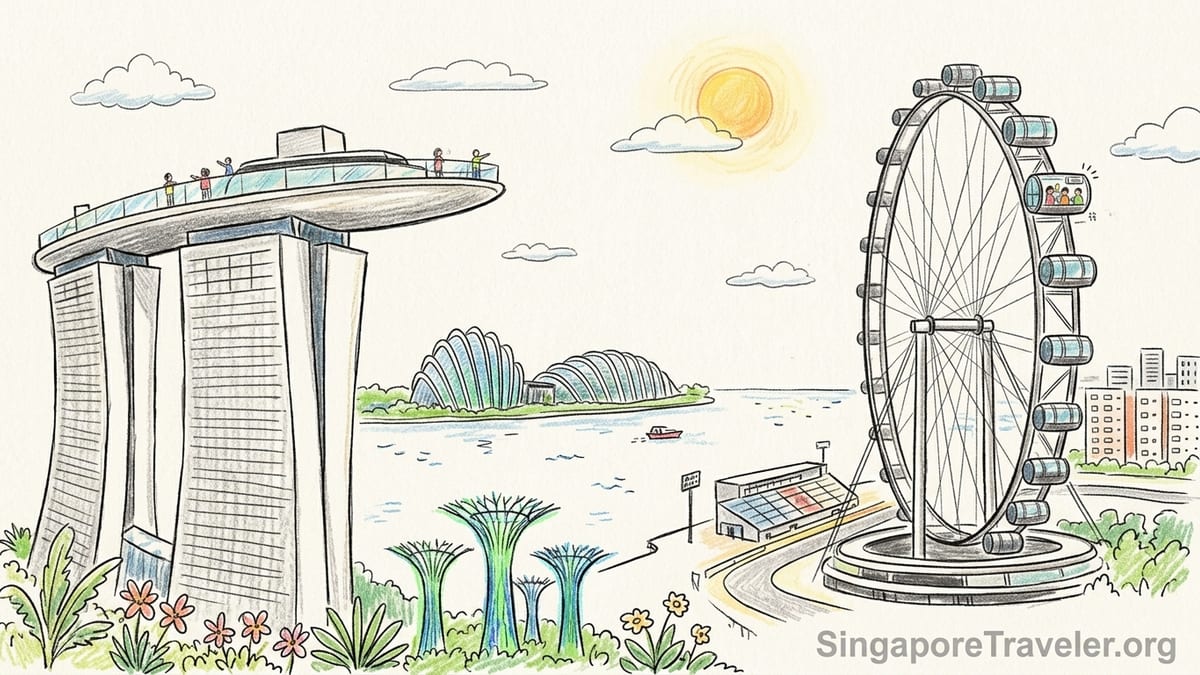
Big Picture: Two Very Different Ways To See Singapore
Marina Bay Sands SkyPark Observation Deck and the Singapore Flyer occupy roughly the same patch of city but deliver contrasting experiences. The SkyPark is a fixed rooftop platform on level 56 of Marina Bay Sands Hotel, about 200 meters above the bay. You ride a fast lift to the open-air deck, step out, and the city is laid out beneath you with Gardens by the Bay in the foreground and the shipping lanes on the horizon. You are looking from one very high, very specific angle for as long as your ticket allows.
The Singapore Flyer is a giant observation wheel that slowly rotates to 165 meters at its highest point. Instead of walking around an open deck, you stand or sit in a large enclosed glass capsule shared with other visitors. Over the course of roughly 30 minutes, the wheel turns once, giving you a full 360-degree sweep over the F1 track, Marina Bay Sands, the port, the East Coast shoreline and the dense city grid inland.
For travelers, the crucial distinction is this: SkyPark offers a static but dramatic rooftop panorama, while the Flyer offers a moving, immersive city tour in the sky. The question is not which attraction is objectively "better" but which format suits your priorities for time, comfort, budget and photography.
Tickets, Prices and Value for Money in 2026
As of mid-2026, Marina Bay Sands lists standard SkyPark Observation Deck tickets from about S$35 for non-peak daytime adult entry and about S$39 during the evening peak, with slightly lower concession prices and a family package that reduces the per-person cost if you are two adults with two children. Peak pricing typically covers the late afternoon and evening window when most visitors want to see sunset and the city lights.
The Singapore Flyer’s official site and recent brochures indicate that a standard adult ticket for a single 30-minute rotation is usually in a similar range, often around the mid-30s in Singapore dollars, with child and senior discounts. Promotional offers are common: for example, in August 2026 there is an “SG61 Buddy Deal” giving Singapore citizens and permanent residents two standard Flyer tickets for S$61, alongside bundled experiences like “SG61 Sip and Soar” combining drinks with the ride. Visitors booking through third-party platforms or using local cards such as PAssion or selected bank promotions sometimes secure a modest discount compared with walk-up prices.
In day-to-day practice, many travelers find that base prices for a straightforward experience are broadly comparable between the two, especially if you are buying a single adult ticket. The SkyPark starts to feel better value if you want to linger, take many photos and watch both daylight and darkness from the same spot, because you are not forced to leave after 30 minutes. The Flyer can feel more like a premium per-minute experience: you pay roughly the same as SkyPark but your core ride is one rotation. If you are price sensitive, it is worth checking current hotel guest deals for Marina Bay Sands, cardholder perks or seasonal Flyer promotions before you lock in your choice.
Height, Sensation and Comfort: How Each View Feels
On paper, SkyPark is higher than the Flyer, sitting about 200 meters above sea level on the hotel’s rooftop, while the Singapore Flyer’s highest point is around 165 meters. In reality, both feel very high, but the sensation is different. At SkyPark you are outdoors, often feeling the breeze and seeing the glass balustrades right in front of you. The height feels more immediate, especially if you walk to the edge and look straight down at the ArtScience Museum and the helix bridge.
In contrast, the Singapore Flyer’s capsules are fully enclosed and air-conditioned. You share each capsule with a limited number of people, typically around 20 to 28 at busy times, though off-peak you may have plenty of space. Because the glass wraps around you and the floor is solid underfoot, many visitors with a mild fear of heights report that the Flyer feels less intimidating than standing on an open rooftop, even though they are still high above the bay.
Comfort-wise, the Flyer has the advantage in Singapore’s hot, humid and sometimes stormy weather. The air-conditioned capsule provides shelter from mid-afternoon heat, rain showers and gusty winds. Elderly travelers or those with mobility concerns may appreciate being able to sit on the in-capsule benches while still enjoying the view. SkyPark is also accessible by elevator, but you will be outdoors or in semi-sheltered areas for photos, which can be tiring during midday heat or uncomfortable in heavy rain.
Time Needed and How Each Fits Into an Itinerary
If you are trying to squeeze a viewpoint into a tight central Singapore itinerary, the time commitment can decide for you. A Singapore Flyer ride is very predictable: boarding plus one rotation typically takes about 30 minutes. You can arrive 10 to 15 minutes before your time slot, ride, and be back at ground level within an hour. This works well if you are combining the Flyer with a timed activity, such as nearby National Gallery Singapore tickets, a dinner reservation around Promenade or catching the Marina Bay Sands light and water show.
SkyPark is more flexible. Once you are up, staff generally allow you to stay as long as you like within operating hours. Many visitors spend 45 to 90 minutes on the deck: they arrive around 5:30 pm, photograph the skyline in golden light, stay through sunset around 7 pm, and then watch the “Spectra” light and water show on the bay from above before heading down to dinner. Because your stay is open-ended, SkyPark works better if you want an evening to revolve around the view rather than squeezing it into a tight schedule.
Practically, that means the Flyer suits travelers who want to tick off many things in a single day, like those on a 2-day Singapore layover. SkyPark suits those comfortable committing a larger chunk of an evening to slow viewing, photography and perhaps a drink at one of the rooftop bars adjacent to the deck.
Open Air vs Air Conditioning: Weather, Seasons and Sunset
Singapore’s climate is consistently hot and humid, with brief but intense showers possible at almost any time of year. This matters when you are deciding between an open-air viewing deck and an enclosed wheel. The SkyPark Observation Deck is outdoors with partial shelter, so conditions can change quickly. On a clear December afternoon, the breeze on level 56 can feel refreshing, and the unhindered air makes sunset and blue-hour photos especially vivid. On a hazy March evening or during an unexpected downpour, the same open exposure can mean windblown hair, wet clothes and photos speckled with raindrops.
The Singapore Flyer’s climate-controlled capsules remove much of that uncertainty. Even during the pre-monsoon heat in May or a thunderstorm rolling in from the Straits, you are behind glass and in air conditioning. That makes the Flyer more reliable if you are booking a specific time weeks ahead, planning a proposal or celebrating something like a birthday dinner in their sky dining capsules, where multiple rotations are combined with a multi-course meal.
Both attractions offer excellent sunset potential. From SkyPark, the sun tends to sink behind the CBD towers or into distant clouds depending on the season, with the gardens and Supertrees glowing below. Many photographers aim to arrive 60 to 90 minutes before local sunset time to capture the progression from late afternoon through blue hour. On the Flyer, timing one rotation so that you are near the top just after sunset gives you a soft gradient of color over the bay, and the gradual change in elevation during the 30-minute ride lets you see how the city transitions into night from multiple angles.
Photography Angles and What You Actually See
For photographers, the difference between a fixed rooftop and a rotating wheel is crucial. SkyPark offers a commanding, mostly west-facing view across Gardens by the Bay toward the central business district. Classic compositions include the two cooled conservatories framed against the bay, the Supertree Grove in the foreground and the skyscrapers behind. You can also look in other directions along the deck to see the Singapore Strait, residential districts and the East Coast. However, you are effectively working from one side of the Marina Bay Sands roof, so your angles are variations on a theme.
The Singapore Flyer, by contrast, constantly changes your perspective. As the capsule climbs, Marina Bay Sands shifts from eye-level on the opposite side of the water to a structure sitting below you. At other moments, you may be looking directly down onto the F1 pit lane and track, then toward the Kallang Basin or inland HDB estates. If you shoot video, the slow, continuous movement can create compelling timelapse sequences without needing a tripod or long stay.
There are trade-offs. On SkyPark, photographers contend with glass panels around the deck, but as of 2026 many visitors report that the barriers are high yet not overly obstructive, especially if you position your lens close to the glass or shoot over some sections with a smartphone held high. On the Flyer, you are always shooting through window glass that may have reflections from interior lighting. Wearing darker clothing, cupping your hands around the lens, or using a rubber lens hood can reduce glare for DSLR and mirrorless cameras. If you primarily use a phone camera and care about crisp night shots, SkyPark’s open-air vantage often wins.
Suitability for Children, Groups and Nervous Travelers
Families deciding between the two should think about both attention spans and tolerance for heights. On the Singapore Flyer, young children can move around the capsule, sit on benches and look out from different sides as the scenery changes. The enclosed environment prevents any direct exposure to edges, which tends to reassure parents with toddlers. Because the ride is only about half an hour, it fits neatly before or after an early dinner without pushing bedtimes too late.
At SkyPark, children who enjoy being outdoors may love the sensation of wind and the thrill of being “on the roof of the big ship hotel.” However, very young kids might get restless if parents want to stay up for a long sunset session. Strollers are generally allowed up to a point but may need to be parked aside in crowded areas, and parents must keep a close watch near the glass barriers. The higher altitude and open-air feel can unsettle children or adults sensitive to heights.
For multi-generational groups or anyone anxious about elevators and open decks, the Flyer’s smooth boarding process and calm, enclosed ride are often more manageable. Staff typically assist with wheelchairs and mobility aids, and the lack of sudden drops or fast movements makes it approachable even for those who usually avoid thrill rides. SkyPark remains accessible by lift and is far from an extreme attraction, but it feels more exposed, which can be a deal-breaker for height-averse travelers.
Weather Sensitivity, Maintenance Closures and Practicalities
Because the SkyPark deck is outdoors, very heavy rain, lightning risk or strong winds can limit how much of the platform is open at any given time. Marina Bay Sands publishes general operating hours, usually with a daytime non-peak block in late morning and afternoon and a peak period through the evening, and may offer partial refunds or re-entry options if you enter shortly before a weather-related shutdown. However, sudden tropical storms can disrupt even carefully timed visits, so it is wise to keep some flexibility on the day.
The Singapore Flyer also closes during severe weather or scheduled maintenance. In early 2026, for example, official channels announced a routine maintenance closure from early March to mid-April, reminding would-be riders to check dates before planning a trip solely around the wheel. The advantage is that if capsules are running, the ride experience itself is less affected by rain thanks to the enclosure. Light showers can even add drama, with reflections of city lights on wet roads below, though heavy storms may reduce visibility.
In terms of location, both attractions are easy to combine with other central highlights. SkyPark is directly above Marina Bay Sands Shoppes and within walking distance of Gardens by the Bay, making it simple to link an evening rooftop visit with afternoon time inside the cooled conservatories. The Flyer sits at the edge of the F1 circuit and the Waterfront Promenade near Promenade MRT station, with straightforward access to Suntec City, Millenia Walk and the Marina Square mall cluster. Either choice integrates cleanly into a typical first-time visitor route around the bay.
Is Doing Both Redundant, or Worth It?
Many visitors wondering if they should pay for both fear that the experiences might feel repetitive. In practice, while the scenery overlaps, the sensations are distinct enough that doing both is not automatically redundant, especially if you spread them across different times of day. For example, you could ride the Singapore Flyer in late morning to get your bearings, when haze is often milder and visibility inland can be good, then visit SkyPark one evening later in the trip for the drama of sunset and city lights.
However, if you are managing a tight budget or simply do not care enough about skyline views to justify two paid tickets, choosing one is perfectly reasonable. Both attractions cover the same general area of Singapore, and your photos of iconic landmarks like Marina Bay Sands, the Supertrees and the CBD towers will be impressive from either. Travelers who have done both often say that each offers one or two standout moments, but that the memory of “seeing Singapore from above” does not require two separate admissions.
A good rule of thumb is this: if you are a casual sightseer with only two or three days in the city, pick one and spend the saved money on a hawker center food crawl or a neighborhood walk in Kampong Gelam or Tiong Bahru. If you are an avid photographer, architecture enthusiast or planning a special occasion, experiencing both formats can give you a richer, more layered mental map of the city and more varied images.
Recommendations by Traveler Type
For photographers, SkyPark usually comes out slightly ahead. The open-air environment allows cleaner night shots, and the high vantage directly above Gardens by the Bay yields classic postcard images that showcase multiple icons in one frame. If you enjoy long exposures, bring a compact travel tripod or use the deck railings to stabilize your camera and aim for the period between dusk and full darkness. That said, serious photographers who enjoy experimenting with movement and perspective will also appreciate a Singapore Flyer ride for daytime or late-afternoon sequences and 360-degree city panoramas.
For families with young children, the Singapore Flyer is more straightforward. The predictable 30-minute duration, air-conditioned comfort and enclosed capsule make it easier to manage naps, snacks and meltdowns. You can, for instance, plan a day that includes the ArtScience Museum or Gardens by the Bay in the morning, an indoor mall play area in the afternoon, and a pre-dinner Flyer ride as a highlight, without worrying about kids overheating or getting bored roaming a rooftop deck for an hour.
For couples and special occasions such as anniversaries or proposals, the choice depends on mood and budget. SkyPark’s open-air deck feels more dramatic and cinematic, especially around sunset, and nearby rooftop bars can turn the experience into a full evening with cocktails overlooking the bay. The Singapore Flyer, on the other hand, offers structured romance packages like sky dining with multi-course meals inside private or semi-private capsules, which appeal to those who prefer a seated, air-conditioned celebration in motion.
For travelers determined to pick only one paid viewpoint, ask yourself what you value more: the feeling of standing on an iconic rooftop terrace high above the city, or the novelty of gliding through the sky in a glass capsule that slowly reveals every angle. If you picture leaning on a railing, feeling the breeze and watching the Supertrees glow on and off below, choose Marina Bay Sands SkyPark. If you imagine a calm, cool ride where the skyline rotates around you like a living postcard and comfort is key, opt for the Singapore Flyer.
The Takeaway
Marina Bay Sands SkyPark Observation Deck and the Singapore Flyer both deliver the central Singapore skyline in grand style, but they do it in fundamentally different ways. SkyPark gives you an open-air, fixed high-angle perspective, particularly strong for views over Gardens by the Bay and for long, unhurried sunset sessions. The Flyer gives you a sheltered, air-conditioned 360-degree journey that trades lingering in one spot for a constantly changing panorama.
When weighing tickets, look beyond headline height comparisons and consider your real-world priorities: how much time you have, how well you tolerate heat, who is traveling with you, and whether you care more about iconic photographs or a unique experience in motion. For many visitors, the “best” view is simply the one that fits smoothly and comfortably into the rest of their Singapore itinerary without stress.
If you can afford it and love cityscapes, doing both at different times of day will give you a deeper appreciation of how compact yet layered Singapore’s core really is. If you choose just one, you will still come away with a memorable mental image of the Lion City from above, whether that is from the deck of the “ship” atop Marina Bay Sands or from a slowly turning capsule in the sky.
FAQ
Q1. Which is cheaper in 2026, Marina Bay Sands SkyPark or the Singapore Flyer?
Their base adult prices are broadly similar, usually in the mid-30 Singapore dollar range, though promotions, citizen deals and card discounts can make one or the other slightly cheaper at any given time.
Q2. Which offers the better sunset view?
SkyPark generally wins for sunset because you can arrive early, stay as long as you like within opening hours and watch the full transition from daylight to night over Gardens by the Bay and the CBD.
Q3. Is the Singapore Flyer air-conditioned?
Yes. The Singapore Flyer’s capsules are fully enclosed and air-conditioned, which makes the ride more comfortable in Singapore’s humidity and during rain or strong sun.
Q4. How long does a Singapore Flyer ride take?
A standard Singapore Flyer ticket covers one rotation, which usually takes about 30 minutes from boarding to disembarkation, making it a predictable, time-limited activity.
Q5. Can I stay as long as I want at Marina Bay Sands SkyPark?
Within the official opening hours, visitors are typically allowed to stay on the SkyPark Observation Deck for an extended period, so many people spend 45 minutes to over an hour enjoying the views.
Q6. Which is better for families with young children?
The Singapore Flyer is usually easier for families with small children because it is enclosed, air-conditioned, has seating and has a clear 30-minute duration that fits neatly around meals and bedtimes.
Q7. Which is less scary for people afraid of heights?
Most nervous travelers find the Singapore Flyer less intimidating thanks to its enclosed capsules and stable ride, while SkyPark’s open-air deck and visible edges can feel more exposed.
Q8. Do I need to book tickets in advance?
Advance booking is strongly recommended for both, especially for sunset or weekend slots, as it helps secure your preferred time and sometimes unlocks small online discounts or packages.
Q9. Is it worth doing both SkyPark and the Singapore Flyer?
Doing both is not essential but can be rewarding if you love city views; SkyPark gives a dramatic rooftop panorama, while the Flyer gives a rotating 360-degree experience that feels quite different.
Q10. If I must choose only one, which should I pick?
If you want dramatic open-air views and top-tier night photography, pick Marina Bay Sands SkyPark; if you prioritize comfort, predictability and a gentle moving panorama, choose the Singapore Flyer.