


The Singapore River curves through the historic heart of the city, and along its banks three distinct dining stretches compete for your evening: Boat Quay, Clarke Quay and Robertson Quay. All three are packed with restaurants and bars, but each quay offers a different balance of river views, crowd energy, cuisine mix and price. This guide focuses on how to choose the right quay and the right riverside table for the experience you want, with concrete examples of where to eat and what to expect when the bill arrives.
Singapore River at a Glance: Three Quays, Three Vibes
The Singapore River precinct is formally divided into Boat Quay, Clarke Quay and Robertson Quay, a compact corridor that stretches from the Central Business District towards the more residential upriver neighborhoods. Official planning documents describe it as one of Singapore’s premier waterfront lifestyle areas, with dense clusters of food, beverage and nightlife operators on both banks of the water. For visitors, that means you can easily walk between the three quays in a single evening, but the feel of each changes noticeably from one bend of the river to the next.
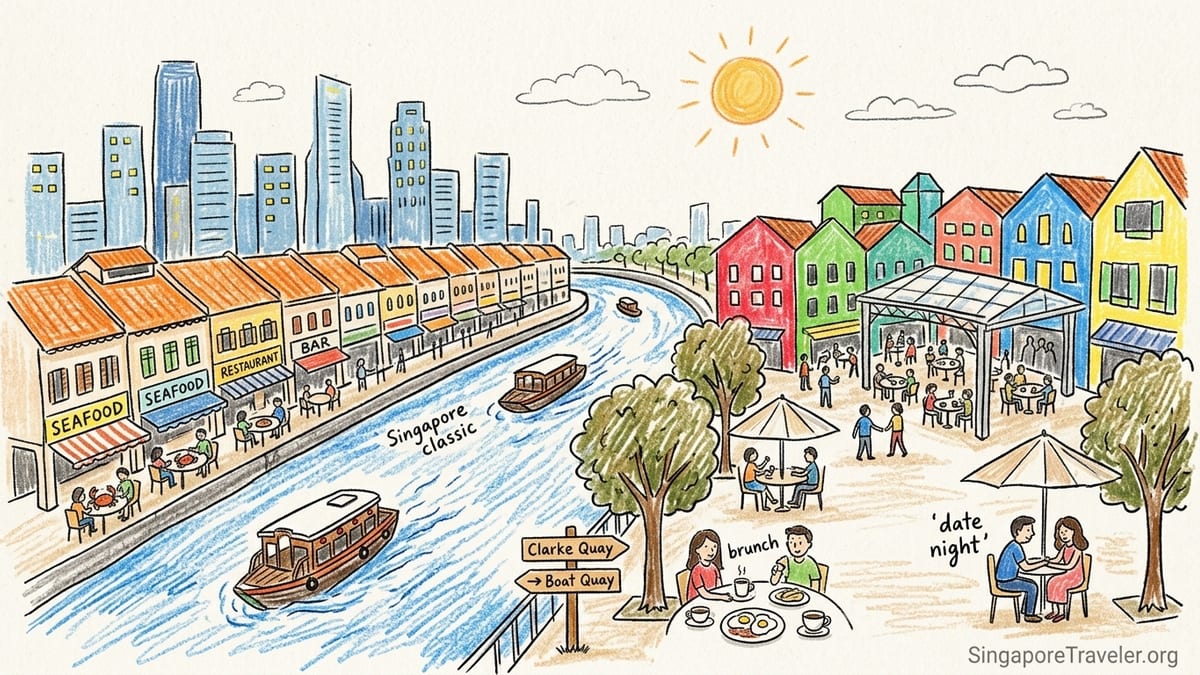
Boat Quay, closest to the financial district, is lined with low shophouses fronting a narrow promenade of outdoor tables facing the river and the skyline of Raffles Place beyond. Clarke Quay, a short stroll upstream, is anchored by a sheltered courtyard of brightly painted warehouses, now filled with restaurants and bars that feed into the nightlife scene. Robertson Quay sits further along again, quieter and more residential, with wider promenades and hotel-front terraces that lend themselves to brunch, sunset drinks and softer-spoken date nights.
Because the three quays are so close together, it is tempting to treat them as one big restaurant strip. In practice, choosing the right quay makes a real difference to your meal. This guide approaches the river as locals and business travellers use it: Boat Quay for historic waterfront dining and CBD evenings, Clarke Quay for pre-nightlife dinners and people-watching, and Robertson Quay for slower alfresco meals, weekend brunches and relaxed date nights.
Although menus and operators change regularly, one thing is stable: competition. The Singapore River’s official precinct materials highlight the unusually high concentration of food and beverage outlets across all three quays. For visitors, that density means real choice, from casual chains and sports bars to upscale seafood and chef-led concepts, often within a few steps of one another.
Boat Quay: Historic Shophouses and CBD Evenings
Boat Quay is the most atmospheric of the three stretches if you want to feel the river’s trading past. Conserved shophouses face the water in a neat curve, many with ground-floor restaurants spilling onto narrow terraces just above the promenade. The view across the river takes in the Asian Civilisations Museum and a wall of towers in the Raffles Place financial district, which makes Boat Quay particularly popular with office workers and business travellers looking for dinner after a day in the CBD.
By day, the area is comparatively quiet, and some restaurants only open for lunch from Monday to Friday to serve office crowds. You can usually walk in to casual spots like Dallas Restaurant & Bar, which serves steaks, burgers and bar food with river views, or one of the Indian or North Indian restaurants that dot the terrace. Expect mains to land in the mid-range for Singapore: for example, a burger or pizza typically costs roughly what you would pay at a mid-priced international chain in the city, with river-facing tables commanding a small but noticeable premium.
At night, the promenade fills up with host staff and menus. Seafood restaurants advertise chilli crab and black pepper crab prominently, sometimes with set menus targeting tourists. Well-known local seafood brands operate in the nearby Riverside Point and The Riverwalk complexes rather than directly on Boat Quay’s shophouse row, but the atmosphere on the quay itself remains strongly seafood-driven. Paying extra for a waterfront table can be worth it here if you want postcard views of the illuminated skyline and river cruise bumboats gliding past, especially between about 7.30 pm and 9.30 pm.
In terms of cuisine, Boat Quay is heavily international: expect Italian, Spanish, Indian, Japanese and generic Western menus alongside a handful of Singaporean and Chinese restaurants. If you want a “Singapore classic” experience rather than simply a nice meal by the water, consider pairing Boat Quay with a nearby hawker centre or heritage lunch earlier in the day, then using the quay for an atmospheric evening drink and light dinner rather than your only taste of local food.
Clarke Quay: Lively Pre-Nightlife Dining Hub
Clarke Quay sits just upstream from Boat Quay, within walking distance or a one-stop hop on the MRT. It is best known as one of Singapore’s main nightlife hubs, and its restaurants are closely tied to that identity. Many diners come here for pre-drinks and dinner before moving on to bars and clubs, or choose to eat in the middle of an already-lively courtyard. This means that the dinner atmosphere is often more boisterous than at Boat Quay or Robertson Quay, with music from multiple venues and a constant stream of people-watching.
The mix of restaurants at Clarke Quay ranges from family-friendly casual chains and riverside grills to more polished venues inside Clarke Quay Central and the riverside warehouses. You will find Japanese izakaya, Korean barbecue, Thai food, American-style smokehouses and modern Asian restaurants. Along the river itself, seafood remains a draw, with popular spots that serve chilli crab and other Singapore-style dishes catering to visitors who want a recognisably local meal but prefer the convenience of an air-conditioned dining room right on the river.
Clarke Quay is strongest in the early evening dining window. Arrive around 6 pm on a weekday and you may be able to walk in to many restaurants, particularly those set a little back from the water, and take advantage of happy hour drink deals or early-bird set menus. By 8 pm on Friday and Saturday, prime riverside tables and the more popular Korean barbecue or izakaya spots can fill up fully, and reservations become highly advisable. Expect per-person spending to be slightly higher than at Boat Quay for similar cuisines, especially if you add cocktails or imported beers to your meal.
Where paying extra for a waterfront table at Clarke Quay is worthwhile depends on what you enjoy. If you like to be in the thick of things, the buzz of live music, bar lights reflecting on the water and boats departing from nearby jetties can make an outdoor table excellent value. If you are sensitive to noise or cigarette smoke, you may be better off taking a window seat just inside, which typically costs the same as a non-view table but still offers a peek at the river scene without the full sensory overload.
Robertson Quay: Calmer Promenades, Brunch and Date Nights
Robertson Quay is the furthest upstream of the three quays and has a noticeably more relaxed energy. Where Boat Quay and Clarke Quay are tightly packed with bars and music, Robertson Quay opens out into wider promenades and lower-rise residences and hotels. The dining mix reflects this: there are still plenty of bars and restaurants, but they skew more towards neighbourhood bistros, cafés and hotel outlets than loud clubs.
This is one of the most pleasant spots in the city for a riverside brunch. Well-known cafés such as Common Man Coffee Roasters attract long weekend queues for full breakfasts, eggs on sourdough and specialty coffee, while nearby bakeries and hotel cafés offer pastries and lighter plates that you can enjoy at outdoor tables sheltered by trees and umbrellas. Prices for brunch are in line with other central neighbourhoods: a full breakfast and coffee per person quickly approaches an upper-mid-range spend, but the quality of ingredients and coffee is usually high.
In the evenings, Robertson Quay transforms into a low-key date-night and after-work dinner destination. French bistros, Italian trattorias, Japanese izakaya and contemporary wine bars dot both sides of the river. Les Bouchons, for example, has a Robertson Quay outpost known among regulars for its steak frites and intimate charm, while several hotel restaurants along the water serve modern European or Chinese menus in more formal settings. This is a good area to linger over a bottle of wine or a longer tasting menu without shouting over bar music.
Because Robertson Quay is also a residential area, it typically feels less tourist-oriented and more like a neighbourhood you might actually live in. That shows up on the bill as well: while you still pay central Singapore prices, there are fewer aggressive tourist set menus and fewer touts pulling you in from the promenade. Here, paying extra for waterfront seating is often genuinely worth it, especially around sunset when the river path fills with joggers and dog walkers and the city lights come on behind them.
Views, Atmosphere and When a Riverside Table Matters
All three quays are on the same river, but the quality and character of the view differs enough to affect whether a premium table is worth it. At Boat Quay, the most prized seats are on the narrow terraces directly over the water, facing the CBD skyline and the open curve of the river towards Marina Bay. If you visit after dark, you get reflections of tower lights on the water and regular bumboat traffic, which makes these tables attractive for visitors and business dinners alike. The trade-off is space: tables can be close together, and you are often seated shoulder-to-shoulder with neighbouring groups.
At Clarke Quay, the prettiest river views tend to be from restaurants on the outer rim of the complex, where outdoor tables overlook both the water and the historic godowns now painted in bright colours. Inside the covered central courtyard, the view is more about architecture and crowd energy than the river itself. Here, paying more for a table right on the waterfront is about being in the middle of the nightlife scene: you see boats dock and depart, hear buskers and watch bar terraces fill. If you prefer to actually see the water without too many distractions, an early-evening reservation before the loudest music starts works best.
Robertson Quay’s river views are less dramatic but more relaxing. Terraces are usually set back slightly from the water by a pedestrian promenade, so you watch people cycling, walking dogs or pushing strollers in the foreground, with the river and low bridges beyond. It feels more like dining in a canal-side neighbourhood in a European city than at a major entertainment hub. Because the ambience is already calmer, you rarely pay a substantial markup for the tables closest to the edge here, and many restaurants treat outdoor and indoor seating as interchangeable in terms of pricing.
In general, if your priority is dramatic skyline and river views, Boat Quay gives the best return on paying for a premium table, especially if you time dinner to coincide with dusk. If you care more about people-watching and being in the thick of Singapore’s nightlife, Clarke Quay’s waterfront bars and terraces are where an outdoor table feels most valuable. For relaxed conversation and a sense of living like a local, waterfront seating at Robertson Quay is often the norm rather than a special upgrade.
Lunch vs Dinner: How Each Quay Changes Through the Day
The three quays share the same stretch of river, but their rhythms across the day are quite different. Boat Quay, being closest to the CBD, feels most alive at weekday lunch and early evening when office workers head out. Many smaller restaurants open only for weekday lunch and dinner, with quieter afternoons. On weekends, some venues shorten lunch hours or focus on evening service, so if you want a relaxed daytime meal by the river here, it pays to check individual opening times.
Clarke Quay, by contrast, runs on a later schedule. Lunchtimes can be relatively subdued, especially on weekdays, with some venues only partially open or focusing on takeaway. The energy builds from late afternoon onwards, when tourists, commuters and local groups converge for after-work drinks. By 8 or 9 pm on Friday and Saturday, it becomes one of the city’s liveliest spots, with queues forming outside popular clubs and bars. Families with younger children often dine early here to enjoy the colourful setting before the nightlife crowd fully arrives.
Robertson Quay has the clearest split between mornings and evenings. Weekend brunch is its signature time, with cafés and casual eateries buzzing from late morning through early afternoon as residents, hotel guests and visitors line up for coffee, pancakes and eggs. Weekday lunches are calmer but still draw professionals from nearby offices and co-working spaces. Evenings are sociable but rarely raucous, with a gentle hum of conversation along the river rather than the amplified music of Clarke Quay.
For travellers, that means timing your visit to the river around your preferred atmosphere. If you want a peaceful stroll and the flexibility to choose from many open venues without a reservation, Boat Quay or Robertson Quay at weekday lunch can work very well. If you want to see Singapore River at its most energetic, Clarke Quay on a Friday or Saturday night or Boat Quay on a weekday evening are the most vivid options, though you will need to accept higher crowd levels and possibly longer waits for the best tables.
Local vs International Flavours on the River
Although the Singapore River precinct heavily markets itself as a place to try local food, the actual restaurant mix across all three quays leans strongly international. Visitors will find a wide range of Western, Japanese, Korean, Thai, Indian and Mediterranean menus, along with bar food designed to pair with beer and cocktails. Singaporean dishes appear on some of these menus, sometimes in fusion form, but traditional hawker-style experiences are generally found inland at food centres rather than directly on the riverfront.
If your priority is to taste classic Singapore dishes like chicken rice, laksa or char kway teow at their most authentic and affordable, locals will usually direct you to hawker centres such as Maxwell Food Centre, Lau Pa Sat or nearby neighbourhood kopitiam rather than Boat Quay, Clarke Quay or Robertson Quay. The riverfront is better seen as a scenic follow-up to those meals: a place to sit down to a more leisurely dinner with a view, or to enjoy chilli crab and other seafood in a comfortable, tourist-friendly environment.
That said, there are real opportunities along the river to try local-leaning menus in more polished settings. Several seafood restaurants in and around Clarke Quay and Riverside Point are known for serving Singapore-style chilli crab and pepper crab, while modern Chinese restaurants by the river offer dishes like cereal prawns, salted egg yolk squid and wok-fried greens. At Robertson Quay, a handful of contemporary Asian concepts and hotel restaurants incorporate local ingredients and flavours into creative menus, often paired with wine or cocktails.
For many travellers, a good compromise is to dedicate one evening on the river to a “classic” experience such as a seafood dinner with chilli crab at a reputable riverside restaurant, then use other meals to explore local hawker centres and neighbourhood spots beyond the river. That way, the premium you pay for the waterfront setting goes towards views and ambience, not towards your only exposure to Singaporean food.
Budgets, Reservations and Practical Tips
Dining along the Singapore River is rarely the cheapest way to eat in the city, but with careful choices you can keep spending under control. As a rough guide, a mid-range riverside restaurant at Boat Quay or Clarke Quay might charge a similar price for a main course as a sit-down chain in a central mall, with drinks and service charge pushing the final bill higher. Seafood, steaks and imported wine are the quickest ways to see your per-person cost rise; sharing larger dishes family-style can help keep individual costs manageable.
Robertson Quay’s cafés and bistros generally price brunch and dinner comparably to other central neighbourhoods like Tiong Bahru or River Valley. You are paying for good coffee, quality ingredients and the location, but because the area is less tourist-oriented, you encounter fewer aggressive upsells. Many venues here and at Clarke Quay run happy hour or early-evening drink promotions, which can significantly reduce the cost of cocktails, beer or wine if you time your visit accordingly.
Reservations are strongly recommended at all three quays on Friday and Saturday evenings, on the eves of public holidays and during major events when the riverfront is busier than usual. At Boat Quay and Clarke Quay, waterfront tables often go first, so if the view is important, note that preference when you book. Walk-ins are still possible, especially for two people, but you may have to accept an indoor table or a later seating time. For Robertson Quay brunches, it is common for popular cafés to operate waiting lists on weekends; arriving earlier than the main rush or being flexible about sitting indoors can cut down your wait significantly.
Beyond reservations and budgets, small practical choices can improve your experience. The riverfront can be warm and humid, especially before the evening breeze picks up, so light clothing is advisable for outdoor tables. Sudden showers are common; many restaurants have roll-down awnings or umbrellas, but if rain would spoil your evening, request a window seat that still faces the river. Finally, consider pairing dinner with a short Singapore River cruise, boarding from jetties near Clarke Quay or Boat Quay, then returning on foot to whichever quay you choose for your meal.
The Takeaway
Boat Quay, Clarke Quay and Robertson Quay share the same river and a common role as dining and nightlife hubs, yet each offers a distinct experience. Boat Quay is your go-to for historic waterfront dining against a backdrop of shophouses and skyscrapers, ideal for after-work dinners or first-time visitors who want an instantly recognisable cityscape. Clarke Quay thrives as a pre-nightlife dining hub, its riverside terraces and colourful warehouses delivering maximum buzz and people-watching from early evening into the night.
Robertson Quay, by contrast, is the calm end of the river: a favourite for brunch, strollable promenades and low-key date nights that still feel special without being overwhelming. Whether you are travelling on business, visiting for a weekend or staying longer, using the quays strategically lets you match your meal to your mood, choosing between high energy and quiet conversation, skyline drama and neighbourhood charm.
Whichever quay you favour, remember that you are paying as much for the setting as for the food. Seek out restaurants whose menus appeal to you at any location, then decide how much extra you are willing to spend for that table right on the river’s edge. On the Singapore River, when the lights come up and the water reflects the city around it, that premium can feel like money well spent.
FAQ
Q1. Which quay is best for first-time visitors to Singapore?
Boat Quay is often the best starting point, thanks to its historic shophouses, CBD skyline views and easy access from the city’s main business and sightseeing areas.
Q2. Where should I go for a lively dinner before a night out?
Clarke Quay is the top choice for pre-nightlife meals, with plenty of restaurants that flow naturally into nearby bars, clubs and late-night venues.
Q3. Which quay is most suitable for a relaxed date night?
Robertson Quay usually feels the most relaxed, with quieter promenades, intimate bistros and hotel terraces that are ideal for conversation over dinner or drinks.
Q4. Is it necessary to book a table in advance along the Singapore River?
While walk-ins are sometimes possible, reservations are strongly recommended on Friday and Saturday nights and for popular brunch spots at Robertson Quay.
Q5. Are waterfront tables really worth paying extra for?
They can be. At Boat Quay and Clarke Quay, river-facing tables offer standout skyline and nightlife views that many visitors feel justify a moderate premium.
Q6. Which quay offers the best brunch options?
Robertson Quay is widely regarded as the river’s brunch hub, with specialty coffee cafés, bakeries and hotel restaurants lining a pleasant waterfront promenade.
Q7. Can I find authentic local food along the Singapore River?
You can find Singapore-style seafood and modern Asian dishes, but for classic hawker favourites most locals still recommend visiting dedicated food centres away from the river.
Q8. How do prices compare across Boat Quay, Clarke Quay and Robertson Quay?
All three are central and priced accordingly, with seafood and imported drinks costing most. Robertson Quay often feels slightly less aggressively tourist-priced than the other two.
Q9. Which quay is best suited to families with children?
Clarke Quay and Robertson Quay both work for families, especially if you dine earlier in the evening; Robertson Quay’s calmer paths and cafés are particularly stroller-friendly.
Q10. Is it easy to walk between the three quays?
Yes. The Singapore River promenade connects Boat Quay, Clarke Quay and Robertson Quay, allowing you to stroll between them in a single outing if the weather cooperates.