

The Singapore River is one of the easiest places in the city to spend a relaxed half-day or atmospheric evening without ever getting in a taxi. In a compact stretch from Robertson Quay to Marina Bay, you can wander past historic shophouses, hop on a bumboat cruise, explore museums and colonial landmarks, and finish with cocktails or a night-time light show against one of Asia’s most dramatic skylines. This guide walks you step by step along the river so you can string together a realistic route that fits your time and energy, whether you have one afternoon or a single evening in town.
Understanding the Singapore River & How to Plan Your Route
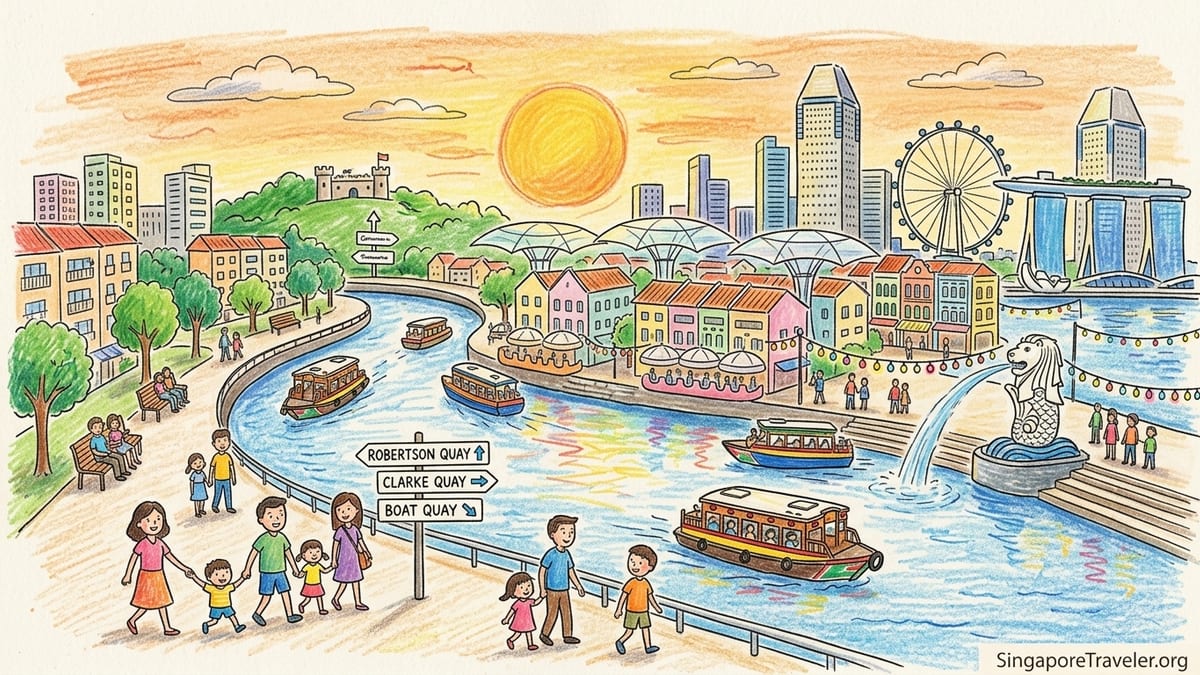
The Singapore River is only about 3 kilometres long, but it punches far above its size for visitors. The three main quays sit roughly in a line: quieter, residential-leaning Robertson Quay upstream; lively Clarke Quay in the middle; and historic Boat Quay closest to the downtown business district and Marina Bay. Walking the whole stretch at a normal pace takes around 40 to 50 minutes without stops, so it is entirely realistic to cover it in an afternoon or evening if you are wearing comfortable shoes and ready for the humidity.
Most visitors start at Clarke Quay MRT or Fort Canning MRT, both on central lines that connect easily with Orchard Road, Chinatown and the airport. From Clarke Quay station, you are less than five minutes’ walk from the riverfront. From Fort Canning station, one exit leads directly up the hill to Fort Canning Park while the opposite exit drops you near the river and Robertson Quay. This makes it easy to mix green space, history and waterfront nightlife in a single outing without backtracking all over town.
The classic experience many travellers choose is a late-afternoon walk that starts at Robertson Quay or Fort Canning, drops down to Clarke Quay for an early dinner, continues through Boat Quay as office workers knock off for the day, then finishes at Merlion Park and Marina Bay just after dark. If you add a Singapore River Cruise into the mix, you can let the boat do some of the work while you watch the skyline light up.
You do not need to book a guided tour to enjoy this area. Sidewalks are wide and well lit, there are frequent public benches and shade, and signs along the river point you toward landmarks like the Asian Civilisations Museum, Raffles Landing Site and the Cavenagh Bridge. The main decision is how much time you want to spend in each zone and whether your priority is museums and history, river views and cruising, or dining and nightlife.
Daytime Along the River: Fort Canning, Museums and Riverside Wandering
If you have free time in the morning or early afternoon, start with Fort Canning Park before the heat becomes intense. From Fort Canning MRT, follow the signs up to the hill or, if you are coming from the river, use the stone steps on River Valley Road near Clarke Quay. Once the seat of Malay royalty and later a British military stronghold, the park today is a leafy escape filled with spice gardens, remnants of fort walls, and viewpoints back down over the river and city. Allow at least an hour to wander, more if you enjoy photography or want to detour to the Battlebox underground bunker museum.
From Fort Canning, walk down the hill toward the river and cross over to Clarke Quay. In daylight you will see beyond the nightlife reputation: restored godowns painted in pastel colours, outdoor decks that sit almost level with the water, and occasional joggers and residents walking dogs. This is also a good time to scout restaurant menus for later, when the atmosphere changes completely after sunset. Budget travellers might grab a simple lunch in the air-conditioned Clarke Quay Central mall, while those wanting something local can walk a few extra minutes to nearby food courts and hawker centres off the river for cheaper noodles and rice dishes.
Continue downstream and you will soon reach the Asian Civilisations Museum, housed in a stately riverside building near the Cavenagh Bridge and Raffles Landing Site. Inside, galleries trace trade and cultural exchange across Asia, including maritime history that helps you picture how this once-busy working river looked in the 19th and early 20th centuries. Plan on paying a modest admission fee and spending one to two hours if you are a museum enthusiast; casual visitors can focus on highlights in under an hour and still gain context for the riverfront you are about to explore.
Just outside the museum you will find a statue commemorating Sir Stamford Raffles as well as panels explaining the original landing site. This short section of the river, with the elegant Cavenagh Bridge and views back toward Boat Quay’s colourful shophouses, is ideal for photographs during the day. The bridge itself is one of the oldest in Singapore, still carrying pedestrians across the river beneath a web of white ironwork. From here, it is a pleasant stroll to Boat Quay and on toward the financial district, or across the road into the civic district and St Andrew’s Cathedral if you have more time.
Exploring Boat Quay, Clarke Quay and Robertson Quay on Foot
Walking the three quays is the simplest way to understand how each has developed its own personality. Starting at Robertson Quay, the uppermost section, you will notice a more relaxed, neighbourhood feel. Low-rise apartment blocks, boutique hotels and riverside cafes share space with paved promenades and occasional playgrounds. Locals come here for weekend brunch at alfresco restaurants or to sip coffee under large umbrellas, and the atmosphere stays calm even later in the day compared with the other quays further downstream.
As you follow the river toward Clarke Quay, the scene gradually becomes busier. The warehouses give way to clusters of bars and restaurants, some with live music in the evenings. Even by mid-afternoon you will see preparations for the night ahead: sound checks, fairy lights being switched on under the distinctive translucent canopies, and drinks promotions written on sidewalk boards. This is a good spot for a mid-walk break, whether that is an iced coffee, a local craft beer or a quick snack. Prices here tend to be higher than in typical neighbourhood eateries, reflecting both the tourist trade and the prime waterfront location.
Further along, Boat Quay appears on the opposite bank as a line of traditional shophouses facing the river, backed immediately by modern office towers. Many of these heritage buildings now house seafood and international restaurants, often with touts or hosts outside inviting you in and offering set menus. The narrow walkway can feel a little crowded in the evening, but by day it is a pleasant place to walk, photograph the contrast of old and new architecture, or pause for a drink with a clear view of the passing bumboats. If you prefer shade and quiet, step back one street toward Circular Road where small cafes and bars see fewer passersby.
Because the three quays are connected by pedestrian bridges and paths, you can easily customise your route. Families with young children might stick to Robertson and Clarke Quay for wider promenades and fewer touts, while couples interested in history will likely spend more time around Boat Quay, the Asian Civilisations Museum and the nearby civic district. In all cases, bring a bottle of water, wear light clothing and consider a small towel or portable fan; humidity on the river can surprise first-time visitors, even on apparently cloudy days.
Singapore River Cruise: When to Ride and What to Expect
Bumboat cruises along the Singapore River remain one of the most popular ways to see the city’s skyline with minimal effort. Boats typically operate from late morning until late evening, with more frequent departures around sunset and after dark. Boarding points are usually located at Clarke Quay, Boat Quay and Merlion Park, making it easy to integrate a cruise into your walking route rather than planning a separate journey just for the boat ride.
For many travellers, the ideal time to board is around dusk when the heat begins to ease and the city’s lights start to glow. A typical shared cruise lasts 40 to 45 minutes and follows a simple route from the upper river near Robertson Quay, past Clarke Quay and Boat Quay, under several historic bridges, and out into Marina Bay where you can see the Merlion, Marina Bay Sands and the ArtScience Museum from the water. Commentary onboard usually points out major landmarks and gives brief historical background, which helps make sense of what you are seeing without feeling like a formal guided tour.
Tickets can often be bought at small riverside kiosks near the main jetties or directly from staff near the boarding points. Prices change over time, but expect to pay the equivalent of a mid-range attraction in Singapore rather than a budget ride on public transport. Families may find it good value compared with multiple museum entries, and it is particularly convenient if anyone in your group tires easily from walking in the heat. Try to arrive 10 to 20 minutes before your preferred departure, especially on weekends and during school holidays when queues can form just before sunset.
If you enjoy photography, sit toward the back or sides of the open-air section rather than inside the covered cabin. The angle from the river gives you clear perspectives of landmarks such as Cavenagh Bridge, the Fullerton Hotel and the Esplanade. Be aware that passing showers are common in the tropics; many boats carry plastic ponchos or have roofed seating, but it is still wise to carry a light rain jacket or accept a few drops as part of the experience. After the cruise, most travellers either disembark near Merlion Park to continue into Marina Bay or stay on to return to their original boarding point.
Evenings: Dining, Golden Hour Views and Early Nightlife
The hours between 5 pm and 8 pm are ideal for combining river views with a relaxed meal. As office workers leave nearby towers and temperatures soften, the quaysides fill with people strolling, choosing restaurants and snapping photographs in the soft golden light. This is also the easiest time to get a table without a long wait at many riverside spots, especially on weekdays outside major holiday periods.
One realistic plan is to start your evening at Robertson Quay with an early dinner at one of the numerous bistros or family-friendly restaurants that line the water. Outdoor tables here tend to feel less hectic than in Clarke Quay, and menus often lean toward Italian, Japanese or modern Asian cuisine with plenty of options for children. If your budget is tight, consider an early meal at a food court just off the river, then return to the water just for drinks or dessert to enjoy the atmosphere without paying full restaurant prices for every course.
After eating, walk downriver toward Clarke Quay as the sky darkens and lights flick on under the distinctive curved canopies. By this time, many bars begin to fill and street performers or buskers sometimes appear along the more popular stretches. It is a photogenic scene even if you do not plan to drink: colourful lighting reflecting on the river, occasional live music drifting across the promenade and bumboats gliding past. Families often still feel comfortable here earlier in the evening, although noise levels increase noticeably as the night progresses.
Continue toward Boat Quay if you want to experience the area in its liveliest state. Hosts outside restaurants will be more active, offering set menus that frequently feature seafood, international grills and drinks packages. Take your time choosing a place and do not feel pressured by the first offer you hear. If you prefer a quieter or more local feel, detour one or two streets inland to Circular Road or nearby lanes where smaller bars and eateries serve a mix of office workers and residents with less of a tourist focus. From here, it is a straightforward riverside walk of about 10 to 15 minutes to Merlion Park and Marina Bay.
Nighttime: Merlion Park, Marina Bay and Late-Night River Energy
Once the sky is completely dark, usually around 7.30 pm to 8 pm depending on the time of year, the river and bayfront take on a very different character. At Merlion Park, crowds gather to photograph the illuminated Merlion statue with Marina Bay Sands rising behind it. This is one of the city’s classic postcard views, and it is worth braving the crowds for a few minutes to take it in. Street food options around the park itself are limited, but you are within walking distance of malls and hotel lounges around the bay if you need a late snack or drink with air conditioning.
On the Marina Bay side, you can continue along pedestrian promenades that circle the water, taking in the ArtScience Museum, the Esplanade and the Helix Bridge. Light projections on surrounding buildings, reflections in the bay and the slow movement of tourist boats create a layered nightscape that feels very different from the intimate scale of the riverfront quays. If you time your walk to coincide with one of the regular light or fountain shows staged around the bay, you will add another memorable element to your evening without additional planning beyond checking the latest schedule once you are in Singapore.
Back along the river, Clarke Quay comes into its own later at night as clubs, bars and live music venues reach full volume. Exact opening hours and crowd levels change as venues come and go, but it is safe to assume that Friday and Saturday nights are the busiest, with weeknights somewhat calmer. Dress codes vary from relaxed to smart casual; you will see everything from tourists in sandals to office workers in shirtsleeves. Alcohol prices are relatively high in Singapore compared with many cities, so consider alternating alcoholic drinks with water or soft drinks to keep both your budget and hydration under control.
Robertson Quay and parts of Boat Quay stay active but more laid back, with wine bars, hotel lounges and small pubs catering to a mix of residents, expatriates and visitors who prefer conversation over loud music. This makes them appealing options for travellers who want to stay out late without committing to a full nightclub experience. If you are staying near the river, you can usually walk back to your hotel; otherwise, rideshare cars and taxis are easy to find from main roads just a short distance off the waterfront even after midnight.
Practical Tips for a Half-Day or Evening Along the River
To build a realistic half-day itinerary, think in rough blocks of one to two hours per major segment. For example, you might spend late morning in Fort Canning Park, break for lunch in or near Clarke Quay, devote mid-afternoon to the Asian Civilisations Museum, then walk through Boat Quay and finish in Marina Bay before or just after sunset. Alternatively, if you only have an evening, you could aim for a 5 pm walk from Robertson Quay to Clarke Quay, take a 6.30 pm river cruise, enjoy dinner around Boat Quay, then end with a leisurely stroll to Merlion Park and the bayfront.
Weather is the main factor that can change your plans. Singapore is hot and humid year-round, and short bursts of heavy rain are common, especially in the late afternoon. Pack a small umbrella or light rain jacket, and remember that some riverside paths may be more exposed than city streets inland. Fortunately, malls and underpasses are never far away if you need a quick cool-down in air conditioning. If a downpour coincides with your scheduled cruise, you can often wait it out under cover at the jetty and take the next boat instead of cancelling altogether.
For transport, the cluster of MRT stations around the river makes it straightforward to arrive and depart without using taxis. Clarke Quay, Fort Canning, City Hall and Raffles Place stations all sit within walking distance of different parts of the river and Marina Bay. If you stay out late, check last train times once you are in the city, or budget for a taxi ride back to your accommodation. Walking between quays late at night remains a common choice for visitors, as the main promenades are well lit and usually busy on weekends.
Finally, keep cashless payment options handy. Most restaurants, bars, cruise operators and attractions along the river accept major cards and mobile payments, and some do not handle cash at all. Tipping is not expected in Singapore, as a service charge is often included in the bill, though rounding up slightly or leaving a small amount for excellent service is always appreciated. Dress for comfort rather than strict formality, but carry a light layer for air-conditioned interiors, which can feel surprisingly cool after an hour in the tropical night air outside.
FAQ
Q1. How long do I need to explore the Singapore River and Marina Bay on foot?
Most travellers can comfortably walk from Robertson Quay to Merlion Park in 40 to 50 minutes without stops. To enjoy museums, a river cruise and a sit-down meal, plan at least a half-day or a full evening so you can move at a relaxed pace and factor in frequent breaks from the heat.
Q2. What is the best time of day to take a Singapore River Cruise?
Dusk and early evening are usually the most rewarding, as you experience both daylight views and the city lighting up after dark. Boarding around 6.30 pm to 7 pm often gives you cooler temperatures and better photographs than midday, though daytime cruises are quieter and can suit families with young children.
Q3. Is the Singapore River area suitable for families with children?
Yes, especially in the daytime and early evening. Robertson Quay and the promenades near Marina Bay offer wide paths for strollers, and many restaurants have children’s menus or are used to families. Very late at night, parts of Clarke Quay and Boat Quay feel more like adult nightlife zones, so families often head back to their hotel or toward Marina Bay’s more open spaces by then.
Q4. Can I visit Fort Canning Park and the riverfront in one outing?
It is easy to combine both. Fort Canning MRT and Clarke Quay MRT sit on either side of the hill, and there are stairways linking the park directly to River Valley Road near the river. A common route is to climb Fort Canning in the morning, descend to Clarke Quay for lunch, then follow the river toward Boat Quay and Marina Bay in the afternoon or evening.
Q5. Are restaurants and bars along the quays expensive?
Riverside venues tend to be pricier than neighbourhood eateries, as you are paying for views and location. Drinks and dinner in Clarke Quay or directly on Boat Quay usually cost more than similar items a few streets inland. To manage costs, some visitors eat an affordable meal at a nearby food court, then choose one riverside drink or dessert to enjoy the atmosphere without stretching their budget too far.
Q6. How safe is it to walk along the river at night?
The main promenades along the Singapore River are generally well lit and busy in the evenings, and many visitors feel comfortable walking between quays after dark. Usual urban common sense still applies: keep valuables secure, stay on well-used paths and avoid very quiet back alleys late at night. If you finish especially late or feel tired, taxis and rideshare cars are easy to find on main roads just off the waterfront.
Q7. Do I need to book Singapore River Cruise tickets in advance?
Most travellers buy tickets on the day at riverside kiosks or directly at the boarding jetties, especially outside peak holiday periods. If you are visiting on a major public holiday, during a festival or with a large group, checking schedules and availability in advance once you are in Singapore can help you avoid waiting for multiple departures at popular sunset times.
Q8. What should I wear for an evening along the river quays?
Light, breathable clothing and comfortable walking shoes are most important, as humidity remains high even after sunset. Many riverfront restaurants accept smart casual attire such as shorts and a collared shirt, and dress expectations vary across bars and clubs. Carry a light layer or scarf for indoor venues, where air conditioning can feel quite cool after time outdoors.
Q9. Is the Singapore River area accessible by public transport?
Yes, it is one of the easiest districts to reach by MRT. Clarke Quay, Fort Canning, City Hall and Raffles Place stations all sit within walking distance of different stretches of the river and Marina Bay. Buses also run along nearby roads, but most visitors find the MRT the simplest and most predictable option, especially during the evening when traffic can be heavy.
Q10. Can I see the Merlion and Marina Bay Sands as part of a river walk?
Absolutely. If you start upstream at Robertson Quay or Clarke Quay and follow the river toward Boat Quay, you can continue straight on to Merlion Park where the Merlion faces Marina Bay. From there it is a short walk along the bayfront promenades to viewpoints of Marina Bay Sands and the surrounding skyline, making it easy to combine these landmark sights in a single continuous outing.