


The Singapore River is one of the easiest places in the city to understand on a first visit, yet it is also where Singapore’s past and present meet most vividly. Follow its 3.5 to 4 kilometre course from leafy Robertson Quay to glittering Marina Bay and you move from warehouse wharves and shophouses to the modern skyline in a single, level walk. This guide explains how the main riverside areas fit together, what to see and do along the way, how to use the MRT, and how much time first-time visitors really need.
Orienting Yourself: Where the Singapore River Actually Is
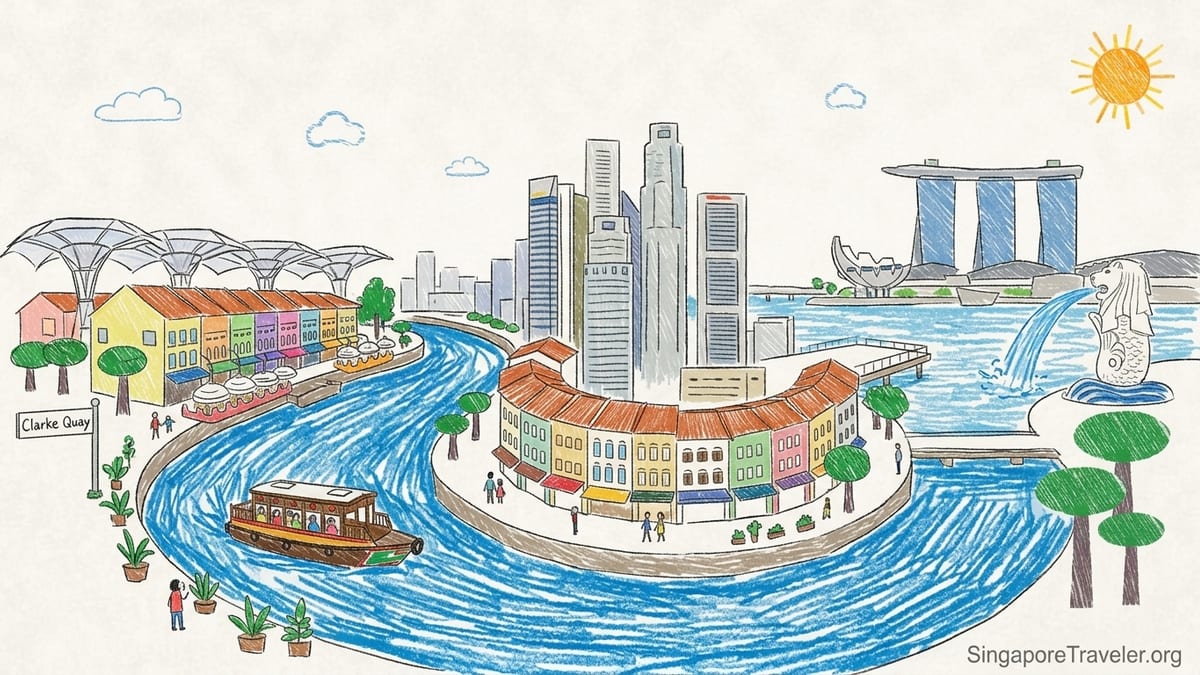
The Singapore River runs through the historic core of downtown Singapore, flowing roughly west to east. Upstream, it begins around the calm, residential-lively district of Robertson Quay. From there it winds past Clarke Quay and Boat Quay before opening out into Marina Bay, where the famous skyline of Marina Bay Sands, the ArtScience Museum and the financial district frames the water. For a first visit, it helps to think of the river as a simple corridor you can stroll from end to end in around 1.5 to 2 hours, not counting stops.
The three main quays sit in sequence along the river. Robertson Quay is furthest upstream and feels more local, with apartments, boutique hotels and relaxed dining. Clarke Quay sits in the middle and is the most obviously entertainment focused, with restored warehouses, bars, and the Clarke Quay Central mall above the MRT station. Boat Quay is downstream, a narrow crescent of colourful shophouses beneath tall office towers, popular for after-work drinks and riverside seafood restaurants. Beyond Boat Quay the river passes the historic Civic District and the Fullerton Hotel before merging into Marina Bay.
Geographically, the river also stitches together several key sightseeing zones. Walking downstream you can easily detour up to Fort Canning Park from Robertson Quay or Clarke Quay, step into the museums and colonial-era buildings of the Civic District near Boat Quay, then continue on past the Merlion to complete a loop around Marina Bay. For many visitors this one continuous walk replaces the need for separate neighbourhood-hopping, and is especially convenient in Singapore’s heat because much of the path is flat and paved.
Public transport access is straightforward. Clarke Quay MRT on the North East Line, Raffles Place MRT on the East West and North South Lines, and the newer Fort Canning and Havelock stations each sit a short walk from different parts of the river. This means you can start or finish your walk at whichever quay best fits your wider itinerary, or hop on the MRT if a tropical downpour suddenly arrives.
Robertson Quay: Leafy Mornings and Riverside Cafés
Robertson Quay sits at the upstream end of the Singapore River, a 10 to 15 minute walk from Fort Canning or Havelock MRT. Historically this area housed warehouses and godowns that stored goods brought in by bumboats. Those have gradually made way for a mix of low-rise commercial blocks and residential towers, leaving a quieter, broader stretch of riverside promenade than you find further downstream. For a first-time visitor it is an ideal place to start a morning or late afternoon walk when the light is soft and the temperature a little lower.
The mood here is residential and relaxed. On a weekday you will see office workers and parents with strollers; at weekends joggers, cyclists and dog walkers share the path. Cafés and restaurants line both sides of the river, particularly around The Quayside and the Robertson Walk complex. It is easy to sit down for a coffee at a café where a flat white costs around what you would pay in a major European city, then simply step back onto the promenade to continue your walk downstream. Outdoor seating is common, but many places also have indoor, air-conditioned rooms if the humidity builds.
Robertson Quay is also where you will find some of the river’s most convenient mid-range and upper mid-range hotels for longer stays. Properties such as Park Hotel Clarke Quay’s successors in the area, serviced apartments, and a handful of international brands offer pools and shaded terraces facing the river. Staying here keeps you close to the action but slightly removed from the late-night noise of Clarke Quay, which can be helpful for families or light sleepers. For many visitors, basing themselves at Robertson Quay and walking or taking the MRT to the more hectic sections of the river works well.
From a practical perspective, Robertson Quay is a good place to join the river path. From the Quayside area simply turn so you are walking with the current and follow the water: within 10 to 15 minutes you will begin to see the bright colours and busier waterfront of Clarke Quay ahead. Bridges are frequent and the path runs on both banks, so you can cross whenever a particular restaurant terrace or piece of shade catches your eye.
Clarke Quay: Entertainment Hub and River Cruise Gateway
Clarke Quay, about midway along the river, is the most instantly recognisable of the quays. Warehouses and godowns that once handled river trade have been preserved and adapted into an entertainment district, with rows of colourful shophouses covered by a sculptural canopy that offers shade and some protection from rain. The atmosphere is quiet in the day, with a few riverside restaurants, cafes and the Clarke Quay Central mall serving office workers. After sunset it shifts toward bars, live music and nightlife, especially on Fridays and Saturdays.
For first-time visitors, Clarke Quay is important not only for its nightlife but also because it is the main boarding point for Singapore River Cruise’s traditional-style bumboats. Ticket counters on the riverside promenade typically sell 40 minute cruises that run between Clarke Quay and Marina Bay, looping past Boat Quay, the Merlion and the bayfront skyline. Recent schedules have focused on boarding from Clarke Quay and selected jetties near Marina Bay, so it is worth checking operating times on the day and arriving 15 to 20 minutes early during peak evening hours when queues build up.
Prices for standard river cruises are in line with many city boat tours worldwide, and you can usually pay by card at the ticket booth. Most visitors prefer to cruise around sunset or after dark, when the financial district, Marina Bay Sands and the bridges are lit. Families with children and older travellers often find this an easier way to see the river than walking its full length in the heat. Seating is open-air with a roof, so you still feel the breeze from the water while remaining sheltered from light rain.
Clarke Quay’s dining and nightlife mix skews toward international chain restaurants, sports bars and themed venues rather than cutting-edge cuisine. You will find familiar names offering happy hour drinks, riverside seafood and casual Asian dishes with per-person costs comparable to other central Singapore hotspots. If you are more interested in local food courts or hawker centres, you can eat beforehand at a nearby food centre and then come to Clarke Quay for a drink, a stroll and a cruise. Clarke Quay MRT station, located just across the road in the basement of The Central mall, makes coming and going particularly simple.
Boat Quay, the Civic District and the Link to Marina Bay
Downstream from Clarke Quay, a short, level stroll brings you to Boat Quay. Historically this was the busiest stretch of the river, where bumboats crowded together to unload into the crescent of shophouses that still curves along the south bank. Today those shophouses house a dense strip of restaurants and bars, many with outdoor seating directly beside the water. The tall office towers of Raffles Place form the backdrop, giving Boat Quay a more urban, after-work feel compared to Clarke Quay’s festival-like layout.
For many visitors, Boat Quay works best in the late afternoon and early evening. Riverfront tables with views of the financial district, Cavenagh Bridge and the Fullerton Hotel are popular for drinks, and menus lean heavily toward seafood, international grills and Indian cuisine. Prices for a main course are similar to other central riverside spots; as in many touristy dining zones worldwide, it is sensible to read menus carefully and confirm any promotional pricing before ordering. If you walk a block or two inland, you will find simpler local eateries where you can eat for less, then return to the water for views.
Just beyond Boat Quay the river widens as it passes the Civic District and approaches Marina Bay. This is where several of Singapore’s landmark buildings sit within a few hundred metres of the water: the Asian Civilisations Museum, Victoria Theatre and Concert Hall, the Old Parliament House and the grand Fullerton Hotel, a former post office. Walking this stretch during daylight lets you appreciate the contrast between colonial-era architecture and the modern skyline, while at night bridge lighting and building uplighting make it one of the most photogenic sections of the entire walk.
From the pedestrian bridges near the Fullerton Hotel you can turn left toward Merlion Park, a compact viewing platform that overlooks Marina Bay with front-row views of Marina Bay Sands and the bayfront promenade. Continuing around the water on the Jubilee Bridge and the Marina Bay waterfront paths allows you to complete a full loop, passing the Esplanade theatres and the Helix Bridge. The river here merges into the bay rather than ending abruptly, so most first-time visitors experience the two as one continuous waterfront, especially in the evening when the bay area hosts light projections and crowds gather to watch the skyline.
Walking, Cruising and How Much Time You Actually Need
Walking the Singapore River from Robertson Quay to Marina Bay is manageable for most reasonably fit visitors. The distance is roughly 3.5 to 4 kilometres depending on your exact starting point and any detours, and the route is almost entirely flat, paved and lined with railings. In pure walking time this takes around one hour, but most travellers prefer to allow at least 2 to 3 hours so they can stop for coffee, photos, a museum visit or a drink along the way.
An easy first-time plan is to start in the late afternoon at Robertson Quay, when the sun is lower and the riverside trees offer dappled shade. Stroll downstream via Clarke Quay, pausing for an early dinner or a quick look at the river cruise jetties. Continue to Boat Quay and the Civic District before arriving at Merlion Park just as the city lights come on. From there, walk part of the Marina Bay loop before taking the MRT back to your hotel from a station such as Raffles Place, Esplanade or Bayfront. This gives you the full sweep of the river and bay in one evening without rushing.
River cruises are best thought of as a complement rather than a replacement for walking. Even if you take a 40 minute cruise between Clarke Quay and Marina Bay, you will likely want to explore some sections on foot to enjoy street-level details like sculptures, historic plaques and small cafés tucked under bridges. A common compromise is to walk one way and take the boat back, especially if you are travelling with children or older relatives who tire easily in the humidity.
In terms of overall trip planning, first-time visitors who are staying in central Singapore typically need one long afternoon and evening to experience the river comfortably. If you are particularly interested in riverside dining and nightlife you might return on a second night to try a different quay, but there is rarely a need to allocate multiple full days just for the Singapore River itself. Combining a river walk with a morning in the Civic District museums, or with a visit to Gardens by the Bay via Marina Bay, makes efficient use of limited time.
Restaurants, Nightlife and Where to Stay Along the River
The character of eating and drinking options shifts noticeably as you move downriver. Robertson Quay is dominated by mid-range restaurants, family-friendly bistros and cafes with a strong brunch and coffee culture. Outdoor terraces here tend to be calm and spread out, making them suitable for lingering conversations and relaxed evenings. You can easily find everything from Italian to Japanese and contemporary Asian cuisine, with typical mains priced comparably to downtown restaurants in other global cities.
Clarke Quay tips toward louder, more energetic venues. Here you will find live music bars, themed pubs and larger restaurants that stay open late, particularly on weekends. It is a convenient place to meet friends or colleagues because of its MRT station and central location, and the broad pedestrian concourses mean you can wander to see what appeals before committing to a table. Noise levels can be high, so families with younger children may prefer an early evening visit or to focus on the quieter riverside promenade closer to Fort Canning.
Boat Quay’s strip of restaurants under the shadow of the CBD towers has long attracted office workers and tourists looking for after-work drinks or riverside dinners. The setting, with the curve of shophouses and the skyline rising behind, is undeniably scenic. As with many popular waterfronts worldwide, it pays to compare menus and be clear about prices before ordering, particularly for seafood and set meals. If your priority is atmosphere rather than culinary discovery, Boat Quay can be a memorable place to sit outside and watch the bumboats and river traffic glide by.
Accommodation follows a similar pattern. Upstream, Robertson Quay has a cluster of mid-range and upscale hotels plus serviced residences that cater well to families and longer stays. Around Clarke Quay and the Civic District you will find larger international hotels, some with direct river views and quick MRT access. Downstream toward Marina Bay, the skyline is dominated by high-end properties with expansive views over the bay rather than the river itself. For most first-time visitors, choosing a hotel near Robertson or Clarke Quay gives the best balance of cost, convenience and atmosphere for exploring the river precinct on foot.
MRT Access, Practical Tips and the Best Time to Visit
The Singapore River area is unusually well connected by public transport. For Robertson Quay, the closest MRT stations are Havelock and Great World on the Thomson-East Coast Line, as well as Fort Canning on the Downtown Line. From these, level sidewalks lead directly to the river in around 5 to 10 minutes. Clarke Quay MRT on the North East Line sits beneath The Central mall a short walk from the riverbank, while Fort Canning station offers another access point slightly upstream. Boat Quay is most easily reached from Raffles Place MRT, which also serves as a gateway to the Civic District and Marina Bay promenade.
Bus routes criss-cross the area, but for first-time visitors the MRT is generally simpler. Stations are air conditioned, well signposted in English, and equipped with lifts and escalators. Using a contactless bank card or a stored-value transport card allows you to tap in and out without buying individual tickets. Because the three main quays each have at least one nearby station, you can comfortably plan point-to-point walks without needing taxis unless you are out very late or caught in heavy rain.
Singapore’s equatorial climate means temperatures are relatively stable and warm year-round. The most comfortable times to explore the river are early morning and late afternoon into the evening, when the sun is lower and the riverside breeze is more noticeable. Afternoon heat and humidity are intense, and tropical showers are common, particularly around the monsoon periods. Lightweight clothing, sun protection and a compact umbrella or rain jacket make a big difference. Many sections of the river promenade pass under bridges or through areas of partial shade, but you will still be exposed for stretches, especially approaching Marina Bay.
In terms of seasons, there is no single “off” period when the river is closed or unpleasant, but visitors who are sensitive to heat often find that evenings are the most pleasant time to experience the area. Weeknights are lively without being overwhelming, while Friday and Saturday nights around Clarke Quay and Boat Quay can be very busy and noisy. Families or travellers seeking a quieter vibe may prefer Sunday evenings or weekday strolls. Whenever you visit, carrying water and planning short indoor breaks in museums, malls or hotel lobbies along the way helps manage the climate comfortably.
The Takeaway
For a first-time visitor, the Singapore River is less a single attraction than a spine that connects several of the city’s most interesting districts. Starting at Robertson Quay, you can follow a simple, well-maintained riverside path past Clarke Quay’s entertainment zone and Boat Quay’s historic shophouses, through the Civic District and out into Marina Bay, all in the space of a single afternoon and evening. Along the way, the changing character of the waterfront tells the story of how a working trading river evolved into a leisure and cultural corridor.
Plan on two to three unhurried hours along the river itself, more if you intend to stop for a sit-down meal, join a 40 minute bumboat cruise or explore a museum. Use the MRT stops at Havelock, Fort Canning, Clarke Quay and Raffles Place to shorten or extend your route as needed, and time your visit so that you see both daylight on the shophouse facades and the city lights reflecting in the water after sunset. With a little planning, the Singapore River becomes a memorable, low-stress introduction to Singapore’s history, urban design and skyline, all without needing a tour group.
FAQ
Q1. Where should first-time visitors start walking along the Singapore River?
Most first-time visitors find it easiest to start at Robertson Quay in the late afternoon and then walk downstream through Clarke Quay and Boat Quay toward Marina Bay.
Q2. How long does it take to walk from Robertson Quay to Marina Bay?
The riverside route is roughly 3.5 to 4 kilometres. Without stops it takes about one hour, but most travellers allow 2 to 3 hours with breaks and photo stops.
Q3. What is the difference between Robertson Quay, Clarke Quay and Boat Quay?
Robertson Quay is quieter and more residential with cafés and family-friendly restaurants, Clarke Quay is the main nightlife and entertainment hub, and Boat Quay is a narrow curve of historic shophouses popular for after-work drinks and riverside dining.
Q4. Is a Singapore River cruise worth it for first-time visitors?
Many first-time visitors consider the 40 minute bumboat cruise between Clarke Quay and Marina Bay worthwhile, especially at sunset or after dark when the skyline is illuminated.
Q5. Which MRT stations are best for accessing the Singapore River?
Havelock, Great World and Fort Canning stations work well for Robertson Quay, Clarke Quay MRT serves the central section, and Raffles Place is closest to Boat Quay and the Civic District.
Q6. What is the best time of day to visit the Singapore River?
Late afternoon into the evening is usually the most comfortable and atmospheric time, with softer light, cooler temperatures and illuminated buildings after sunset.
Q7. Are there good places to eat along the river for different budgets?
Yes. Robertson Quay offers mid-range cafés and bistros, Clarke Quay has many casual restaurants and bars, and Boat Quay mixes tourist-oriented riverside dining with more affordable options slightly inland.
Q8. Is the Singapore River area suitable for families with children?
Yes, the riverside paths are generally flat and stroller friendly. Families often prefer calmer Robertson Quay and early evening visits to Clarke Quay before nightlife gets louder.
Q9. Can I see the Merlion and Marina Bay as part of a river walk?
Yes. Walking downstream from Boat Quay takes you past the Civic District to Merlion Park, from where you can continue around Marina Bay’s waterfront paths.
Q10. How many days should I allocate to the Singapore River in my itinerary?
Most first-time visitors set aside one long afternoon and evening for the Singapore River and Marina Bay, returning only if they want to try more riverside restaurants or nightlife.