


The Singapore River is one of the easiest places in the city to feel both its past and its hyper-modern present in a single glance. A short cruise here can take you from colourful shophouses and former godowns at Clarke Quay to the glass and steel of Marina Bay in under an hour. With several operators, routes and departure points to choose from, it is worth understanding how the main options differ before you step aboard.
Understanding the Main Singapore River Cruise Options
Most visitors encounter the river by boarding the classic bumboat sightseeing cruise that runs a roughly 40 minute loop between Clarke Quay, Boat Quay and Marina Bay, with recorded commentary about the river’s trading past and the landmarks along the way. Tickets are widely sold through hotel concierges and online travel agencies, and boarding is usually from the jetties at Clarke Quay or nearby Boat Quay, making it an easy add-on to an afternoon in the city centre.
In recent years the brand Singapore River Cruise has been closely associated with WaterB, which operates electric river boats and ticketing kiosks at multiple points including Fort Canning near Clarke Quay, Eu Tong Sen, Merlion Park and Bayfront North beside the ArtScience Museum. From a traveller’s point of view, this means you can now start your ride from the heritage river stretch or from the Marina Bay side, depending on what else you are doing that day.
Beyond the standard sightseeing loop, WaterB and partners sell dedicated Marina Bay light show cruises, longer evening departures timed to the Spectra light and water show outside Marina Bay Sands, and various themed or snack-inclusive river cruises. These run closer to one hour and focus more on the skyline than on detailed historical commentary, which makes them popular with photographers and families who want a relaxed nighttime outing.
It is also possible to experience the river from smaller alternative operators or via private charters, especially if you are staying at a riverside hotel. Some hotels bundle heritage bumboat cruises into stay packages, while private charters use dedicated jetties around Esplanade, Raffles Place or Kim Seng near Robertson Quay. These are usually more expensive per person but can be worthwhile for small groups who want a flexible route or timing.
Routes, Departure Points and What You Actually See
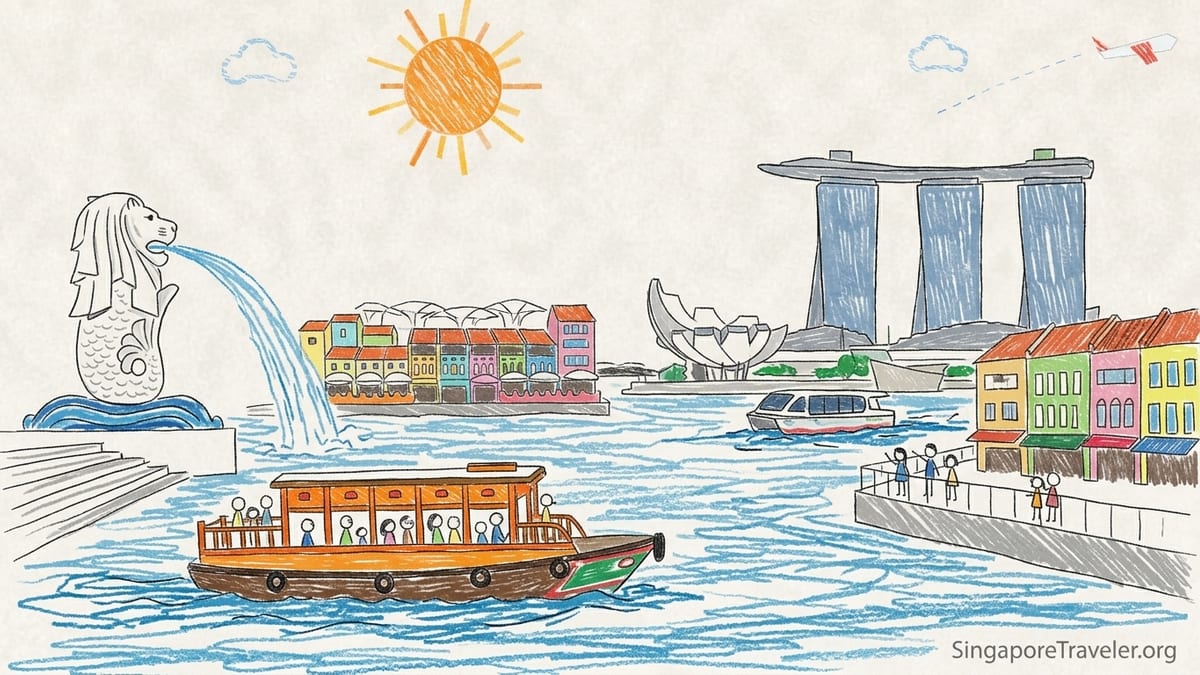
The classic bumboat sightseeing route typically starts at Clarke Quay Jetty, beside the cluster of bars and restaurants near the Read Bridge. From here the boat glides past colourful riverside warehouses toward Boat Quay, then passes under the low historic bridges into the civic district where you see the Asian Civilisations Museum, the restored Fullerton Hotel and the Raffles Landing site. The final stretch opens out into Marina Bay, with close-up views of the Merlion, Esplanade theatres, Marina Bay Sands and the ArtScience Museum before the boat loops back.
If you board from Merlion Park or the Bayfront North kiosk instead, the visual emphasis flips. Departures from Marina Bay immediately deliver panoramic views of the skyline, the Helix Bridge and the trio of Marina Bay Sands towers. As the boat turns into the narrower Singapore River, the mood changes into something more intimate and historical. You still see Clarke Quay and Boat Quay, but you are arriving at them from the bay end rather than starting from the nightlife district. This is convenient if you are already exploring Gardens by the Bay, Marina Bay Sands or the business district.
WaterB’s network of kiosks and jetties means there are also intermediate points where you can embark or disembark on selected products, especially for private events or special routes. For example, some cruises start near Kim Seng, close to Grand Copthorne Waterfront Hotel, and follow the river down from the quieter Robertson Quay stretch, giving a look at residential riverside life before hitting the busier Clarke Quay area. Others make use of Esplanade and Raffles Landing jetties for chartered journeys that focus on specific sections of the river.
For a first-time visitor, the key decision is whether you want more time in the traditional river corridor or in the open bay. If your mental image of Singapore leans toward shophouses, old warehouses and colonial-era buildings, choose a Clarke Quay or Eu Tong Sen departure. If you are mainly interested in dramatic skyline photos and the Marina Bay Sands towers reflected in the water, start at Bayfront North or Merlion Park and consider an itinerary that keeps you longer in the bay during golden hour or the light show times.
Daytime Cruises vs Evening and Night Departures
Daytime river cruises are usually less crowded, particularly on weekdays, and they give clearer views of architectural details on shophouses, bridges and civic buildings. The recorded commentary is easier to follow when the sun is up and there is less competing music from the riverside bars. Families with young children or older travellers who tire easily often prefer late-morning or mid-afternoon slots, when it is hot but the boarding jetties are quieter and there is less rush to secure an outdoor seat.
However, many visitors consider the river at its best in the early evening, from about 6 pm onwards. As the heat softens and the sky turns from gold to deep blue, lights come on along Boat Quay and the skyscrapers of the financial district. A cruise that departs from Clarke Quay around sunset will often reach Marina Bay just as the buildings and the ArtScience Museum are lighting up, which gives a mix of day and night views in a single trip. This window is particularly appealing if you want warm, flattering light for photos without staying out too late.
After dark, especially between 7.30 pm and 9.30 pm, the focus shifts to the skyline and Marina Bay’s light shows. WaterB’s Marina Bay Light Show Cruise and similar evening products aim to position the boat within the bay so that passengers can watch the light and water show staged in front of Marina Bay Sands, along with the animated lighting on the towers and bridges around the bay. These runs typically last around 60 minutes and may linger in the bay section longer than the daytime sightseeing loop, trading close-up views of the shophouses for more time circling the illuminated skyline.
If your schedule allows for only one river experience, it is worth asking yourself whether you are more excited about history and context or about city-lights panoramas. For detailed storytelling about the river’s transformation from a working waterway to a leisure-focused precinct, a daytime sightseeing cruise is usually best. If your highlight is the feeling of gliding through a canyon of glass towers while taking long-exposure photos of reflections on the bay, an evening or night departure from Marina Bay, possibly on a light show cruise, is the better fit.
Onboard Experience, Commentary and Photography Tips
Modern bumboats on the Singapore River are electric-powered vessels with both indoor and outdoor seating. Most boats offer an open deck or partially open rear section where you can stand for photos, along with air-conditioned cabins for those who prefer to sit. Recorded multilingual commentary plays through speakers, pointing out key sights such as Raffles Landing, the Merlion, Esplanade and Marina Bay Sands, and explaining briefly how the river was cleaned up in the late twentieth century and integrated into the new Marina Bay development.
The commentary is informative but relatively light, designed to match the 40 minute loop without overwhelming casual visitors. If you are particularly interested in history, it is useful to combine the cruise with a visit to the Asian Civilisations Museum or the National Gallery, which sit along the same corridor. Some themed cruises hosted by hotels or private guides may layer live narration on top of the standard recording, focusing on architecture, urban planning or food culture, but these usually need to be arranged in advance through the organiser rather than bought on the pier.
For photography, the best seats are often at the back corners of the boat, where you can shoot both sides without too much obstruction. In the narrowest section of the river around Boat Quay, the boat passes very close to the shophouses, so a wide-angle smartphone or lens is helpful to capture both the buildings and their reflections. As you enter Marina Bay, a slightly longer focal length works well to compress the skyline and the Marina Bay Sands towers into dramatic frames, especially during blue hour when the sky still holds colour.
If you are set on capturing the Spectra light and water show from the water, check estimated departure times at the ticket kiosk before you buy. The nightly shows are usually scheduled at set times in the evening, and you want a cruise that will be in the bay portion while the show is running rather than already heading back into the river. In practice, this often means boarding from Merlion Park or Bayfront North for a cruise beginning roughly 15 to 20 minutes before the scheduled show. Arriving early at the pier improves your chances of getting an outdoor seat facing Marina Bay Sands.
Families, Accessibility and Who Each Option Suits Best
The standard Singapore River bumboat cruise is well-suited to families, multi-generational groups and casual travellers who want a low-effort way to orient themselves in the city. The total time on board is short enough that children do not usually get restless, and the constant stream of visual landmarks keeps even jet-lagged adults engaged. Seating is bench-style, with enough room to keep strollers folded nearby, and there is generally level or ramp access from the pier to the boat, although very young children will still need to be carried on and off.
For older visitors or anyone with limited mobility, daytime or early-evening cruises from Clarke Quay can be easier than late-night departures from Marina Bay, which may involve more walking through large malls or open promenades. Many travellers who have brought elderly relatives report that as long as the passenger can manage a few steps and is comfortable with short periods of gentle bobbing on the water, the cruise feels safe and manageable. Anyone with specific accessibility needs should speak directly to the operator’s staff at the ticket kiosk, who can advise on the most convenient boarding point and timing.
Couples and solo travellers who are primarily interested in atmosphere often gravitate toward the evening and light show cruises that focus on Marina Bay. The glow of the skyline, reflections on the water and the contrast between the intimate river channel and the wide-open bay create a setting that feels distinct from daytime sightseeing. These departures can be busier and noisier, especially on weekends or during festivals, so they are better for those who do not mind sharing space with tour groups and families.
If you are staying at a riverside hotel or have a particular interest in urban design, a private or semi-private charter that runs upstream toward Robertson Quay can be rewarding. This quieter section of the river shows how the city has layered apartments, cafes and jogging paths onto a former warehouse district. Although more expensive than the mass-market sightseeing cruises, these charters offer flexibility in where you stop, how long you linger in the bay and whether you align your trip with sunset or a light show.
Prices, Duration and How to Book
Standard sightseeing cruises on the Singapore River typically last about 40 minutes, with departures roughly every 20 to 30 minutes from mid-morning until late evening. Adult prices can vary depending on where you book and whether any promotions are running, but a rough benchmark for walk-up tickets at the quays is in the high tens of Singapore dollars per adult, with child tickets somewhat lower. Singapore residents occasionally benefit from special deals and discounted periods publicised through official tourism campaigns.
Evening products that include extended time in Marina Bay or light show viewing are usually priced higher than daytime loops. Expect to pay a modest premium for the dedicated light show cruises that run closer to one hour and depart from Merlion Park or Bayfront North, particularly on weekends and public holidays. Packages that add snacks or a simple dinner on board will cost more again, but they can simplify planning if you have limited time and want to combine a meal with sightseeing.
Tickets can be bought in several ways. Walk-up counters at Clarke Quay, Eu Tong Sen, Merlion Park and Bayfront North generally sell same-day tickets for the next available departures, which works well if you are flexible. Many visitors also book through hotel concierges, online ticketing platforms or directly with the operator for specific time slots, especially for evening light show cruises that can sell out on busy nights. If you are visiting during a major event such as the Formula 1 Grand Prix weekend or a big festival, it is sensible to secure evening cruise tickets at least a day ahead.
Regardless of how you book, arrive at the pier at least 15 to 20 minutes before departure to exchange any vouchers for physical tickets and to queue for preferred seating. Outdoor seats tend to go first. On hot days bring water, a hat and light clothing; although the boat moves at a leisurely pace and there is often a breeze, the sun reflecting off the water can feel intense, especially around midday when there is little shade from the buildings.
Should You Cruise First or Walk the River First
One of the most useful decisions to make is whether to start your exploration of the river with a cruise or with a walk along the quays. Taking the boat first can serve as a moving introduction to the geography of central Singapore. In around 40 minutes you see how Robertson Quay, Clarke Quay and Boat Quay line up, where the civic buildings sit in relation to the skyscrapers, and how the river opens out into Marina Bay. Many travellers find that after this overview, it becomes easier to choose where to linger on foot for dinner or evening drinks.
Walking first, on the other hand, can make the cruise feel like a reward and a chance to rest. A common pattern is to spend the late afternoon strolling from Fort Canning Park down into Clarke Quay, then along Boat Quay to the Merlion and around Marina Bay. After an hour or two on foot, a sunset or evening cruise lets you retrace the same route from the water, seeing familiar landmarks from a fresh angle while giving your legs a break. This approach works particularly well if you plan to end the night with a light show at Marina Bay Sands or a meal near the Merlion.
Your personal energy levels and schedule should guide the choice. If you are arriving in Singapore that same day and anticipate jet lag, starting with a gentle cruise can be more manageable than committing to a long walk in the heat. If you have already spent the morning indoors in museums or shopping malls, a riverside walk followed by an evening cruise can balance fresh air, movement and rest. In both cases, think about where you want to be at the end of the experience, whether that is back at Clarke Quay for dinner, at Marina Bay for photos, or at your hotel.
For photography enthusiasts, walking first allows you to identify compositions you want to capture from the boat. You might, for instance, scout reflections of Marina Bay Sands near the Merlion, or vantage points where the low bridges frame the shophouses at Boat Quay. Later, on the cruise, you can position yourself on the boat to align with these ideas, knowing roughly when the river will curve or when the skyline will open up. This makes the experience feel more intentional and less like a passive ride.
The Takeaway
Singapore’s river cruises are short, straightforward experiences that nonetheless offer a rich cross-section of the city’s history and skyline in under an hour. The standard bumboat loop from Clarke Quay is the most flexible and family-friendly way to get oriented, combining recorded commentary with views of shophouses, colonial landmarks and the modern bay. It works particularly well during the day or at sunset, when details on the riverfront buildings are easy to see and crowds are moderate.
For those drawn more to night photography and glittering cityscapes, evening departures and Marina Bay-focused light show cruises provide a different flavour. Starting from Merlion Park or Bayfront North, these cruises spend more time in the open bay and are timed to the lights on Marina Bay Sands and the skyline. They are livelier and often busier, but they capture the sense of Singapore as a neon harbour city in a way few other experiences can match.
Whether you cruise before or after walking the river, the key is to align the route, timing and departure point with your broader plans. Think about where you will be in the city that day, how much energy you have, and whether your priority is context, comfort or photography. With a little planning, the Singapore River can be more than a quick boat ride: it can be the thread that ties together your understanding of the old trading port and the futuristic bay that has grown from it.
FAQ
Q1. How long does the standard Singapore River bumboat cruise take?
The core sightseeing cruise along the river and into Marina Bay usually lasts around 40 minutes, depending on river traffic and boarding times.
Q2. Where is the best place to board the cruise for first-time visitors?
Clarke Quay is a convenient starting point for most first-timers, as it is easy to reach by MRT and combines the heritage river stretch with access to Marina Bay on a single loop.
Q3. Is it better to cruise the Singapore River during the day or at night?
Daytime cruises are quieter and better for seeing architectural details, while evening and night departures excel for skyline views and light shows. Your choice should match whether you value context or atmosphere more.
Q4. Can I catch the Marina Bay light show from the river cruise?
Yes, certain evening and dedicated light show cruises are timed so that the boat is in Marina Bay while the light and water show outside Marina Bay Sands is taking place. Check departure times carefully before booking.
Q5. Are the river cruises suitable for young children and elderly travellers?
Most families and visitors with older relatives find the cruises manageable. The boats are stable, the journeys are short, and there is seating throughout, but those with specific mobility needs should confirm access at the ticket kiosk.
Q6. How much do Singapore River cruises typically cost?
Prices vary by operator and product, but standard 40 minute sightseeing cruises are generally in the high tens of Singapore dollars per adult, with child tickets somewhat cheaper and evening light show cruises priced slightly higher.
Q7. Do I need to book river cruise tickets in advance?
For daytime rides, same-day walk-up tickets are usually sufficient. For evening departures and light show cruises, advance booking is recommended, especially on weekends or during major events.
Q8. Is there live commentary on board the boats?
Most public sightseeing cruises use recorded multilingual commentary that plays through speakers. Private charters and some themed cruises may add live narration, arranged through the organiser.
Q9. What should I wear and bring on a Singapore River cruise?
Light, breathable clothing, a hat, sunscreen and water are helpful during the day. In the evening, a light layer can be useful against the breeze, and photographers may want a small tripod or phone stabiliser.
Q10. Should I cruise the river before or after walking along it?
If you want an overview to orient yourself, cruise first and then walk back to the spots that appeal. If you prefer to explore on foot and then rest, walk the quays in late afternoon and finish with a sunset or evening cruise.