


Choosing where to stay in Singapore can feel overwhelming. Names like Marina Bay Sands and Sentosa dominate Instagram, but for most visitors, the smarter choice is not a single famous hotel. It is a well connected neighborhood near the right MRT station, with food, sights and nightlife that match how you actually want to spend your days. The good news is that Singapore is compact and efficient, so once you understand the main districts you can pick an area that fits your budget and travel style without sacrificing convenience.
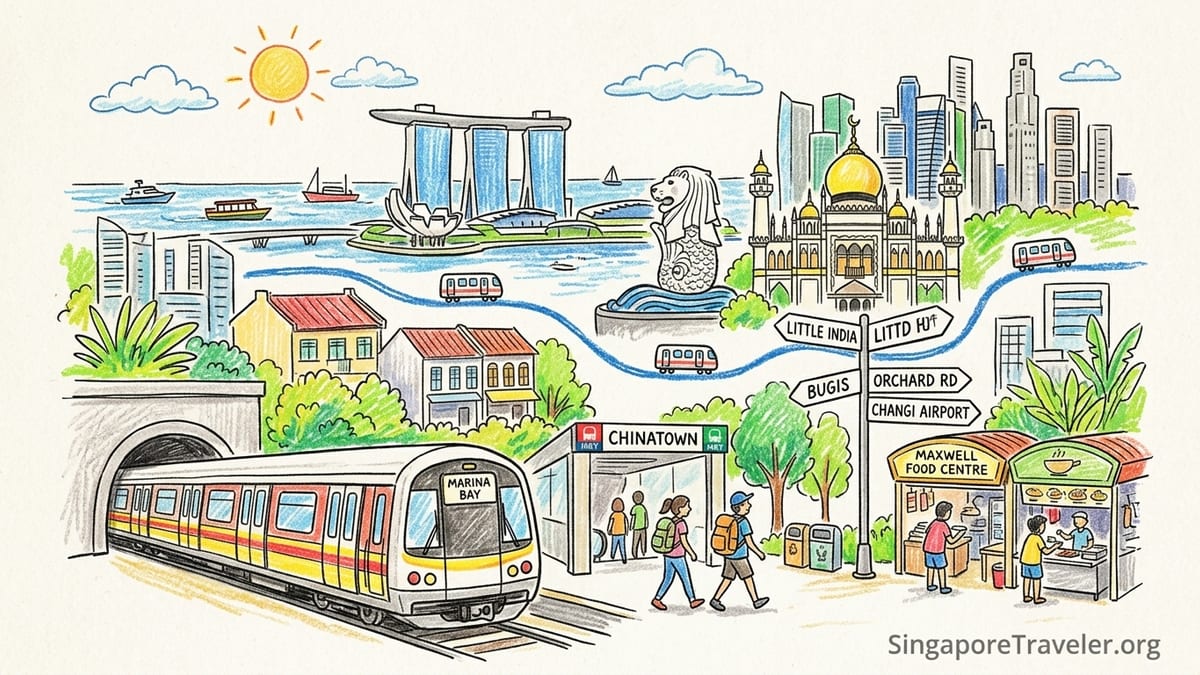
How Compact Singapore Really Is (And Why MRT Access Matters Most)
On a map, Singapore looks like a full country. On the ground, central Singapore feels closer to a large, tightly organized city where key districts sit just a few MRT stops apart. Marina Bay to Chinatown is only about a 10 minute train ride. Orchard Road to Little India takes roughly the same. From most central areas you can reach Changi Airport in 20 to 30 minutes by taxi in normal traffic, sometimes less outside rush hour. That means you rarely need to stay directly beside a single attraction to enjoy it.
The Mass Rapid Transit network is the real anchor of a Singapore stay. Stations like Marina Bay, Orchard, City Hall, Bugis, Chinatown and Clarke Quay connect multiple lines, so a hotel within a 5 to 8 minute walk of one of these can save you many transfers and a lot of heat. For example, a midrange hotel near Bugis MRT places you on both the East West Line and the Downtown Line, with fast access to Marina Bay, Little India and Changi Airport without changing trains. Similarly, Orchard MRT links the North South Line with the Thomson East Coast Line, giving you a quick route down to Marina Bay or out towards the eastern beaches.
Because the MRT is so extensive, first time visitors should think less about getting a room facing the Merlion and more about how many times a day they are likely to walk to the nearest station. In humid weather, trimming that walk from 15 minutes to 5 can be the difference between hopping out for one more hawker center meal or calling it a night. In practice, a well located hotel in Chinatown, Bugis or Little India can be almost as convenient for sightseeing as a much more expensive room overlooking Marina Bay.
Hotel prices reflect this gap between name recognition and day to day usefulness. A standard room at a flagship luxury property like Marina Bay Sands or Fullerton Bay typically runs several times the nightly rate of a solid four star business hotel in Bugis or Tanjong Pagar on normal dates. For travelers who spend most of the day out exploring, paying a premium just to be a few minutes closer to one landmark often makes less sense than choosing a cheaper area with strong transport and great food at your doorstep.
Marina Bay: Iconic Skyline, Luxury Price Tag
Marina Bay is the postcard face of modern Singapore, dominated by Marina Bay Sands, the lotus shaped ArtScience Museum and a ring of gleaming office towers. Staying here puts you in the city’s showpiece district, with dramatic skyline views, waterfront promenades and easy walking access to the Merlion Park and Gardens by the Bay. Bayfront and Marina Bay MRT stations connect the area to the Circle, Downtown, North South and Thomson East Coast lines, so you are well placed for fast trips around town.
This convenience and prestige come at a steep cost. Nightly rates at Marina Bay Sands, Fullerton Bay and similar five star hotels are often among the highest in Southeast Asia, particularly during major events and holiday periods. Even standard rooms can price out many families and longer stays. Dining in the integrated resorts and waterfront malls trends upscale, though you can still find food courts in Marina Bay Sands’ shopping arcade and in nearby office complexes where a simple hawker style meal remains affordable by Singapore standards.
Marina Bay is strongest for couples and luxury travelers who want impressive views, polished service and comfortable walking access to evening strolls around the bay. Families often appreciate that you can push a stroller on wide pavements and duck into the air conditioned Gardens by the Bay conservatories on hot days. Nightlife is more about cocktail bars in hotel lounges and rooftop terraces than rowdy clubs. For visitors on a tighter budget, staying just one or two MRT stops away, near City Hall, Bugis or Chinatown, often delivers 80 percent of the convenience at a fraction of the cost.
Airport access from Marina Bay is straightforward. A taxi to Changi usually takes 20 to 25 minutes in regular traffic. By MRT, you can ride the Thomson East Coast Line or East West Line with one change depending on where you board. This makes Marina Bay efficient for very short trips when you want to minimize time spent commuting to and from the airport, and maximum time by the pool or at the casino.
Chinatown & Tanjong Pagar: Character, Food and Good Value
Southwest of Marina Bay, Chinatown and neighboring Tanjong Pagar are among the most practical bases in the city. Chinatown MRT sits at the junction of the North East and Downtown lines, while Tanjong Pagar is on the East West Line and one stop from the Raffles Place and Outram Park interchanges. In real terms this means you can reach Marina Bay, Orchard Road, Little India and Changi Airport with few or no transfers, while enjoying a strong mix of heritage shophouses and modern towers outside your hotel.
Hotel pricing here spans compact budget rooms above shophouses, efficient midrange business hotels and a handful of upscale boutique properties. On an average week in the cooler months, it is common to find clean, central three or four star hotels in Chinatown or Tanjong Pagar priced significantly below similar quality rooms in Marina Bay. For example, a standard room in a midscale chain near Tanjong Pagar MRT often comes in well under typical Marina Bay rates yet keeps you only two or three MRT stops away from the same attractions.
Food is a major reason to base yourself here. Maxwell Food Centre, Chinatown Complex and Amoy Street Food Centre concentrate dozens of hawker stalls serving everything from Hainanese chicken rice to laksa and fish soup at local prices. On Keong Saik Road and around Duxton Hill you will find bistros, sake bars and wine spots that attract a younger local crowd. Nightlife leans toward lively but generally not rowdy, with plenty of casual bars open late. Families can still find quiet early evenings if they stay a couple of blocks off the main bar streets.
For first time visitors, Chinatown and Tanjong Pagar balance culture, value and connectivity. You can walk to the historic temples and shophouses of Chinatown in minutes, be on the Singapore River or in the CBD after a short MRT hop, and still return to a neighborhood that feels distinct from the polished set pieces around Marina Bay. Airport taxis from this area typically take around 20 minutes, while the East West Line gives a straightforward rail option to and from Changi with no more than one transfer.
Bugis, Kampong Glam & Little India: Colour, Culture and Central Convenience
North of Marina Bay, the trio of Bugis, Kampong Glam and Little India offers one of the best combinations of price, food and MRT access for first time visitors. Bugis MRT sits on both the Downtown and East West lines, Little India connects the Downtown and North East lines, and nearby Rochor and Jalan Besar stations further increase your options. In practice, staying around Bugis or Little India gives you direct rail links to Marina Bay, Chinatown, Orchard Road and Changi Airport without long walks or complex transfers.
Bugis itself feels like a modern shopping and student area, with malls, midrange hotels and cafes. Kampong Glam, centered on the Sultan Mosque and Haji Lane, is a short stroll away and known for Middle Eastern and Malay eateries, indie boutiques and vibrant street art. Little India, anchored by the Sri Veeramakaliamman Temple and bustling Tekka Centre, has 24 hour shopping at Mustafa Centre and plenty of South Indian food at approachable prices. Each area carries its own atmosphere but all are close enough that you can easily wander between them on foot.
Hotel prices here are generally kinder than Marina Bay or Orchard, though they have risen in recent years. You will find many three and four star chains, capsule style rooms and heritage shophouse hotels. A family might book a family room or connecting rooms in a Bugis or Little India hotel for the cost of a single standard room in one of the Marina Bay icons on many dates. At the same time, you remain no more than a few stops from major attractions like Gardens by the Bay or the Singapore Flyer by MRT or taxi.
For food focused travelers and budget conscious visitors, this cluster is particularly appealing. You can have South Indian breakfast in Little India, lunch at a Bugis mall food court, then dinner at a Kampong Glam nasi padang stall or a hip Haji Lane restaurant, all within walking distance of your hotel. Nightlife is more low key than Clarke Quay, skewing toward casual bars and shisha cafes. Airport access by taxi is usually 20 to 25 minutes, while the East West Line gives a simple rail link to Changi via Bugis or nearby City Hall.
Orchard Road: Shopping Boulevard with Strong Transport
Orchard Road is Singapore’s classic shopping corridor, lined with malls like ION Orchard, Ngee Ann City and Paragon. Orchard MRT is an interchange station on the North South and Thomson East Coast lines, and nearby Somerset and Dhoby Ghaut stations further enhance connectivity. From Orchard, you can ride directly to Marina Bay, City Hall, Little India and the eastern coastal areas without leaving the train system.
Hotels along Orchard Road skew towards the midrange and upscale segments. Large international brands, longstanding Singapore favorites and newer lifestyle hotels cluster between Orchard and Somerset. Prices vary widely depending on brand and renovation date, but you generally pay a premium over similar quality properties in Bugis or Little India, though still often less than the top tier Marina Bay icons. Many hotels in this area offer family rooms, pools and kids’ facilities, which can be attractive for travelers who want to combine shopping with city sightseeing.
Food along Orchard Road ranges from high end restaurants inside luxury malls to basement food courts that draw office workers and shoppers alike. You will find everything from Japanese ramen to local noodle stalls under one roof. Nightlife in Orchard is relatively restrained, focused more on hotel bars and late opening cafes than on clubs. For families, this makes the area feel comfortable in the evenings, though it lacks the distinctive street life of Chinatown or Little India.
For first time visitors who prioritize shopping and want straightforward transport, Orchard is a safe if slightly generic choice. You can walk in air conditioned comfort almost the entire length of the strip thanks to linked malls and underpasses. Taxis to Changi take around 25 minutes in normal traffic, while the Thomson East Coast Line will eventually give even more direct rail connections to the airport side of the island as extensions continue to open.
Clarke Quay & The Singapore River: Nightlife and Central Access
Clarke Quay and the broader Singapore River area appeal to travelers who value evening atmosphere. Clarke Quay MRT on the North East Line puts you one stop from Chinatown and two from Dhoby Ghaut, with additional connectivity through nearby Fort Canning and City Hall stations. From a practical standpoint, staying near the river gives you quick access to most downtown attractions while surrounding you with riverfront dining and nightlife.
Hotels here range from compact boutique properties in heritage shophouses to full service four and five star riverside hotels. Because of the nightlife focus, some riverfront rooms can pick up noise on weekends, so light sleepers may prefer properties a few streets back or higher floors. Price wise, the area often sits between Chinatown and Marina Bay, though there are still deals at older or smaller properties, especially midweek.
In the evenings, the riverfront fills with restaurants, bars and music venues catering primarily to visitors and office workers. The atmosphere is lively, sometimes boisterous, especially on Fridays and Saturdays. For couples, groups of friends and solo travelers who enjoy going out, this makes Clarke Quay a convenient base. Families with young children may prefer to stay slightly away from the busiest blocks while still enjoying daytime river walks and boat tours that depart from the quays.
From Clarke Quay, walking distances to major attractions are short. You can stroll to the Asian Civilisations Museum, the civic district and parts of Marina Bay in 15 to 20 minutes, or ride two quick MRT stops to reach Gardens by the Bay or Orchard. Taxis to the airport are usually around 20 minutes outside rush hour, and the central location means ride hailing services are plentiful.
Katong & East Coast: Residential Charm by the Sea
On the southeastern side of the island, Katong and the East Coast offer a more local residential feel, with colorful Peranakan shophouses, traditional bakeries and a strong food scene. The Thomson East Coast Line is progressively improving rail access here, with stations such as Marine Parade and Tanjong Katong opening along the coast and linking directly to the city center and, over time, to the airport corridor. Even before the line is fully complete, frequent buses run along East Coast Road into the downtown core, and taxis remain fast and relatively affordable compared with many global cities.
Hotels in this area are fewer than in the city center but include a mix of boutique properties, midrange chains and serviced apartments. Prices are generally moderate, often below equivalent standard hotels in Orchard or Marina Bay. Many visitors choose Katong when they want to be close to East Coast Park, a long beachfront park popular for cycling, jogging and barbecues. For families, being able to rent bikes or let children play in breezy seaside playgrounds can be a welcome contrast to long days in air conditioned malls.
Food is a primary draw. Katong is known for Peranakan cuisine and a dense cluster of eateries serving laksa, curry puffs and kaya toast. Cafes and dessert shops have multiplied in recent years, making the neighborhood feel both traditional and contemporary. Nightlife is mostly neighborhood bars and cafes rather than big clubs, so evenings tend to feel relaxed. For travelers who prefer to stay in a more residential environment while still having straightforward transport into the city, Katong and the East Coast are appealing options.
Airport access is especially convenient from this side of the island. Taxi rides to Changi can be as short as 15 minutes, and as the Thomson East Coast Line extends through to the airport and Tanah Merah area, rail connections will become even more direct. The trade off is that you will rely slightly more on buses and the MRT for trips to Marina Bay and Orchard, which can take 20 to 30 minutes door to door, but this is still manageable for most visitors.
Sentosa: Resort Island for Beach and Theme Park Breaks
Sentosa sits just off the southern coast of Singapore’s main island and has been developed as a resort and entertainment zone. For families focused on Universal Studios Singapore, the Singapore Oceanarium and beach time, basing on Sentosa can be attractive. Resorts World Sentosa alone offers multiple hotels from family oriented to high end, while other properties like Shangri La Rasa Sentosa, Sofitel Singapore Sentosa Resort & Spa and Capella Singapore provide full service resort experiences with large pools and kids’ facilities. Many of these hotels market themselves towards families with packages that bundle attraction tickets or discounted adjoining rooms for children.
Staying on Sentosa is usually more expensive than comparable hotel categories on the main island, though you can sometimes find off peak rates that narrow the gap. The main advantage is convenience for specific activities. If you know you will spend two consecutive days at Universal Studios and the water based attractions, being able to walk or take the internal shuttle back to your room in the middle of the day is a real comfort with young children. Resort style pools, kids’ clubs and curated family programs make Sentosa feel like a beach holiday within the city.
The trade off is everyday connectivity. To reach other parts of Singapore you will typically ride the Sentosa Express monorail or internal bus to VivoCity, then transfer to the MRT or a taxi. Door to door, a trip from a Sentosa hotel to areas like Bugis or Little India can easily take 30 to 40 minutes once you factor in transfers. For short first visits that include a wide range of attractions across the island, many families now choose to stay in the city and plan one or two day trips to Sentosa instead of basing there full time.
Airport access from Sentosa is still fairly convenient by taxi at around 30 minutes outside peak hours, but less straightforward by public transport due to transfers at VivoCity and along the East West Line. Sentosa works best for travelers who prioritize resort downtime and specific island attractions over dense sightseeing days in the rest of the city. For many itineraries, splitting a stay, with a few nights in the city followed by two resort nights on Sentosa, offers the best of both worlds.
How to Choose: Matching Neighborhoods to Traveler Types
For first time visitors who want a bit of everything, Chinatown or Bugis are usually the most balanced choices. Both areas offer excellent MRT access, a strong range of hotels in the midrange brackets, and great access to hawker food and cultural sights. From Chinatown you can walk to the Singapore River and be in Marina Bay after a short MRT ride. From Bugis you can reach Little India and Kampong Glam on foot and take direct trains to many attractions. In both cases, you are close enough to visit the iconic Marina Bay skyline in the evening without paying Marina Bay prices every night.
Families with young children often do well staying either in the Bugis or Orchard areas, where midrange hotels commonly offer family rooms and pools, or choosing a city hotel near an MRT interchange and planning a dedicated Sentosa day or overnight. A typical family plan might involve four nights in a Bugis hotel with a pool and family room, using the MRT to visit Gardens by the Bay, the zoo and Little India, then one or two nights on Sentosa at a resort like Shangri La Rasa Sentosa or one of the Resorts World properties for concentrated theme park time and pool days.
Couples and luxury travelers frequently gravitate to Marina Bay or the more intimate high end properties around Orchard and Sentosa. A stay at Marina Bay Sands, Fullerton Bay or Capella Sentosa pairs dramatic views or lush gardens with fine dining and spa facilities, ideal for a shorter, splurge style visit. For those who prefer character over size, boutique hotels around Tanjong Pagar, Duxton Hill or the riverfront can deliver atmospheric stays with easy access to cocktail bars and independent restaurants.
Budget travelers, including solo visitors and long stay guests, tend to favor Chinatown, Little India and parts of Bugis, where small hotels, hostels and capsule rooms still undercut central high rise properties. Choosing a spot within a short walk of an MRT station remains the key factor. Even if your room is simple, the ability to move around the city quickly and cheaply will shape your experience more than having a view of a single landmark from your window.
The Takeaway
Singapore’s neighborhoods each have a distinct personality, but the distances between them are small, and the MRT network ties them tightly together. For a first or second visit, it is rarely necessary to stay directly beside a specific attraction like the Merlion, Orchard Road or even Sentosa’s beaches. Instead, think about how you travel: how often you will use public transport, how much you care about nightlife, whether your children need easy pool access or early bedtimes, and how much shopping or local food you want within a few minutes’ walk.
In most cases, being within five to eight minutes of a major MRT station in a central area such as Chinatown, Bugis, Little India, Orchard or the riverfront will matter more to your daily comfort than a famous address. Marina Bay and Sentosa are excellent for specific types of trips, especially luxury breaks and resort focused family stays, but they are not mandatory for enjoying the city’s highlights. By choosing the neighborhood that matches your priorities and budget, you can let Singapore’s compact size and efficient transport system do the rest.
FAQ
Q1. For a first time visitor, which area is the best overall base in Singapore?
Bugis and Chinatown are usually the most balanced choices, combining strong MRT access, good midrange hotel options and easy access to hawker food and major sights without Marina Bay level prices.
Q2. Is it worth paying extra to stay at Marina Bay Sands for the first visit?
It can be worth it if you value the rooftop pool and iconic skyline views, but many visitors prefer to book a more affordable central hotel and simply visit Marina Bay Sands for dinner or an observation deck visit.
Q3. Should families with children stay on Sentosa or in the city?
If your trip is built around Universal Studios and beach time, Sentosa is convenient. Otherwise, many families base in the city near an MRT interchange and visit Sentosa for one or two full days instead of staying there the entire time.
Q4. Which neighborhoods are best for budget travelers?
Chinatown, Little India and parts of Bugis tend to have the widest range of budget and simple midrange hotels, hostels and capsule style rooms, all with strong MRT access to the rest of the city.
Q5. Where should couples stay for a romantic trip?
Couples often choose Marina Bay for skyline views, boutique hotels in Tanjong Pagar or the river area for character and nightlife, or resort style properties on Sentosa for a quieter, more secluded feel.
Q6. What is the most convenient area for late night nightlife?
Clarke Quay and the Singapore River area are best if nightlife is a priority, with many bars and clubs in walking distance and easy MRT or taxi access back to other central districts.
Q7. How important is it to stay directly beside an MRT station?
In Singapore’s heat and humidity, being within about a five to eight minute walk of a station makes a noticeable difference. It matters more than being beside a single attraction, since trains connect you quickly to most sights.
Q8. Which area is closest to Changi Airport?
Katong and the East Coast are geographically closest, with taxi rides often around 15 minutes. Central areas like Bugis, Chinatown and Orchard are still only about 20 to 30 minutes away in typical traffic.
Q9. Is Orchard Road a good place to stay if I am not a big shopper?
Orchard has strong MRT access and many hotels with pools, so it still works well, but if shopping is not a priority you may find more character and better value in Chinatown, Bugis or Little India.
Q10. Is it realistic to explore all main sights using only MRT and buses from a central hotel?
Yes. With a hotel near a central MRT station, most visitors find they can reach Marina Bay, Little India, Chinatown, Orchard and even Sentosa using a mix of MRT, buses and occasional taxis without needing a car.