


Singapore’s MRT and bus network is one of the easiest ways to explore the city, but the variety of tickets can feel confusing on a first visit. Should you buy the Singapore Tourist Pass with unlimited rides, pick up an EZ-Link or SimplyGo stored-value card, or just tap in with your regular Visa or Mastercard from home? The right answer depends less on theory and more on how often you will actually ride. This guide uses real 2026 fares and concrete visitor itineraries to show when each option offers the best value.
The Three Main Ways Tourists Pay For MRT And Bus Rides
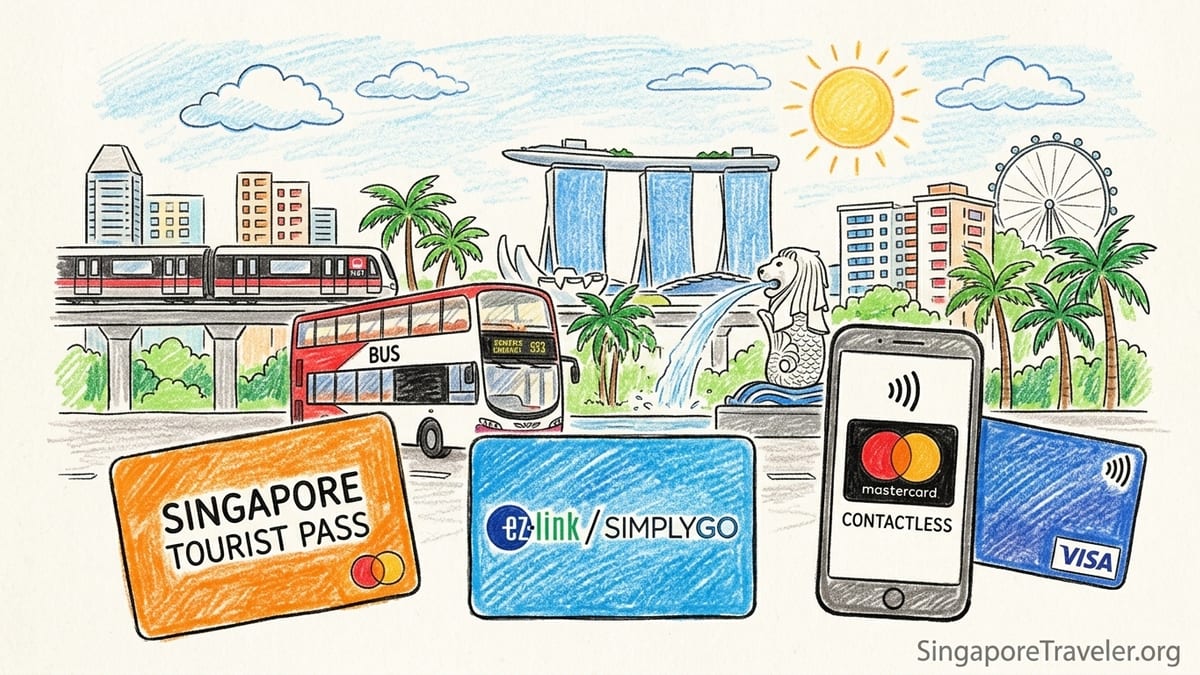
In 2026, adult fares on Singapore’s MRT and buses are distance based, but the way you pay is flexible. Tourists essentially choose between three systems: the Singapore Tourist Pass with unlimited rides for a fixed number of days, an EZ-Link or SimplyGo stored-value card where each ride is deducted from your balance, or a contactless bank card such as a Visa or Mastercard from your home country, including phone wallets like Apple Pay or Google Pay. All three charge the same underlying adult fare per ride; what changes is how you pay, and in the case of the Tourist Pass, whether you hit good value from its flat daily price.
The Singapore Tourist Pass is marketed specifically to visitors and sold as a separate card. It bundles unlimited MRT, LRT and basic public bus travel for a fixed number of calendar days, from one through five. By contrast, EZ-Link and SimplyGo cards are the same cards locals use every day. You load credit in Singapore dollars and pay-as-you-go, with every trip individually priced from roughly S$0.90 for a very short hop up to around S$2.30 for the longest city journeys on standard services.
Foreign contactless bank cards work much like SimplyGo: you tap your physical card or mobile wallet on the gate and adult fares are charged in Singapore dollars. For cards issued overseas there is an additional small admin fee per day of usage on public transport, on top of your bank’s currency conversion. For many visitors this convenience is worth paying for, especially on short trips, but heavy users may save money with a local stored-value card or Tourist Pass.
Current Singapore Tourist Pass Prices, Validity And Coverage
In August 2026, the official list price for the standard Singapore Tourist Pass starts at about S$17 for one day and rises through roughly S$24 for two days and S$29 for three days, up to S$45 for five days. These prices buy consecutive calendar days of unlimited rides on MRT, LRT and basic public bus services across the island. The pass uses a reusable card with a separate refundable deposit; if you return the card to a staffed ticket office within the stated period, that deposit comes back in cash, lowering the effective cost of the pass by around S$10 over the whole stay.
Validity works on calendar days, not 24-hour periods. If you activate a one-day pass at 4 pm on a Monday, it still expires at the end of service that same Monday night, not at 4 pm on Tuesday. That makes it important to time activation with your sightseeing, rather than on a late arrival where you might only squeeze in one or two rides. Multi-day passes must be used on consecutive days; you cannot skip a day in between for a taxi-heavy itinerary and then resume later.
The Tourist Pass covers all regular public MRT and LRT lines and standard trunk and feeder buses, including popular tourist routes such as the Downtown Line to Chinatown and Little India, the Circle Line to Marina Bay, and the North East Line to Clarke Quay. It does not cover premium buses, express coaches, the airport’s private shuttle services, or tourist-oriented hop-on hop-off buses. Travel to Sentosa on the Sentosa Express monorail has historically been included in some variants, but visitors should always check the latest inclusions at purchase because Sentosa access rules can change.
You can buy the Singapore Tourist Pass at TransitLink ticket offices in major MRT stations, including Changi Airport station, or at selected tourist information counters in central areas. At Changi, many arrivals walk from their terminal to the public MRT station, join the short queue at the TransitLink counter, present passports if requested and pay by cash or card. Vending machines in some stations also dispense the pass, but staffed counters are still the safest option if you want to clarify deposit rules and return locations.
EZ-Link And SimplyGo Stored-Value Cards: How They Work For Visitors
EZ-Link and SimplyGo branded cards are regular adult stored-value transport cards widely used by Singapore residents. As of 2026, both work on the MRT, LRT and public buses, with SimplyGo under the hood for newer or upgraded cards. For a tourist, there is no need to worry about the technical platform. You pay a small non-refundable card cost, typically around S$5, and must load a minimum amount of travel value, often S$5 or S$10, at purchase. The smallest starter bundle at some machines is S$10 total, split as S$5 card cost plus S$5 usable balance.
Each time you tap in and tap out, the exact fare is deducted from your stored balance based on distance. For an average intra-city ride most visitors take, such as Chinatown to Bayfront, Bugis to Little India or City Hall to Orchard, expect to pay roughly S$1.60 to S$2.00 per trip on MRT. Short hops of only a couple of stops might cost around S$1.20, while cross-island journeys toward the airport suburbs or industrial areas may climb toward S$2.30. Bus fares on standard routes are similar for comparable distances.
Stored-value cards are easy to top up at General Ticketing Machines in any MRT station, typically in increments from S$10 upward using cash or bank cards. Many convenience stores such as 7-Eleven and supermarket chains can also top up or sell new cards, which is handy if you have already left the airport. For tech-comfortable travelers, topping up via the official SimplyGo app with a linked bank card is also possible, though setup may not be worth it for a very short visit.
For visitors who expect moderate but not heavy use, EZ-Link and SimplyGo cards are often the most straightforward value choice. You pay exactly for what you ride, avoid daily admin fees on foreign cards, and do not have to plan around the calendar-day constraints of the Tourist Pass. The main drawback is the small amount of unused balance many people end up leaving on the card at departure, especially if they top up generously for peace of mind on day one.
Using Foreign Contactless Bank Cards And SimplyGo
Singapore’s SimplyGo system allows adult fares to be charged directly to many contactless bank cards. In practice this means you can tap a foreign-issued Visa or Mastercard at MRT gates and bus readers, or use Apple Pay, Google Pay or similar wallets linked to those cards, without buying any local transport card at all. The gates treat the card as an adult SimplyGo token and calculate distance-based fares in the same way as an EZ-Link or SimplyGo card.
The key extra cost for tourists is a foreign bank card admin fee. In 2026, official SimplyGo information indicates that Mastercard and Visa cards issued outside Singapore incur a small flat admin fee per calendar day of use when they are used on public transport. This is charged once per day per card, on top of the actual fares for the rides you take. Your home bank may also apply its usual foreign transaction markup or currency conversion spread to each day’s total.
Because the underlying fare is the same as local cards, the admin fee becomes negligible if you are making many journeys in a single day. For example, if you clock up S$10 in bus and MRT rides during a packed sightseeing day, a sub-dollar admin fee is a small percentage surcharge. However, if you only take one S$1.70 ride from your hotel to a nearby mall, the same fee becomes a large proportion of the cost. This is why foreign contactless cards tend to be best for very short stays, or for visitors who value convenience over the last few dollars of savings.
One advantage of using your ordinary bank card is that there is nothing physical to return or worry about losing. If you travel as a couple or family, each person must have their own contactless card or phone, since the system only allows one user per card at a time. Parents traveling with small children should note that adult fares will be charged for each tapped card, so if your child is entitled to Singapore’s child concession system, you may wish instead to obtain a dedicated child card at a ticket office.
Realistic Day-By-Day Cost Comparisons
To see when unlimited passes beat pay-as-you-go, it helps to look at concrete example days. Consider three visitor profiles staying centrally around City Hall or Bugis. All examples assume current typical adult fares of roughly S$1.50 to S$2.00 per MRT or bus ride, and contactless bank cards attracting a small daily admin surcharge when issued overseas. Exact amounts will vary slightly by distance, but the comparisons remain valid.
A light user might take the MRT from Changi Airport to City Hall on arrival, use one ride into town the next morning, another ride back in the afternoon, and a final ride out to dinner in the evening. That is roughly three to four trips in a full sightseeing day. At an average of S$1.80 per ride, the day’s transport cost on an EZ-Link or SimplyGo stored-value card comes to around S$5.40 to S$7.20. Using a foreign bank card, you would add the modest daily admin fee to that total, bringing it to perhaps S$6 to S$8 for the day.
An average user might start at Bugis, ride the Downtown Line to Chinatown in the morning, hop over to Bayfront for Marina Bay Sands and Gardens by the Bay, move to Little India later, then return to the hotel at night. Add an after-dinner ride to Clarke Quay and back for nightlife and you are at roughly six to eight trips in one day. At the same S$1.80 average fare, that is around S$10.80 to S$14.40 on a stored-value card, with a foreign contactless card landing only slightly higher once the admin fee is added.
A heavy user could be a keen explorer who treats the MRT like a hop-on system: hotel to Tiong Bahru for breakfast, onward to Chinatown, then Bayfront, then Orchard, then Little India, then Kallang for a waterfront walk, then back again, and maybe one or two evening rides. Ten to twelve rides in a single day is not unusual for this style. On stored-value cards that is roughly S$18 to S$22, with foreign contactless cards again a little higher. It is this heavy pattern where unlimited passes usually come into their own.
When The Singapore Tourist Pass Actually Saves Money
With current Tourist Pass pricing starting at about S$17 for a calendar day of unlimited rides, the break-even point depends on how many paid journeys you expect to make. If your average MRT and bus fare is around S$1.80, then 7 to 8 rides in a day would cost S$12.60 to S$14.40 on a stored-value or local contactless card, and slightly more on a foreign bank card after the admin fee. In that light, a S$17 pass only begins to look good value once you are making roughly 9 or more journeys in a single day, and even then the saving is modest.
Consider a three-day itinerary where each day is busy. If you experience an “average” 7 rides on day one, 7 on day two and 8 on day three, that is 22 rides total. On stored-value cards at roughly S$1.80 per ride you will pay about S$39.60 across the three days. The 3-day Tourist Pass at around S$29, assuming you successfully reclaim the S$10 deposit at the end, effectively costs about S$19 for the unlimited travel itself. In this worked example you save around S$20 versus pay-as-you-go and do not have to think about marginal ride costs.
Now take a light-use family who ride just four times a day over three days, totalling 12 trips. On stored-value cards those rides cost about S$21.60 in total. A three-day Tourist Pass still sets each adult back the effective S$19 or so for travel after deposit refund. In this case the saving over stored-value is only a couple of dollars, and if you accidentally miss the deposit refund window, the pass becomes more expensive than just paying per ride. This illustrates why passes suit intensive sightseeing more than leisurely city breaks.
On short one- or two-day visits, the math gets even tighter. A single day with 5 or 6 journeys costs around S$9 to S$11 via EZ-Link or SimplyGo, making a S$17 one-day Tourist Pass materially more expensive unless you pack the day with movement. A two-day pass at about S$24 begins to pay off around 7 to 8 rides per day across both days. That often happens if you stay in a less central area such as Geylang or the East Coast and rely heavily on the MRT and buses to get back and forth.
Worked Itinerary Examples: Light, Average And Heavy Users
Imagine a couple staying near Clarke Quay for two nights, arriving Friday midday and flying out Sunday afternoon. They plan to walk a lot, take a river cruise, and maybe one trip to Gardens by the Bay. On Friday they ride the MRT from the airport to Clarke Quay, and later take one round trip to Marina Bay for the light show. On Saturday they ride to Chinatown in the morning and back, then to Little India and back, and walk home along Orchard Road. On Sunday they take just the MRT to the airport. Across the whole weekend they make roughly 9 to 10 rides each.
On a stored-value card at roughly S$1.80 per ride, each person’s total spend is about S$16 to S$18. A two-day Tourist Pass per person would have cost around S$24, plus the need to queue for a refund. Even using foreign contactless bank cards and swallowing the small daily admin fee, the couple will still come out under the cost of a Tourist Pass. For this sort of light to moderate usage on a short trip, pay-as-you-go clearly wins.
Now consider a family of four staying five nights near Bugis with a packed plan: day trips to Sentosa, Singapore Zoo, Chinatown, Little India, Marina Bay and various malls. On a typical full day they might ride into town in the morning, then to Sentosa, back again, out to a mall, then to dinner and back: easily 8 to 10 journeys for the adults. Across five days this could mean upwards of 40 to 45 rides per adult. At S$1.80 each, that is S$72 to S$81 in stored-value fares. A 5-day Tourist Pass effectively costing around S$29 of actual travel value after returning the card is significantly cheaper, even more so if you occasionally hop on a bus for a one-stop ride instead of walking.
Finally, picture a solo traveler on a three-day stopover who loves chasing neighborhoods. On day one they ping-pong between Kampong Glam, Tiong Bahru, Chinatown, Marina Bay and Orchard Road, riding perhaps 10 times. Day two sees an early safari to the Mandai area, back to town, then on to Southern Ridges and VivoCity, stacking another 9 or 10 trips. Day three is slightly quieter with 7 or 8 rides. They end up with close to 28 journeys in three days. At S$1.80 per ride, pay-as-you-go totals just over S$50. A 3-day Tourist Pass at an effective S$19 of travel after deposit refund offers a very clear saving and the psychological freedom to jump on any train or bus without thinking about the meter.
Practical Buying Tips And Common Pitfalls
The most common mistake with Tourist Passes is activating them on an arrival evening when you are tired and only planning one trip into the city. Because validity is per calendar day, you waste much of the first day’s potential value. A smarter approach is to use a stored-value or contactless bank card for your airport transfer, then activate a one-, two- or three-day Tourist Pass the next morning once your full sightseeing days begin.
Another pitfall is forgetting to reclaim the card deposit. Travelers who depart at very early or late hours sometimes find TransitLink ticket offices closed. If you must leave before counters open, consider returning the card a day before departure at a central station such as City Hall, Raffles Place or Bugis and using another payment method for your final hotel to airport journey. Alternatively, treat the unclaimed deposit as the price of a souvenir card and judge the value on the rides you did take.
For EZ-Link and SimplyGo stored-value cards, the main annoyance is leftover balance. Because top ups are generally in round amounts and fare deductions are irregular, you are likely to end your stay with a few dollars remaining. You can ask station staff to refund residual value at certain locations, but queues and paperwork may not be worth it for small sums. Some visitors simply keep the card for a future trip or pass it on to a friend heading to Singapore.
With foreign contactless bank cards, be aware not only of the transport admin fee but also your bank’s foreign transaction policies. A bank that charges a 3 percent foreign transaction fee effectively adds that cost to every MRT and bus ride. If you hold a travel credit card that waives such fees, this can be an ideal pairing with SimplyGo. Without one, the combined admin and currency charges might tilt the balance back in favor of a local stored-value card or Tourist Pass, especially on longer stays.
The Takeaway
Choosing between the Singapore Tourist Pass, EZ-Link or SimplyGo stored-value cards, and foreign contactless bank cards is essentially about matching your payment method to how intensely you plan to use public transport. With current 2026 pricing, unlimited passes only deliver clear savings when you ride frequently: typically eight or more MRT or bus journeys per day, especially over three or more consecutive days. For light users and short weekenders, pay-as-you-go on a stored-value card or foreign contactless card is usually cheaper and simpler.
Think concretely about your itinerary: how many distinct places you will visit in a day, how far from your hotel they are, and whether you are likely to zigzag or cluster your sightseeing. A relaxed trip based largely around one or two neighborhoods per day favors stored-value or contactless pay, while an ambitious list of scattered attractions is where the Tourist Pass shines. Whatever you choose, Singapore’s integrated MRT and bus system will almost certainly be both affordable and efficient by global standards.
If you arrive in 2026 with no time for math, one pragmatic strategy is to start with a contactless bank card or single EZ-Link for the first day, track how many rides you actually take, and then decide whether to invest in a Tourist Pass for subsequent days. This real-world test on your own habits is often more reliable than generic advice. With a clear understanding of how each option charges for travel, you can confidently pick the card that fits your Singapore story, rather than letting the ticket machines decide for you.
FAQ
Q1. Is the Singapore Tourist Pass worth it for a three-day visit?
For a three-day stay it is good value if you expect to ride at least seven to eight times per day. If you only make four or five journeys daily, a stored-value or contactless card will usually cost less overall.
Q2. Can I use my foreign Visa or Mastercard directly on the MRT?
Yes, most foreign-issued contactless Visa and Mastercard cards, including those in mobile wallets, can be tapped at MRT gates and bus readers. You will pay standard adult fares plus a small daily admin fee and any foreign transaction charges set by your bank.
Q3. Where can I buy the Singapore Tourist Pass on arrival?
You can buy the Tourist Pass at TransitLink ticket offices in key MRT stations, including Changi Airport station, and at selected tourist information counters in central areas. Staff will explain current prices, validity rules and deposit refunds.
Q4. Does the Singapore Tourist Pass include the airport MRT and Sentosa?
The pass includes standard MRT and LRT services, which cover travel between Changi Airport and the city. Inclusion of the Sentosa Express can change, so you should confirm at the point of purchase whether Sentosa rides are currently covered.
Q5. What is the difference between EZ-Link and SimplyGo for tourists?
For tourists, EZ-Link and SimplyGo branded cards work in very similar ways as stored-value travel cards. You tap in and out, pay adult distance-based fares, and top up when the balance runs low. The technical differences mainly matter to long-term residents, not short-term visitors.
Q6. How much does a typical MRT ride cost in 2026?
Most trips a visitor is likely to take within the central and inner suburban areas fall between about S$1.50 and S$2.00 per ride using a stored-value or contactless card, with shorter hops slightly cheaper and long cross-island journeys a little more.
Q7. Can children use the Singapore Tourist Pass or contactless cards?
The standard Tourist Pass is priced as an adult product, so it rarely represents good value for young children. For kids who qualify for concessionary travel, it is usually better to obtain a dedicated child card at a ticket office rather than tapping an adult contactless card for them.
Q8. What happens if I forget to return my Tourist Pass card for a deposit refund?
If you do not return the card within the stated time window, you forfeit the deposit and the card effectively becomes a souvenir or regular stored-value card. In that case, compare what you actually rode with what you paid to decide whether it still felt like reasonable value.
Q9. Is it cheaper to use an EZ-Link card or my own bank card for MRT rides?
The underlying adult fare per ride is the same. The difference is that foreign bank cards incur a small daily admin fee and may attract foreign transaction charges from your bank, while EZ-Link cards involve an upfront card cost and possible leftover balance at the end of your trip.
Q10. How should I decide which payment option to use without overthinking it?
Estimate how many separate rides you will take on a typical day. If it is fewer than six, use a stored-value or contactless bank card. If it is eight or more and you are staying several days, a Singapore Tourist Pass is likely to be the better-value and lower-stress choice.