


Gardens by the Bay is one of Singapore’s headline attractions, but its ticketing can be confusing. Much of the park is completely free, while the most photographed spaces sit behind separate paywalls and changing packages. This guide explains the current options, what different tickets really buy you, and how to plan a visit that fits both your budget and your time, using up-to-date examples for 2026.
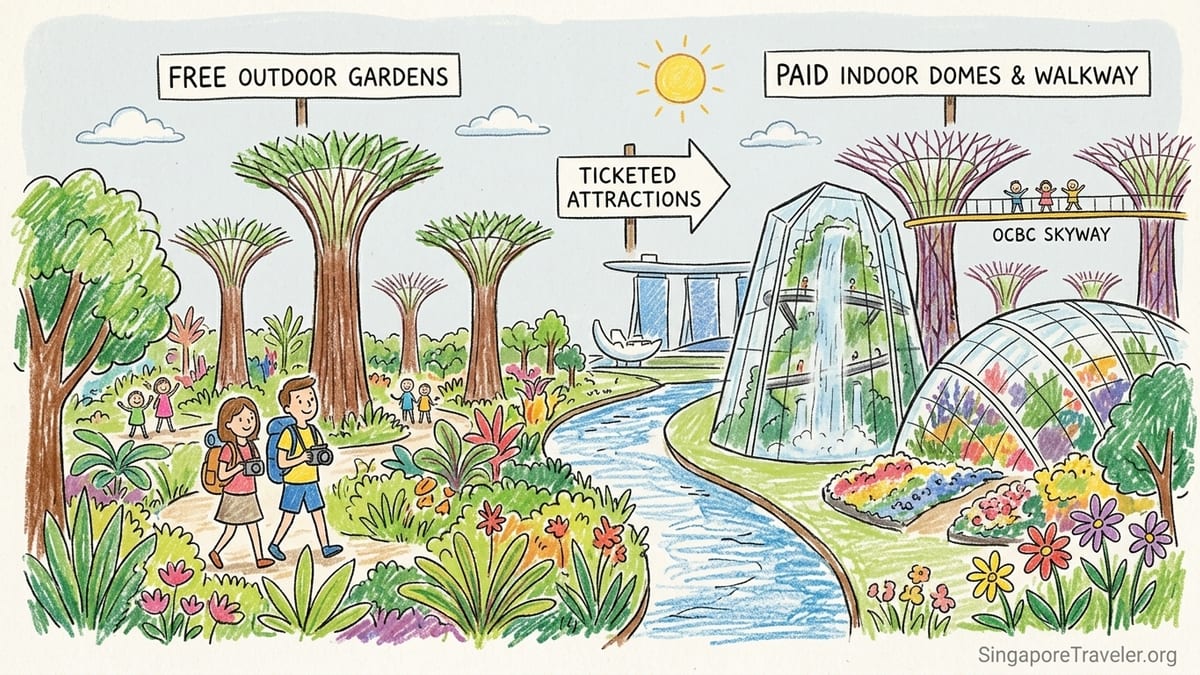
Free Gardens vs Ticketed Attractions: What Really Needs a Ticket
First, it helps to separate what is free from what is paid. The outdoor gardens that many visitors picture when they think of Gardens by the Bay do not require any ticket at all. You can walk into Bay South Garden, wander the Supertree Grove at ground level, loop around Dragonfly and Kingfisher Lakes, explore the Heritage Gardens and World of Plants, and let children play at the Far East Organization Children’s Garden without paying an entry fee. For a traveler on a tight budget, it is entirely possible to spend several hours here and see the iconic Supertrees without ever showing a ticket.
The parts that do require tickets are the cooled indoor attractions and elevated viewpoints. As of late 2026, tickets are needed for Cloud Forest, Flower Dome, Floral Fantasy, the OCBC Skyway (the aerial walkway through the Supertree Grove) and the Supertree Observatory at the top of the tallest Supertree. These are all separate products, sometimes bundled together in packages, and their prices differ for Singapore residents and non-residents.
This split often surprises first-time visitors. For example, a couple might prebook a conservatory combo online, then realise on arrival that they could have watched the Garden Rhapsody light show, walked under the Supertrees and strolled through most of the grounds completely free. Understanding this distinction helps you decide which paid elements genuinely add value for you, rather than buying a bundle simply because it appears on a booking site.
In practice, many travelers mix the two: they spend an afternoon exploring the free outdoor zones, then schedule one or two paid attractions around sunset and stay for the free nighttime show. The rest of this guide is built around that kind of real-world itinerary.
Current Ticket Types and 2026 Prices: Residents vs Visitors
The single most common ticket for non-residents in 2026 is the combined Flower Dome + Cloud Forest conservatory ticket. The official site currently lists this at about S$46 for a standard non-resident adult and around S$32 for a non-resident child aged three to twelve. This combination is important because non-residents generally cannot buy Cloud Forest by itself; if you want to step inside Singapore’s famous indoor waterfall, you are effectively buying both domes together.
Singapore residents pay less for the same double-conservatory product. Typical current rates are in the region of S$34 for an adult, with reduced prices for children and seniors. Residents also have access to options that tourists do not, such as a single-conservatory ticket for Flower Dome only at a significantly lower price than the full combo. Proof of residency is required at purchase or entry, so visitors on short-term stays should always look at the non-resident column when checking prices on the official boards or ticket machines.
Floral Fantasy operates as a separate ticket. Recent figures place standard adult prices around S$20 and children around S$12, with occasional special event variants like the Disney-branded Garden of Wonder there in recent seasons. OCBC Skyway and Supertree Observatory are priced independently again, each usually under the cost of a single conservatory visit, but they add up when a family of four buys them on top of a double-conservatory ticket.
Because promotions, partner packages and temporary exhibitions change regularly, travelers should treat numbers as ballpark. A realistic budget calculation for a non-resident family of four in late 2026 might look like this: S$46 per adult and S$32 per child for the double conservatories, plus roughly S$20 per adult and S$12 per child for Floral Fantasy if they add it, and around S$10 to S$16 per person each for the OCBC Skyway and Supertree Observatory. That means a “do everything” afternoon can easily exceed S$300. Knowing those rough totals helps you decide which experiences justify the cost.
Cloud Forest vs Flower Dome: The Big Decision
The heart of most ticket decisions is the choice between Cloud Forest and Flower Dome, or whether you truly need both. Cloud Forest is the showstopper: a tall, misty glass mountain covered in orchids and ferns, wrapped by elevated walkways and anchored by a dramatic indoor waterfall. Themed exhibitions rotate through the upper levels, and in recent years this has included film tie-ins and special installations. For many visitors, Cloud Forest is the single most memorable part of Gardens by the Bay.
Flower Dome is different in feel. It is wider and lower, recreating mild Mediterranean and semi-arid climates with olive trees, baobabs, succulents and seasonal flower displays. A visitor in December might find a Christmas-themed floral show, while someone visiting in March could see tulips or cherry blossom-inspired arrangements. It is calmer, brighter and more conventional, like an extremely polished botanic conservatory with changing displays and photo spots.
Because non-residents cannot usually buy Cloud Forest alone, the Cloud Forest vs Flower Dome dilemma is really a question of whether you want to pay for both or skip the domes entirely. If you have to choose only one in terms of time and energy, most travelers find Cloud Forest more unique compared with other gardens worldwide. For example, a couple from Amsterdam who already spend time in the Keukenhof tulip fields and large European glasshouses may feel Flower Dome’s Mediterranean plantings are familiar, while Cloud Forest’s vertical mountain and cool mist feel truly different. On the other hand, a family who loves seasonal floral displays, topiary and themed sets might appreciate the Flower Dome’s changing exhibitions just as much.
One practical approach is to buy the standard double-conservatory ticket, then mentally treat Cloud Forest as your “must see” and Flower Dome as a bonus if time and energy allow. Many visitors enter Cloud Forest first, spend 60 to 90 minutes there, and then decide whether to walk through Flower Dome more quickly or linger longer based on how everyone is feeling. With the cool air and multiple levels, it is particularly helpful for travelers visiting in Singapore’s mid-afternoon heat.
Floral Fantasy, OCBC Skyway and Supertree Observatory: Nice-to-Haves or Essentials
Beyond the main domes, the other ticketed attractions are best thought of as add-ons. Floral Fantasy is a compact indoor walkthrough of artistic floral displays, hanging arrangements and a short 4D ride. It is highly curated and photogenic, popular with couples and visitors who enjoy staged backdrops for portraits. However, the experience is relatively short compared with the conservatories. Many reviews describe spending 30 to 45 minutes inside, making it a pleasant but not essential extra for first-timers watching their budget.
The OCBC Skyway takes you onto a narrow, open-air bridge that links the Supertrees about 22 metres above the ground. From here you get horizontal views across the Supertree Grove, Marina Bay Sands and the central business district. It is an excellent perspective for photographers, but weather-sensitive: in heavy rain or lightning it may close temporarily, and even in normal conditions it can feel hot and crowded in the late afternoon. Visitors with a fear of heights sometimes find the see-through floor sections and the gentle sway uncomfortable.
The Supertree Observatory sits at the top of the tallest Supertree, higher than the Skyway, and offers a viewing deck with an indoor gallery. For someone determined to capture a sunset panorama over Marina Bay without paying for a hotel rooftop bar, this can be appealing. In practice, though, many travelers find that the free ground-level view of the Supertrees during Garden Rhapsody, plus city skyline vistas from elsewhere in Singapore, already satisfy their need for iconic photos.
For a first visit, it is reasonable to focus your ticket spend on the conservatories and treat Floral Fantasy, OCBC Skyway and Supertree Observatory as optional based on your interests. For example, a solo photographer might skip Floral Fantasy and the Observatory, buy the Cloud Forest + Flower Dome ticket and OCBC Skyway, and plan one golden-hour session up on the walkway. A family with young children might instead buy Floral Fantasy for its whimsical displays and 4D ride, plus the conservatories, and stay on the ground for the light show to avoid managing kids on heights.
Planning Your Visit Around Garden Rhapsody
Garden Rhapsody, the nightly Supertree light and sound show, is one of the best-value experiences in Singapore because it is free. As of 2026 it usually runs twice each evening, commonly around 7.45 pm and 8.45 pm, with music and lights synchronized across the entire Supertree Grove. You simply find a spot on the ground, often lying down on the central paved area to look up, and watch the Supertrees glow and change color above you.
A good tactic is to time your paid attractions so you finish the indoor experiences before the first show and can enjoy the transition from day to night. For example, a non-resident couple arriving at Bayfront MRT around 3 pm could first walk through parts of the free outdoor gardens, enter Cloud Forest at about 4 pm, leave by 5.30 pm, take a short break or quick look through Flower Dome until around 6.30 pm, then head toward the Supertree Grove to find a spot for the 7.45 pm Garden Rhapsody. This schedule avoids the hottest part of the day outdoors and places you back in the open air as the Supertrees light up.
Families with younger children often prefer an earlier start. One realistic plan for a family of four might be to arrive just after lunch, around 1 pm, explore the Children’s Garden and some of the lakes, have an early snack, then enter the conservatories between 3 pm and 4 pm. Leaving the domes no later than 6.30 pm gives enough time for a restroom break, finding a viewing place and settling children before the first show starts. Because the light show is popular, arriving ten to fifteen minutes early generally makes the experience more relaxed.
It is also possible to reverse the pattern and visit the conservatories in the evening. Both Cloud Forest and Flower Dome usually admit last entries around 8 pm, so an urban photographer might choose to shoot the city skyline at sunset from elsewhere, have dinner nearby, then enter Cloud Forest around 7 pm for cooler, thinner crowds, exiting in time to catch the 8.45 pm Garden Rhapsody. Whichever way you choose, building the free show into your ticketed schedule maximises value without adding cost.
Maintenance Closures, Capacity and Weather: How to Avoid Disappointment
The conservatories and elevated walkways undergo regular maintenance. On some days one dome, the Skyway or the Observatory may be closed either for scheduled works or for short-notice safety reasons such as thunderstorms. The Gardens publish maintenance dates and advisories on their official information channels, and these can change month to month. Before committing to a specific combination ticket, it is worth checking which attractions are open on your intended date.
Realistically, closures can impact your planning. If Cloud Forest is scheduled to close on a Tuesday during your stay, it makes sense to shift your Gardens visit to another day if Cloud Forest is the main reason you are going. On the other hand, if the OCBC Skyway is temporarily closed for weather when you arrive, it may reopen later the same evening. Staff on the ground are accustomed to these questions, so asking at a ticket counter or guest services can save you from buying an add-on ticket at a time when the attraction is unlikely to open.
Capacity and weather also affect the experience, even when everything is technically open. The domes are popular in mid-afternoon heat, and tour groups often arrive in waves. A traveler who wants quieter photos might choose to enter Cloud Forest soon after opening, or in the early evening, instead of at 3 pm on a Saturday. The Skyway, in particular, can feel congested when groups stop to take photos on a narrow section of the bridge; if you are sensitive to crowds or heights, consider visiting earlier in the day or on a weekday.
Singapore’s tropical climate means sudden rain showers are common. Fortunately, Cloud Forest, Flower Dome and Floral Fantasy are all under glass, so your ticket spend is weather-resilient. The free outdoor areas, the OCBC Skyway and the Garden Rhapsody show are more exposed; heavy rain does not always cancel Garden Rhapsody, but it can make it less comfortable. Packing a light rain jacket and being flexible about the exact evening you choose to see the show helps.
Do You Really Need Every Paid Attraction
Given the number of tickets on offer, it is worth asking honestly which ones you need, especially as prices have inched upward over the years. For a first-time non-resident who wants the signature experience but also needs to stretch their budget, the most efficient choice is usually the Flower Dome + Cloud Forest combo, timed to overlap with Garden Rhapsody. This delivers the iconic indoor waterfall, the cool glasshouse experience and the free nighttime show without paying for every possible add-on.
Floral Fantasy is easiest to justify for travelers who particularly enjoy artistic floral design and Instagram-friendly spaces. For instance, a pair of friends on a city-break focused on photography and social media content may gladly add S$20 each for Floral Fantasy, knowing they will spend their visit taking staged portraits among hanging blooms and themed backdrops. A couple backpacking across Southeast Asia on a strict daily budget might decide that the same money is better spent on meals or public transport and enjoy the many free outdoor flower beds instead.
OCBC Skyway and Supertree Observatory are more about viewpoint than content. If your itinerary already includes skyline views from places like Marina Bay Sands, cable cars to Mount Faber or rooftop bars, you may find that one Supertree viewpoint is enough or even unnecessary. On the other hand, visitors who have limited time elsewhere in the city might find a single ticket to the Skyway a convenient way to tick both “Supertree close-up” and “city panorama” off their list in one go.
Residents, who enjoy lower prices and more flexible ticket options, can spread attractions across multiple visits. A Singaporean family might visit the free gardens and Cloud Forest during a school holiday promotion, then return on another weekend solely for Floral Fantasy when a temporary exhibition appeals. Short-stay visitors do not have that luxury, so it is sensible to identify the one or two experiences that matter most, book those, and treat everything else as optional rather than mandatory.
How and Where to Buy Tickets Without Overpaying
There are three main ways travelers typically buy Gardens by the Bay tickets: directly from the official ticketing system, via third-party travel platforms, or at on-site ticket counters. Buying direct gives you the clearest picture of current official prices, resident versus non-resident rates and maintenance closures. The booking interface usually lets you choose specific entry times, which can be useful when building your day around Garden Rhapsody.
Third-party platforms sometimes advertise small discounts, bundle Gardens by the Bay with other Singapore attractions, or allow payment methods that might not work smoothly on the official system for some foreign cards. For example, a traveler whose credit card fails on the official site may find their payment processes fine through a global ticketing marketplace. The trade-off is that third-party listings can lag behind when promotions or show-specific tie-ins change, and they may not always highlight maintenance closures as clearly.
Buying on site is the most flexible option but not always the cheapest. Walk-up counters or ticket machines near the entrance to the domes and Floral Fantasy sell same-day tickets, subject to availability, at the posted prices. This can work well if you only decide on the day whether the weather, your energy levels and the crowd feel justify paying for indoor attractions. The downside is the risk of popular entry slots being sold out during peak seasons, especially for specific timed experiences.
Whichever route you choose, the most important habit is to check the latest official information shortly before you commit. Prices, packages and special exhibitions are adjusted from time to time, and while the baseline figures in this guide reflect 2026 conditions, you should treat them as guides rather than fixed guarantees.
The Takeaway
Gardens by the Bay rewards both budget-conscious travelers and those willing to pay for its indoor showpieces. Understanding that the bulk of the outdoor gardens, including the Supertree Grove at ground level and the Garden Rhapsody light show, are free allows you to allocate your ticket budget where it matters most. For most first-time non-resident visitors in 2026, that means choosing the Cloud Forest and Flower Dome combo and timing it around sunset and the evening show.
From there, everything else is optional. Floral Fantasy adds a short, highly curated floral experience, while OCBC Skyway and Supertree Observatory offer elevated views. Residents benefit from lower prices and more flexible products, making repeat visits realistic. Non-residents, facing higher headline prices, do best when they pick one or two core experiences, check for maintenance closures, and avoid paying for add-ons they are unlikely to fully enjoy.
With a bit of planning, you can move from the cool mist of Cloud Forest to warm twilight in the Supertree Grove and end your evening under a canopy of shifting light and music, all in a single, well-timed visit. The key is to decide what genuinely matters to you before you buy, rely on up-to-date official information for final prices, and remember that some of the Gardens’ best moments still cost nothing at all.
FAQ
Q1. Is there an entrance fee for Gardens by the Bay itself?
Most of Gardens by the Bay is free to enter, including the outdoor Bay South Garden, Supertree Grove at ground level, lakes and many themed gardens. You only pay for specific indoor attractions and elevated viewpoints like Cloud Forest, Flower Dome, Floral Fantasy, OCBC Skyway and the Supertree Observatory.
Q2. How much does the Cloud Forest + Flower Dome ticket cost for non-residents in 2026?
The standard non-resident double-conservatory ticket is currently listed at about S$46 for an adult and around S$32 for a child, though prices and promotions can change. Always check the latest official rates before you buy.
Q3. Can I visit Cloud Forest without buying a Flower Dome ticket?
For most non-residents, Cloud Forest is sold only as part of the combined ticket with Flower Dome. Singapore residents sometimes have access to single-conservatory options, but tourists should plan on buying the combo if they want to see Cloud Forest.
Q4. Do I really need to see both Cloud Forest and Flower Dome?
No, you do not strictly need both. Many visitors consider Cloud Forest the more unique experience, while Flower Dome is an elegant but more traditional glasshouse. If you are short on time or money, prioritise Cloud Forest and treat Flower Dome as a bonus rather than a requirement.
Q5. What is Floral Fantasy and is it worth the extra cost?
Floral Fantasy is a smaller indoor attraction with artistic floral installations and a short 4D ride. It is highly photogenic and popular with visitors who enjoy curated backdrops, but the visit is relatively short. It can be worth the extra ticket if you value that style of experience, but it is not essential for everyone.
Q6. What is the difference between OCBC Skyway and Supertree Observatory?
OCBC Skyway is an open-air walkway connecting Supertrees, giving side-on views of the grove and the city. Supertree Observatory is a higher viewing deck at the top of the tallest Supertree, with indoor space and a more elevated panorama. Both require separate tickets and are more about views than gardens.
Q7. When are the Garden Rhapsody light shows and do I need a ticket?
Garden Rhapsody usually runs twice nightly, often around 7.45 pm and 8.45 pm, and it is free. You do not need any ticket to watch; just arrive a little early at the Supertree Grove to find a comfortable viewing spot on the ground.
Q8. How long should I allow to visit the conservatories?
Most visitors spend about 60 to 90 minutes in Cloud Forest and 45 to 75 minutes in Flower Dome, depending on interest and how many photos they take. Planning 2.5 to 3 hours for both domes gives you a relaxed pace without rushing.
Q9. Do ticket prices differ for Singapore residents and tourists?
Yes. Singapore residents usually pay lower prices and sometimes have access to products like single-conservatory tickets that are not sold to non-residents. Proof of residency is required, so tourists should always budget using the non-resident prices.
Q10. Should I buy tickets in advance or on the day?
Buying in advance secures your preferred time slots and may reveal promotions, but it locks in your plans. Buying on the day gives flexibility based on weather and energy levels but risks popular times selling out. A common compromise is to prebook the main double-conservatory ticket and decide on extras like OCBC Skyway or Floral Fantasy once you arrive.