


Singapore’s Changi Airport is one of the easiest airports in Asia for getting into the city, but choosing the right transport can still make a big difference to your first few hours on the ground. Whether you are heading for Marina Bay’s skyline hotels, the shophouses of Chinatown, Orchard Road malls, Bugis hostels or Sentosa’s resorts, this guide explains how to ride the MRT, hail a taxi or Grab, use airport buses and arrange hotel transfers from all four terminals.
Understanding Changi’s layout and where the MRT is
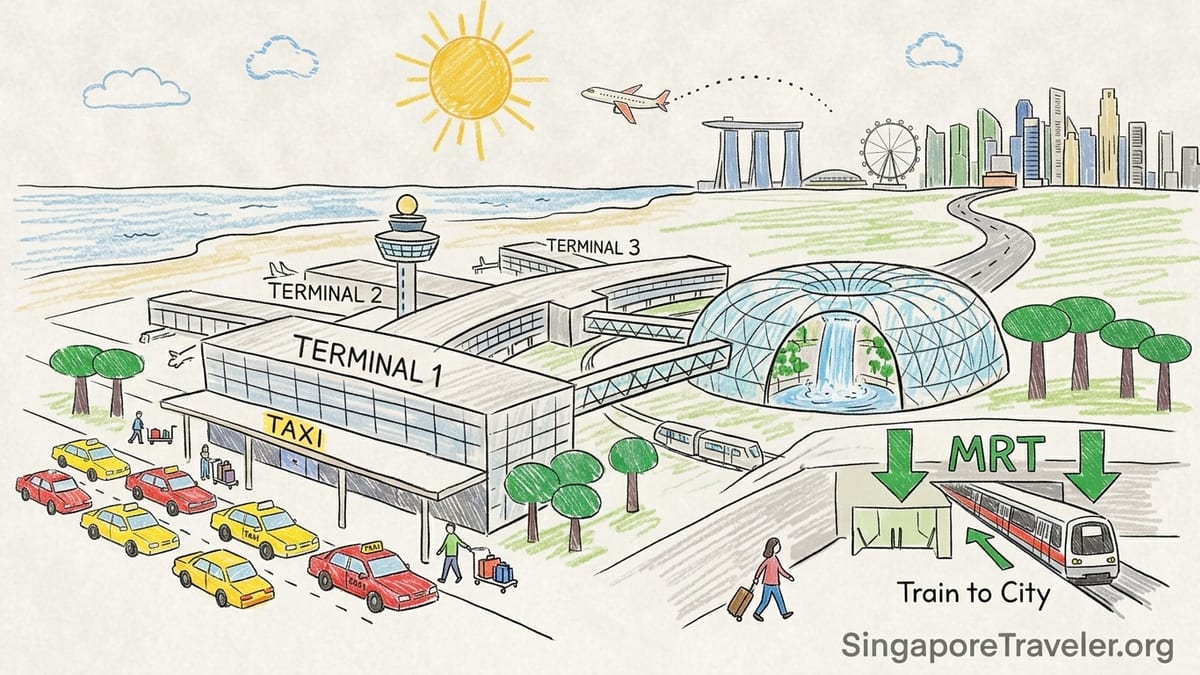
Changi Airport currently has four main terminals, plus the Jewel complex. The MRT station that connects the airport to the city sits between Terminals 2 and 3 on the East West Line’s airport branch, so these two terminals offer the most direct access to trains. From the arrivals hall in Terminal 2 or 3 you simply follow the green "Train to City" signs down to Changi Airport MRT station, passing money changers and information counters on the way.
If you arrive at Terminal 1, you do not have a dedicated MRT entrance in the same building. Instead, you cross into Terminal 3 using the free Skytrain or an indoor walkway, then continue to follow the MRT signs. The transfer usually takes about 10 minutes door to door, including waiting time for the Skytrain. For Terminal 4, which is physically separate from the main terminal cluster, you must first take the free shuttle bus to Terminal 2 or 3 and then walk to the MRT. Allow at least 20 to 30 minutes from T4 arrivals to the MRT gate if you are catching a specific train.
All terminals are well signposted in English, and the airport is fully air conditioned, so moving between terminals is straightforward even after a long flight. Families with strollers and travelers with mobility issues will find lifts at all key points, including between the terminal and the MRT concourse. If you are connecting through Jewel before going into town, look for the short indoor link bridges that lead from Jewel back into Terminals 1, 2 or 3, then continue to the MRT station.
Because the MRT is attached to Terminals 2 and 3, travelers landing there can realistically be on a train within 10 to 15 minutes of clearing immigration with light luggage. For passengers arriving at Terminal 1 or 4, expect slightly longer transfer times to the station but still within typical airport standards.
MRT from Changi to the city: how it works in practice
The MRT is often the most cost-effective way to reach the city centre. Changi Airport is served by the airport branch of the green East West Line. Trains from the airport run in a shuttle pattern: Changi Airport – Expo – Tanah Merah and back. At Tanah Merah you usually change to a mainline East West Line train toward the city. Journey time from the airport to the downtown area, such as City Hall or Raffles Place, is typically around 35 to 45 minutes including the transfer at Tanah Merah.
From Changi, most travelers heading to Marina Bay, Chinatown, Orchard and Bugis will stay on the East West Line until an interchange and then change lines if needed. For Marina Bay hotels near City Hall or Esplanade, you can ride directly from Tanah Merah to City Hall station and walk or take a short connection. For Chinatown, many visitors change from the East West Line to the North East Line or Downtown Line at Outram Park. To reach Orchard Road, change at City Hall or Raffles Place to the North South Line and continue to Orchard or Somerset stations. For Bugis, you ride directly to Bugis station with a cross-platform or short-connection change where necessary. Sentosa usually involves taking the MRT to HarbourFront on the North East Line or Circle Line, then transferring to the Sentosa Express monorail or walking across the Sentosa Boardwalk.
First and last train times matter, especially for long-haul arrivals. Scheduled first trains from the city side toward Changi typically arrive around 5.30 am on weekdays and slightly later on Sundays, while last departures from Changi that still connect into the city usually leave a little before midnight. Exact minutes vary by station and direction, and public holidays may see adjustments, so it is wise to confirm timings on the day using the MRT operator’s journey planner or the station information boards before relying on a late-night service.
For luggage, the MRT is manageable if you have one suitcase and a backpack per person. Trains are level with the platform, and there are lifts at Changi and at major interchange stations such as Tanah Merah, City Hall and Outram Park. However, the network can be crowded during the morning and evening peak periods. If you are arriving with multiple large suitcases, a stroller and tired children, it may still be technically possible to use the MRT, but a taxi or private transfer is often more comfortable.
Taxi from Changi: fastest door-to-door comfort
Metered taxis are available 24 hours a day at all Changi terminals. Taxi ranks are clearly signposted from arrivals and are sheltered from the weather. After picking up your bags, you simply follow the "Taxi" signs to the ground transport area, where marshals direct you to the next available cab. There is no need to pre-book a standard taxi for most arrivals, including late night flights, although queues can build after waves of long-haul landings.
Fares from Changi to central Singapore combine the standard distance-based metered fare with an airport surcharge. As of mid-2026, the typical Changi location surcharge is around 6 Singapore dollars during most periods, rising to around 8 Singapore dollars from late afternoon into the evening. On top of this, normal peak-hour or late-night surcharges may apply. In practical terms, travelers going from Changi to the City Hall or Marina Bay area can expect to pay in the region of 25 to 40 Singapore dollars in total, depending on traffic, time of day and the specific taxi company. Journeys to Chinatown, Bugis or Orchard generally fall in a similar band, while Sentosa can be slightly higher because of distance and resort traffic.
Travel time by taxi from Changi to the city centre is usually 20 to 30 minutes in light traffic. During weekday peak hours or heavy rain it can stretch closer to 40 minutes. The main advantage is door-to-door convenience with no line changes or walking in the heat. This is particularly helpful if you are staying at a hotel that is not directly above an MRT station, such as some smaller properties in Chinatown’s side streets or boutique hotels around Kampong Glam and Bugis.
For payment, Singapore taxis widely accept cash, major credit cards and contactless payment. Some companies charge a small fee for cashless transactions, which is added automatically to the final fare. Large families or groups with heavy luggage can request a larger vehicle type at the queue if available, though standard sedans can usually take two medium suitcases in the boot and a couple of cabin bags in the cabin. For four adults with four large suitcases, it is often more comfortable to split into two taxis or book a larger private hire car.
Grab and private hire cars: app-based flexibility
Ride-hailing apps such as Grab are widely used in Singapore and are a popular way to travel from Changi to the city. After collecting your luggage and clearing customs, you can connect to the airport’s free Wi-Fi, open the Grab app, and request a car to your terminal’s designated pick-up point. Each terminal has clearly signed "Private Hire Pick-up" areas, usually in the ground transport zone close to the taxi queue but separated from it, and the app shows you exactly where to meet your driver.
Prices on Grab vary with demand, time of day and any promotional discounts. At quieter times, a standard GrabCar from Changi to Marina Bay, Chinatown, Bugis or Orchard may be similar in cost to or slightly cheaper than a taxi. During busy evening periods or heavy rain, dynamic pricing can push the fare above what you would pay for a metered cab. One advantage of Grab is being able to see an estimated fare upfront in the app, so you can compare it with the expected taxi cost before choosing.
For Sentosa, Grab and other private hires can be very convenient, especially if you are staying at resorts that are a good walk from the monorail or beach tram. The car can take you directly to your hotel entrance, which saves transfers if you have children, beach gear or theme park shopping bags. However, do factor in any extra island admission arrangements that may apply and check whether your hotel has specific drop-off instructions for ride-hailing vehicles.
Private hire cars are generally comfortable and air conditioned, and drivers are used to handling airport runs. Families can book larger vehicle types in the app if they need more boot space. For late-night arrivals after the last MRT, Grab becomes one of the main alternatives to a taxi. Even around 1 or 2 am, you will usually find drivers operating, though waiting times can be longer than during the day and surge pricing can appear after major events or during weekend nightlife peaks.
Airport buses and hotel transfers
Public buses connect Changi Airport to various parts of Singapore, including routes that pass near the city centre. Buses operate from the basements of the main terminals, and signs in the arrivals halls point toward "Bus to City" stops. Fares are lower than taxis and Grab, and only slightly higher than taking the MRT, but journey times are generally longer because buses make frequent stops and are affected by road traffic.
In practical terms, buses can work for travelers staying near specific bus corridors, or for those arriving at times when the MRT is not yet convenient but who still prefer public transport. For example, an early-morning bus might bring you toward the Bugis or Orchard area while you watch the city wake up. However, handling luggage on crowded buses, dealing with stairs at certain stops and navigating from the bus stop to your hotel can be tiring after a long flight. For this reason, many first-time visitors and families choose MRT, taxi or Grab instead.
Some hotels and travel agencies offer pre-booked airport transfer services. These range from shared shuttle vans that drop passengers at a set list of downtown hotels, to private sedans and minibuses with meet-and-greet at arrivals. A typical shared shuttle might cost less per person than a taxi if two solo travelers are both staying in major hotel districts like Marina Bay or Orchard. Private transfers generally cost more than a standard taxi but offer fixed pricing, guaranteed vehicle type and a driver waiting with your name sign, which can be reassuring for nervous travelers or elderly guests.
When comparing a hotel transfer with a taxi or Grab, consider your arrival time, group size and how comfortable you are using apps. For midnight landings with older relatives or small children, having a pre-arranged driver can remove stress. For independent travelers arriving in the afternoon with light luggage, walking straight to the taxi queue or MRT is usually simpler and cheaper.
EZ-Link cards and Singapore Tourist Pass: paying for public transport
For those planning to ride the MRT or public buses, a stored-value card or tourist pass can save time and make transfers seamless. At Changi Airport MRT station, travelers can purchase EZ-Link cards and Singapore Tourist Passes from ticket counters, SimplyGo service centres and ticket machines. Recent traveler reports mention multiple vending machines at the station that sell standard EZ-Link cards with different designs, as well as dedicated machines for the Tourist Pass.
An EZ-Link card works like a rechargeable wallet that you tap in and out on MRT gates and bus card readers. You pay per trip, with fares deducted automatically. This is ideal if you are staying in Singapore for several days and plan a mix of airport transfers, short MRT hops between districts like Marina Bay, Chinatown and Bugis, and occasional bus rides. You top up the card using cash or bank cards at machines or station counters. Many residents and repeat visitors prefer EZ-Link because it is flexible and can be used over multiple trips to Singapore.
The Singapore Tourist Pass offers unlimited rides on the MRT and basic bus services for a fixed number of days, with prices that scale up for one, two, three or more days. It can be good value if you expect to ride public transport many times each day, for example if you are staying near Bugis and plan to visit Marina Bay, Chinatown, Orchard and Sentosa over a short visit. Because the Tourist Pass is available right at Changi’s MRT station, you can step off your flight, collect a pass and immediately use it to ride into town. The official pricing and validity rules can change, so it is sensible to confirm the latest details at the station machine before purchasing.
Travelers who prefer not to carry another card can also use contactless bank cards or mobile wallets directly on MRT gates and buses in Singapore. However, for families with children, having physical EZ-Link cards can make it easier to budget each person’s daily usage, and for visitors on a strict roaming plan it avoids the need to rely on mobile payments before you are fully set up on a local network.
Best options by area: Marina Bay, Chinatown, Orchard, Bugis and Sentosa
For Marina Bay, which includes big-name hotels such as Marina Bay Sands and a cluster of business hotels around City Hall and Raffles Place, both the MRT and taxis work well. If you land during daytime and travel light, taking the MRT from Changi to City Hall or Bayfront (with a line change) is cost effective and straightforward, with stations integrated into mall complexes. For late-night arrivals or if you are carrying multiple bags after a shopping-heavy trip, a taxi or Grab will take you directly to your hotel’s drop-off point.
Chinatown is well served by multiple MRT lines, and many budget and mid-range hotels sit within 5 to 10 minutes’ walk of Chinatown, Outram Park or Maxwell stations. A daytime MRT journey from Changi with a change at Outram Park is a good choice for solo travelers and couples. At night, when the streets are busier and humidity can be high, stepping straight from a taxi into your hotel’s small lobby might be more pleasant, especially if your property is tucked into one of the narrower streets uphill from the main road.
Orchard Road is essentially a long strip of shopping malls and hotels built around MRT stations such as Orchard, Somerset and Dhoby Ghaut. The MRT is an excellent choice here during its operating hours, since many hotels connect directly to station exits through underground walkways. An example is a traveler landing at 3 pm, clearing immigration by 4 pm and stepping into their Orchard hotel around 5 pm after a simple line change downtown. However, for families arriving in the evening with several suitcases, getting everyone and everything through crowded Orchard station concourses can be tiring, and a taxi up to the hotel driveway is often kinder.
Bugis and nearby Kampong Glam attract many younger travelers, with a mix of hostels, boutique hotels and mid-range chains. Bugis MRT station links directly to the East West Line, making it one of the simplest destinations to reach by train from Changi: you only need one interchange on most routings. For budget-focused solo travelers and couples, the MRT is usually the first choice. For late-night arrivals outside MRT hours, taxis and Grab remain affordable because Bugis is close to the city centre.
Sentosa, by contrast, generally calls for either a taxi, private hire or a combination of MRT and the Sentosa Express monorail. Reaching resorts such as those in Resorts World Sentosa or along Siloso Beach means either changing lines to reach HarbourFront MRT and then transferring to the monorail, or taking a car all the way to your hotel. Many families choose a taxi or Grab directly from Changi to avoid handling luggage across multiple transfers. For example, a family of four arriving midday might pay more for a taxi than for MRT plus monorail, but they save at least one line change and a crowded monorail ride with bags and children.
When to choose MRT, taxi, Grab or bus: by traveler type and arrival time
Solo travelers and couples with light luggage arriving between early morning and late evening are usually best served by the MRT. A typical example is a traveler landing from a regional flight at 2 pm, carrying one suitcase and a backpack. They can clear immigration, buy an EZ-Link card, and be on a train within 20 minutes. By the time they reach their hotel near Bugis or Chinatown, they will have spent relatively little and avoided traffic uncertainty. The walk from station to hotel is manageable with just one bag and offers an early glimpse of local streets.
Families with children, elderly travelers and groups with multiple large suitcases often find taxis or private hire cars more realistic, especially after a long-haul flight. A family of five arriving from Europe at 7 pm, with two large suitcases, three smaller bags and a stroller, will appreciate driving directly to a Marina Bay or Sentosa hotel in air-conditioned comfort. The extra cost over MRT is offset by reduced stress, no need to navigate escalators and lifts at transfer stations, and the ability to settle children into car seats or boosters if they have brought them.
For passengers arriving very late at night, after the last MRT connections have left Changi, the choice narrows to taxis, Grab and pre-booked hotel transfers. Around 1 or 2 am, the taxi queue may still be moving steadily thanks to overnight demand from flight crews and connecting passengers, but apps may show slightly longer waits for ride-hailing. Booking a private transfer ahead of time can be worthwhile if you know you will land around midnight with a full day of travel already behind you.
Budget travelers who land late at night sometimes choose to rest at the airport for a few hours, exploring Jewel Changi or using airport facilities, then take the first MRT into town in the early morning to save on transport costs. This can work well for solo visitors and backpackers heading to hostels in Bugis or Chinatown, especially if their accommodation offers check-in later in the morning.
The Takeaway
Getting from Changi Airport to Singapore’s city centre is straightforward, but the best option depends on your arrival time, luggage, budget and destination. The MRT is fast, frequent and inexpensive for most daytime arrivals, especially if you are heading to areas well served by stations such as Marina Bay, Chinatown, Orchard and Bugis. Taxis and Grab come into their own for late-night landings, heavy luggage, family groups and resorts that are a distance from the nearest MRT, including much of Sentosa.
Using real-world examples, many solo travelers and couples with one suitcase each will find that a combination of EZ-Link cards or a Singapore Tourist Pass and the MRT network gives them an affordable, efficient way to reach their hotel and continue exploring neighbourhoods like Bugis, Chinatown and Orchard over the next few days. Families with children or elderly relatives, and anyone arriving after the MRT shuts for the night, will usually be happier walking straight to the taxi rank or meeting a pre-booked driver.
Whichever option you choose, Changi’s clear signage, integrated MRT station and well-organised ground transport areas mean that you can move from baggage claim to your hotel with minimal confusion. With a little planning around terminal layout and train operating hours, you can match your ride to your needs and start your Singapore stay on a smooth note.
FAQ
Q1. What is the easiest way to get from Changi Airport to Marina Bay?
The MRT is convenient during the day, with a change to reach City Hall or Bayfront, but a taxi or Grab is usually easier with heavy luggage or late-night arrivals.
Q2. How long does the MRT take from Changi Airport to the city centre?
Including the change at Tanah Merah, most journeys to central stations like City Hall or Raffles Place take roughly 35 to 45 minutes, depending on waiting times.
Q3. Are there MRT stations at every Changi terminal?
No. The MRT station is between Terminals 2 and 3. From Terminal 1 you walk or use the Skytrain to Terminal 3, and from Terminal 4 you take a shuttle bus to Terminals 2 or 3 first.
Q4. Is a taxi from Changi much more expensive than the MRT?
Yes. A typical taxi ride to central areas like Marina Bay, Orchard or Bugis can cost several times more than an MRT ticket, but it offers faster, door-to-door comfort.
Q5. Can I use Grab from Changi Airport at any time of day?
Grab is generally available 24 hours, though cars may be less frequent and prices higher during late-night and peak-demand periods compared with daytime off-peak times.
Q6. What is the best option for families with young children and a lot of luggage?
A taxi, larger private hire car or pre-booked hotel transfer is usually best, so you can load bags easily, avoid transfers and go straight to your hotel entrance.
Q7. How do I buy an EZ-Link card or Singapore Tourist Pass at Changi?
You can purchase them at Changi Airport MRT station from ticket counters, SimplyGo service centres or ticket machines, then start using them immediately on MRT and buses.
Q8. Which transport is recommended for staying in Bugis or Chinatown on a budget?
For budget-conscious solo travelers and couples arriving during MRT hours, the MRT combined with an EZ-Link card or Tourist Pass is typically the best-value choice.
Q9. What should I do if my flight lands after the MRT stops running?
Use the airport taxi rank, book a Grab or rely on a pre-arranged hotel transfer. All three operate through the night and can take you straight to your accommodation.
Q10. Is taking the bus from Changi Airport to the city practical for visitors?
It is possible and very cheap, but buses are slower and less convenient with luggage. Most visitors find the MRT, taxis or Grab more comfortable and straightforward.