


Singapore looks compact on the map, but the city can quickly overwhelm first-time visitors who try to squeeze in every skyline view, beach, food market and wildlife park. This guide focuses on the core experiences that define modern Singapore and shows you how to group them into workable days, with realistic time estimates, who each area suits best and which nearby sights to combine so you are exploring, not criss-crossing the island on public transport.
Planning Your Singapore Days by Area, Not by Checklist
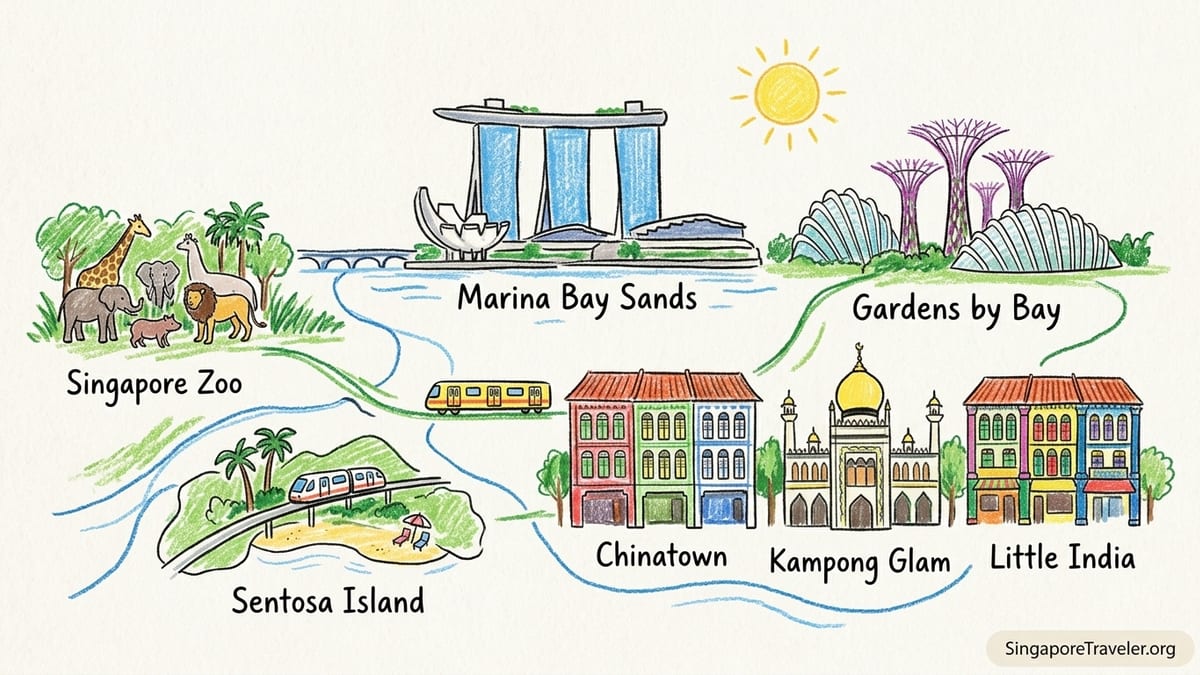
Singapore’s biggest trap for first-timers is treating every attraction as a separate mission. The city is small, but humidity, crowds and travel time mean that four or five big-ticket sights in one day is rarely enjoyable. A better approach is to cluster your time around a few key hubs: Marina Bay and the Civic District, Gardens by the Bay and the southern waterfront, Sentosa Island, Mandai’s wildlife parks in the north, and the inner-city heritage neighborhoods of Chinatown, Kampong Glam and Little India.
Public transport is efficient, particularly the MRT. Marina Bay and Chinatown are linked by the Downtown Line, while HarbourFront MRT, at the edge of Sentosa, connects easily to the rest of the network. Mandai’s wildlife parks, including Singapore Zoo, Night Safari, River Wonders and the newer Rainforest Wild Asia, sit in the north and are best treated as a half or full day rather than an add-on. Taxis and ride-hailing cars are abundant, but costs add up if you zigzag between distant districts.
For most first-time visitors with three to five days, a workable framework is one day around Marina Bay and Gardens by the Bay, one day split between Chinatown and Kampong Glam or Little India, one full or almost full day on Sentosa, and one long afternoon and evening in Mandai. You can then add flexible time for museums, the Singapore Botanic Gardens and extra food explorations depending on your interests and the weather.
This article walks through each major experience zone, explains how much time you realistically need, whether to pre-book, who each area suits and how to combine nearby experiences into smooth, low-stress days instead of a frantic box-ticking sprint.
Marina Bay & Gardens by the Bay: The Iconic Skyline
Marina Bay is the postcard view most visitors imagine: the lotus-shaped ArtScience Museum, the durian-like Esplanade theatres, and the triple towers of Marina Bay Sands. You can comfortably cover the bayfront promenade, Merlion Park and basic skyline photos in two to three hours, but to include indoor attractions like the ArtScience Museum and the observation deck at Marina Bay Sands you should commit at least half a day. The area sits on the eastern end of the downtown core, served by Bayfront and Marina Bay MRT stations.
Gardens by the Bay, directly behind Marina Bay Sands, deserves more time than many itineraries allow. The outdoor waterfront gardens are free and open from early morning to late night. The paid conservatories, Flower Dome and Cloud Forest, are climate-controlled glasshouses that typically take 60 to 90 minutes each at an unhurried pace. Combination tickets are widely sold and, for non-residents, the standard pairing of Flower Dome plus Cloud Forest costs in the ballpark of mid-double digits Singapore dollars per adult, so it is worth planning a dedicated visit rather than rushing through. Tickets can be bought on the spot, but buying online for a specific date is advisable in peak periods or holiday seasons.
A classic first-timer day is to arrive at Gardens by the Bay late afternoon when the heat softens, visit at least one conservatory, then stay for the Supertree Grove light show after dark and walk back through Marina Bay to see the skyline illuminated. Couples and photographers often linger to catch twilight reflections on the water, while families may prefer to visit the Children’s Garden earlier in the day. Those keen on observation decks can add the Marina Bay Sands SkyPark or the rooftop bars in the area, keeping in mind that sunset slots can be busy and may require advance reservations.
Marina Bay and Gardens by the Bay pair naturally with the nearby Civic District museums, such as the National Gallery or Asian Civilisations Museum, for culture-focused travelers. If you have only three days in the city, a strong strategy is to devote a single day to Marina Bay, Gardens by the Bay and one museum, using the evening for the Supertree light show and a bayfront stroll, rather than splitting these experiences across multiple days.
Sentosa & Universal Studios: Beaches, Rides and Resorts
Sentosa Island sits just off Singapore’s southern coast, connected to the mainland by road, monorail and a pedestrian boardwalk from HarbourFront. For most first-time visitors, Sentosa is a full-day commitment, especially if you are including Universal Studios Singapore. From central areas like Orchard Road or Bugis, expect 25 to 40 minutes on the MRT to reach HarbourFront, then another 10 to 20 minutes to transfer to the Sentosa Express monorail or walk across the boardwalk.
Universal Studios Singapore is compact compared with its US counterparts, but queues for headline rides and new areas such as Minion Land mean you should allocate at least six to eight hours if you want a broad sampling of attractions, shows and character encounters. Buying date-specific tickets in advance is strongly recommended for weekends, school holidays and public holidays; same-day tickets are usually available on quieter weekdays. Families with young children and theme park fans will get the most from a full park day, while casual visitors might plan a shorter stay and spend more time at the beaches or the S.E.A. Aquarium.
Beyond the theme park, Sentosa offers sandy beaches at Siloso, Palawan and Tanjong, waterfront dining at Quayside Isle and an assortment of attractions like cable cars, luge rides and observation points. It is easy to over-schedule when every activity sells a ticket, so first-timers should choose one main focus. For example, pair a half day at Universal Studios with a relaxed late afternoon at Siloso Beach, or dedicate a non-park day to the aquarium, cable car and a beach sunset. Attempting to do Universal Studios, multiple adventure attractions and a long beach session in one day often leads to fatigue in Singapore’s heat.
Sentosa combines well with hawker dining on the mainland before or after your visit. For example, travelers often grab an early dinner at nearby hawker centers such as Seah Im Food Centre near HarbourFront, where local plates like chicken rice or fried noodles typically cost a handful of Singapore dollars, rather than paying resort prices on the island. This approach keeps costs manageable and lets you experience relaxed, everyday dining alongside the resort-style environment of Sentosa.
Mandai Wildlife Parks: Planning a Nature-Focused Day
The Mandai Wildlife Reserve in Singapore’s north is home to several major wildlife attractions: Singapore Zoo, River Wonders, Night Safari, Bird Paradise and the newer Rainforest Wild Asia. The area is green and relatively remote compared with central neighborhoods. Reaching Mandai from downtown by taxi usually takes 25 to 40 minutes depending on traffic, while public transport involves an MRT ride followed by a connecting bus or shuttle. Because of the travel time, it makes sense to cluster multiple wildlife parks into the same day if you enjoy animal encounters.
For most first-time visitors with children, a strong plan is to spend a full daytime session at Singapore Zoo or a combination of Singapore Zoo plus River Wonders, break for an early dinner, then continue with Night Safari in the evening. Each major park can easily absorb three to four hours at a moderate pace, especially if you attend feeding sessions or animal presentations. Trying to do more than two parks in the daytime before Night Safari is technically possible but can be exhausting in the heat, particularly with younger kids or older travelers.
Singapore Zoo, River Wonders and Rainforest Wild Asia are primarily daytime attractions, generally operating from morning until late afternoon or early evening. Night Safari opens after dark and is built around a tram ride with optional walking trails. Bird Paradise focuses on aviaries and shows, also in a daytime window. Tickets are sold as single-park or multi-park bundles, and buying online in advance for a chosen date gives you better control over timing, especially for Night Safari time slots which can sell out during peak seasons. Many visitors report that leaving the city by mid-morning, doing Singapore Zoo, taking a rest and dinner break in the Mandai dining areas, then starting Night Safari’s first or second tram session works well.
Mandai is best suited to families, nature lovers and travelers who appreciate conservation-focused attractions. If you have only three full days in Singapore and are not particularly interested in zoos, you might instead prioritize neighborhoods and museums. However, for those staying four nights or more, Mandai can provide a refreshing change from malls and skyscrapers. It does not pair naturally with other city attractions in the same day given the location, so treat it as one long, self-contained excursion.
Heritage Neighborhoods: Chinatown, Kampong Glam & Little India
Singapore’s historic inner-city neighborhoods sit within a short MRT or taxi ride of one another, yet each has a distinct atmosphere. Chinatown, on the south side of the Singapore River, mixes shophouses, temples, hip cafes and tourist markets. Kampong Glam, anchored by the golden-domed Sultan Mosque, is the historic Malay-Arab quarter packed with textile shops and Middle Eastern eateries. Little India, centered on Serangoon Road, bursts with colorful temples, spice shops and South Indian restaurants. Each district deserves at least half a day including meals and a bit of aimless wandering.
Chinatown pairs naturally with either Marina Bay or the nearby business district. You might spend a morning visiting Chinatown’s major temples and heritage streets, have lunch at a hawker center such as Maxwell Food Centre, then walk or ride the MRT to Marina Bay for afternoon and evening skyline views. Kampong Glam, reached via Bugis MRT, can anchor another half day focused on street art, boutiques and Middle Eastern or Malay dishes, combined with the nearby Bras Basah and Bugis museum belt for travelers interested in design and history.
Little India works especially well in the late afternoon and evening when streets fill with shoppers and the aroma of spices and incense intensifies. A typical visit might include the Sri Veeramakaliamman Temple, a stroll through the 24-hour Mustafa Centre for its maze-like aisles, and a South Indian or North Indian meal at one of the many vegetarian and non-vegetarian restaurants clustered around the main roads. Expect to spend three to four hours to feel the neighborhood rather than rushing in for a single temple photo and leaving.
First-time visitors often underestimate how much energy these neighborhoods can absorb, particularly in tropical humidity. If you are coming straight from an air-conditioned mall or hotel, plan for slower walking speeds and frequent drink breaks. Heritage districts are ideal for travelers interested in culture, architecture and food, and they rarely require advance booking beyond perhaps a guided walking tour or a timed entry for a specific museum or mosque. They also provide some of the best low-cost food in the city, making them ideal to combine with higher-priced attractions elsewhere.
Singapore Botanic Gardens & Urban Nature Experiences
The Singapore Botanic Gardens sit slightly inland from Orchard Road and are easily reached by MRT. This UNESCO-listed tropical garden is free to enter and best enjoyed in the early morning or late afternoon to avoid midday heat. A basic loop around the main lawns and lakes can take 60 to 90 minutes, but plant enthusiasts and photographers often linger for three hours or more, especially if they add the paid National Orchid Garden, which itself warrants an additional hour.
Because the Botanic Gardens are large, it helps to choose one or two zones rather than trying to cover every section on a first visit. Families often gravitate to the Jacob Ballas Children’s Garden, while others prioritize the Rain Forest and Ginger Garden areas. The gardens are well suited to travelers seeking a slower, more contemplative break from the city: think shaded paths, bird calls and locals walking dogs or practicing tai chi. No advance booking is required for general entry, though occasional special events or performances may use ticketing.
Beyond the Botanic Gardens, Singapore offers several other accessible nature experiences that first-timers can fit into a city-heavy itinerary. Elevated walkways such as the Southern Ridges link parks and offer views over the harbor and greenery without leaving the urban area. Coastal boardwalks at places like East Coast Park provide a look at everyday local recreation, with cyclists, skaters and families barbecuing along the waterfront. These outings are flexible by design; you can tailor them to an hour’s stroll or a half-day exploration depending on energy levels and weather.
A practical way to schedule nature into a compact trip is to pair the Botanic Gardens with Orchard Road shopping, since the MRT makes the jump between them quick, or to set aside a morning for the gardens and an afternoon for museums. Travelers who prioritize nature might choose to combine the gardens with an evening at the Mandai wildlife parks on separate days, balancing manicured urban greenery with immersive wildlife experiences.
Hawker Food, Cafes & Everyday Eating
Hawker centers are covered food courts filled with individual stalls selling everything from Hainanese chicken rice and laksa to Western grills and bubble tea. For visitors, they are both a cultural experience and a very practical way to keep meal costs under control. Recent guides and local reporting suggest that a typical hawker meal now runs in the rough range of three to six Singapore dollars for a basic dish, with some popular or seafood-heavy plates costing more. Drinks such as iced tea or kopi are usually a couple of dollars or less.
Well-known hawker centers like Maxwell in Chinatown or Lau Pa Sat in the business district offer convenient access to classic dishes, though prices at major tourist hubs or newly renovated centers can creep slightly higher. At places near the city center, you might pay around five to seven dollars for a plate of chicken rice, char kway teow or nasi lemak. Still, for a couple used to restaurant pricing elsewhere, it is entirely possible to eat two filling plates and share a side of satay for less than the cost of a single main course at a mid-range sit-down restaurant in many global cities.
The everyday etiquette is straightforward but unfamiliar to some travelers. You order and pay directly at the stall, often in cash or stored-value card, then wait nearby until your number or dish is ready. Locals “chope” or reserve seats by placing a packet of tissues or a small personal item on the table; as a visitor, you can adopt the practice or simply have one person secure a table while another orders. Queues are a useful signal of quality, and at popular stalls it is not unusual to wait 10 to 20 minutes at peak meal times.
To integrate hawker food naturally into your sightseeing days, plan specific centers near your chosen attractions. For example, combine Maxwell Food Centre with a Chinatown walking tour, Tekka Centre with Little India, or a neighborhood hawker near Bugis with Kampong Glam. Hawker centers are ideal for mixed groups or families because each person can pick a different cuisine without needing separate restaurants. They are also a good fallback on days when rain disrupts outdoor plans, since many are partially enclosed yet still feel distinctly local.
Museums & Culture: When to Go Indoors
Singapore’s museums provide both cultural depth and valuable air-conditioned breaks from the heat. The main cluster around the Civic District and Bras Basah includes the National Museum of Singapore, National Gallery, Asian Civilisations Museum and several smaller institutions focusing on art, design and history. Many first-time visitors under-allocate time for these spaces; even a focused visit to one major museum usually requires two to three hours, not including time for a cafe stop or gift shop browsing.
Museums generally do not require advance booking for standard visits, though special exhibitions or timed-entry events may use online reservations. Admission fees vary, with discounts often available for children, students and seniors. For travelers who enjoy context, starting a trip with the National Museum or Asian Civilisations Museum can provide a helpful framework for understanding the multicultural neighborhoods you will explore later, including Chinatown, Kampong Glam and Little India.
Practically, museums are best slotted into the hottest parts of the day or used as rainy-weather insurance. A strong pairing, for example, is to spend a humid afternoon at the National Gallery or a similar institution, then emerge in the early evening for a walk along the Singapore River toward Clarke Quay or Boat Quay. Culture-focused travelers might dedicate an entire day to the museum belt and adjacent heritage districts, while those on shorter stays can choose a single anchor museum and combine it with Marina Bay or Kampong Glam.
Museums also suit a wide range of travelers: families can take advantage of children’s galleries and interactive displays, couples and solo travelers can linger in quiet galleries, and multi-generational groups often appreciate the seating and climate control. In a city known for shopping and skyscrapers, these institutions round out the picture with stories of migration, colonial history and contemporary creativity.
The Takeaway
Singapore rewards travelers who think in clusters rather than checklists. By grouping Marina Bay with Gardens by the Bay, keeping Mandai’s wildlife parks to a dedicated day, and pairing heritage neighborhoods with nearby hawker centers, you turn a dense attraction map into a comfortable, coherent trip. Realistic timing is crucial: most signature experiences, from Universal Studios to a single major museum, deserve several focused hours rather than quick drive-bys.
For a first visit of three to five days, prioritizing Marina Bay and Gardens by the Bay, at least one heritage neighborhood, a full or partial day on Sentosa, and time in the Mandai wildlife parks or Botanic Gardens will give you a rounded sense of the city. From there, you can add specialized interests like design museums, shopping streets or additional nature walks. Leave room in your schedule to sit with a bowl of laksa in a hawker center, watch the evening crowds flow past a temple, or linger by the waterfront after dark. Those unscheduled pockets often become the memories that stay with you long after the skyline photos fade.
FAQ
Q1. How many days do I need in Singapore for a first visit?
Most first-time visitors are well served by three to five full days, which allows time for Marina Bay and Gardens by the Bay, at least one heritage neighborhood, a full or partial day on Sentosa and either the Mandai wildlife parks or the Botanic Gardens, without rushing every stop.
Q2. Do I really need to pre-book tickets for Gardens by the Bay and the Mandai wildlife parks?
Booking online in advance is strongly recommended during weekends, school holidays and peak tourist seasons, especially for Night Safari time slots and the conservatory combo tickets at Gardens by the Bay, though on quieter weekdays same-day purchases are usually possible.
Q3. Is Universal Studios Singapore worth it for adults without children?
Universal Studios Singapore can still be enjoyable for adults who like rides and themed environments, particularly if you visit on a quieter weekday and focus on major attractions, but if you are indifferent to theme parks you may prefer to spend that full day on heritage neighborhoods, museums or additional nature experiences.
Q4. How much should I budget for meals at hawker centers?
As a broad guideline, plan on roughly three to six Singapore dollars for a basic hawker dish and a few dollars more for drinks or premium items, so a filling meal per person often falls into the single-digit or low double-digit dollar range depending on what and where you order.
Q5. Can I visit Singapore Zoo, River Wonders and Night Safari on the same day?
It is physically possible to combine all three in one very long day, but most travelers find that two daytime parks plus Night Safari is tiring; a more comfortable plan is to choose one or two daytime parks, take a dinner break, and then do Night Safari in the evening.
Q6. Are the heritage neighborhoods safe to explore at night?
Chinatown, Kampong Glam and Little India are generally busy and feel safe into the evening, with shops and eateries open late, but as in any major city it is wise to keep an eye on belongings and avoid poorly lit back alleys when walking alone.
Q7. Is it better to stay near Marina Bay or in a neighborhood like Bugis or Little India?
Staying near Marina Bay offers immediate access to the skyline and water views, often at higher prices, while areas like Bugis, Little India or Chinatown tend to provide more mid-range options, easier access to hawker food and quick MRT links to multiple attraction clusters.
Q8. What time of day is best for Gardens by the Bay and the Supertree light show?
Late afternoon into evening works well: arrive while there is still daylight to explore a conservatory or the outdoor gardens, then stay for the Supertree light show after dark and, if energy allows, continue with a bayfront walk to capture night-time skyline views.
Q9. Do museums in Singapore have dress codes or cultural restrictions?
Museums themselves usually have casual dress codes focused on comfort, but if you are visiting religious sites on the same day, such as mosques or temples in the heritage neighborhoods, it is respectful to wear clothing that covers shoulders and knees and to follow posted etiquette.
Q10. How should I handle the heat and humidity while sightseeing?
The climate can feel intense, especially for visitors from cooler countries, so plan slower walking speeds, carry water, take regular breaks in air-conditioned spaces such as malls or museums, and schedule outdoor-heavy activities like the Botanic Gardens or Mandai wildlife parks for early morning or late afternoon where possible.