


Singapore is one of the easiest big cities in Asia for first-time visitors: compact, efficient and refreshingly straightforward to navigate. Yet with Marina Bay’s skyline, heritage districts like Chinatown and Little India, resort-style Sentosa, and outlying attractions from Mandai to the East Coast, it can be surprisingly hard to know where to start. This guide explains how the city fits together on the ground and how to plan a first visit that balances headline sights with everyday street life.
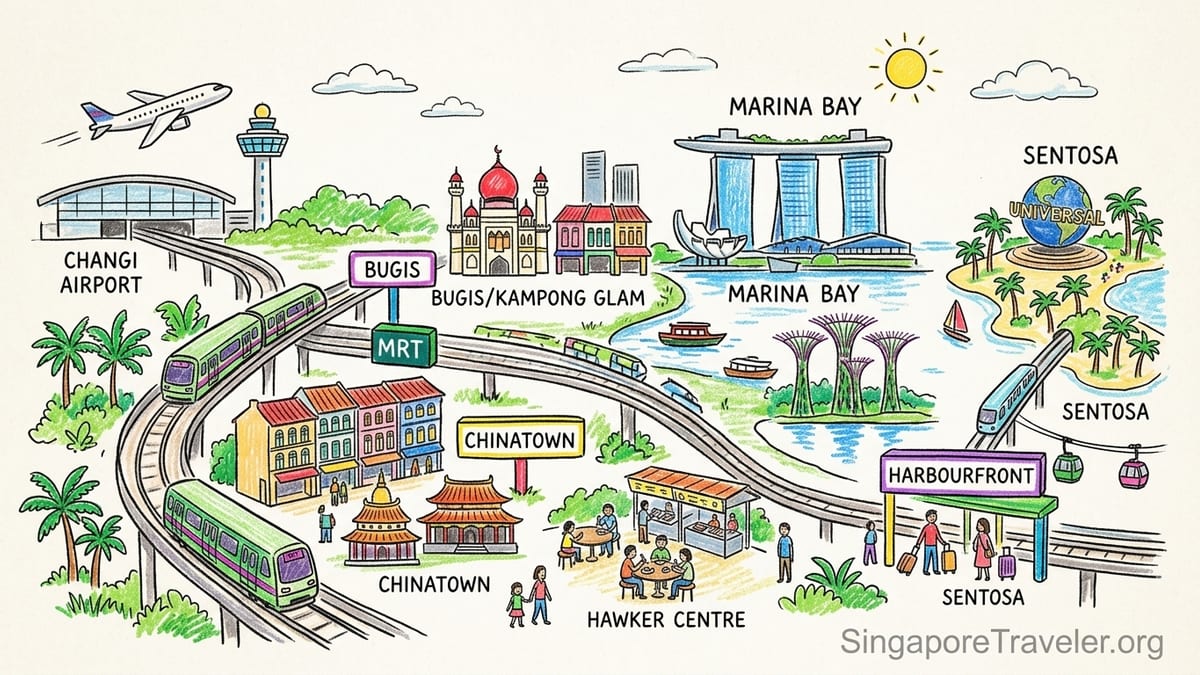
How Singapore’s Layout Shapes a First-Time Itinerary
Singapore is compact enough that most visitors never need a car. The central area, including Marina Bay, Chinatown, Kampong Glam, Little India and Orchard Road, sits within a rough 5 to 6 kilometre radius, and the Mass Rapid Transit (MRT) system stitches it all together. You can ride from Changi Airport to central stations such as City Hall, Bugis or Orchard in around 30 to 40 minutes, often with a single transfer. That scale means you can stay in one hotel and still reach the major sights without changing bases.
For planning, it helps to think in three zones. First, the city centre: Marina Bay and the historic core around the Singapore River, plus nearby neighborhoods like Chinatown, Little India and Kampong Glam. Second, Sentosa, the resort island linked to the mainland by MRT and monorail, home to beaches and theme-park style attractions. Third, outlying sights such as Mandai Wildlife Reserve in the north and East Coast Park along the southern shoreline. A typical first-time trip of four to five days might spend two to three full days in the city centre, one long day or two half days on Sentosa, and one day or evening block for Mandai or the East Coast.
Because distances are short, you rarely need to group every nearby attraction in one day. For example, you might visit Gardens by the Bay in the late afternoon, have dinner at a hawker centre in Chinatown, then return to Marina Bay for the Spectra light-and-water show at night. The MRT makes these hops routine, and trains usually run from around 5.30 am until shortly after midnight. This flexibility matters in Singapore’s heat and humidity: you can break the day into cooler morning and evening sessions and retreat to an air-conditioned mall or hotel in the middle of the day without losing time to long commutes.
Traffic is generally smooth, but taxis and ride-hail can still get stuck during rush hour. The MRT, by contrast, runs on predictable timetables and tends to be faster across town. Planning around rail rather than roads means you are less vulnerable to weather and congestion. When sketching your days, look up which MRT lines serve your hotel and the places you want to visit; building an itinerary around one or two intersecting lines usually keeps transfers simple.
Getting Around: MRT, Tourist Passes and Practical Examples
First-time visitors quickly discover that the MRT is the backbone of the city. Trains are clean, air-conditioned and well signposted in English. Most central sights have a station within a 5 to 10 minute walk: Bayfront for Marina Bay Sands and Gardens by the Bay, Chinatown for the shophouse streets and food streets, Little India and Farrer Park for the Indian quarter, Bugis for Kampong Glam, and HarbourFront for Sentosa via the VivoCity mall. Orchard Road is served by several stations along the shopping belt, including Orchard and Somerset.
You pay for rides using either a contactless bank card or a stored-value card such as EZ-Link. For many visitors, tapping a regular credit or debit card at the MRT gates is easiest. Standard fares vary by distance but short hops in the central area usually cost only a couple of Singapore dollars or less. A typical journey from Changi Airport to Bugis or City Hall using the MRT is often under S$2 to S$3 in 2026 prices, which is far cheaper than a taxi and only slightly slower in off-peak hours.
For intensive sightseeing, the Singapore Tourist Pass offers unlimited travel on most MRT and public bus services for 1, 2 or 3 days, with a separate refundable deposit. It is sold at selected MRT ticket offices and can be cost effective if you expect to make multiple trips each day, for example staying in Little India and crisscrossing frequently between Marina Bay, Sentosa and Mandai. A family of four doing four MRT journeys per person in a day may find that a day of unlimited travel gives both savings and the freedom to hop on a bus for short local rides without worrying about individual fares.
Buses fill the gaps between MRT lines and can be particularly useful for reaching East Coast Park or moving between neighborhoods like Tiong Bahru and Orchard. Each stop displays route numbers and major destinations in English, and you tap in and out with the same card you use on the MRT. For shorter distances or late nights, taxis and ride-hailing services are straightforward: you can usually find a taxi rank outside major malls such as VivoCity, Marina Bay Sands and ION Orchard, while app-based rides are priced clearly before you confirm.
Changi Airport Arrival and Entry Formalities
Changi Airport is often the first taste of Singapore’s efficiency. On landing, you follow clear signage to immigration, which for most travellers now includes automated lanes with facial recognition. Many foreign visitors, including first-timers, are eligible for these lanes, where your photo and passport are scanned and biometric data recorded for future visits. Lines are typically shorter than at manual counters, though peak evening arrivals can still mean a wait.
Before travelling, check Singapore’s official immigration requirements for your nationality. In general, visitors must hold a passport valid for at least six months on arrival and may need a visa depending on citizenship. All non-resident travellers must complete the online SG Arrival Card within three days before entering Singapore. This is a short electronic form covering your trip details and health declaration; it is free and separate from any visa process. Airlines may ask to see confirmation of submission at check-in, so it is wise to save a screenshot or printout.
After immigration, you collect your luggage and pass through customs, where screening is efficient but rules are strict. Singapore tightly controls imports of controlled drugs, weapons, high-value cigarettes and certain categories of food and alcohol. Duty-free allowances, especially for tobacco, are far more limited than in many countries, and fines for breaches can be significant. When in doubt, use the “Goods to Declare” channel and ask an officer rather than risk penalties.
Once in the public arrivals hall, you will see clear signs to taxis, the MRT and shuttle services. The MRT station at Changi is in the basement of Terminals 2 and 3, linked by walkways from other terminals. A metered taxi into the city centre usually costs in the range of several tens of Singapore dollars, with a small airport surcharge and possible peak-hour surcharges. For two or three people with luggage arriving late at night, a taxi can be worth the premium; during the day, solo travellers often prefer the MRT, which takes about 40 minutes to central stations and avoids traffic.
Where to Base Yourself: Marina Bay vs Heritage Districts vs Orchard
Choosing the right area to stay can shape your experience more than any single attraction. Marina Bay offers the big-ticket skyline and immediate access to waterfront paths, Gardens by the Bay and the Marina Bay Sands complex. Hotels here are mostly high-end, with pricing that reflects the views and facilities such as rooftop pools and integrated shopping malls. For a first-time visitor who wants a “wow” factor and plans to spend evenings around the bay, this location is hard to beat, but you pay for the convenience.
Chinatown, Little India and Kampong Glam suit travellers who value atmosphere over luxury. In Chinatown, you will find renovated shophouse hotels, boutique properties along Keong Saik Road and budget guesthouses near South Bridge Road. Walk a few minutes and you are amid hawker centres like Chinatown Complex Food Centre and Maxwell Food Centre, temples, and side streets lined with lanterns and cafes. Little India offers colourful streets around Serangoon Road, the busy Tekka Centre hawker and wet market, and easy MRT access via Little India station. Kampong Glam revolves around the golden-domed Sultan Mosque and Haji Lane, where murals, independent boutiques and Middle Eastern eateries cluster.
Orchard Road, by contrast, is primarily a shopping corridor. Staying here places you above or beside major malls such as ION Orchard, Ngee Ann City and Paragon, which means instant access to air-conditioned food courts, supermarkets and fashion. It is less atmospheric than the older quarters but extremely practical if you intend to shop and value direct MRT connections. Business districts like Raffles Place and Tanjong Pagar offer modern hotels that are quiet on weekends and evenings, sometimes with better value than Marina Bay for similar quality.
For most first-time visitors, basing in a heritage district such as Chinatown or Bugis/Kampong Glam strikes a good balance. You are one or two stops from Marina Bay and Orchard, within walking distance of hawker centres and late-night eateries, and surrounded by streets that feel distinctively “Singapore” rather than generic downtown. A family might choose a mid-range hotel near Bugis MRT, splitting days between kid-friendly Sentosa and central sights while keeping transport simple via intersecting lines.
Hawker Centres, Everyday Eating and What to Expect
Hawker centres are open-air food courts where individual stalls serve everything from Hainanese chicken rice and laksa to Indian roti prata and Muslim nasi padang. They are one of the best-value and most authentic ways to eat in Singapore. Classic examples include Maxwell Food Centre near Chinatown, Lau Pa Sat in the financial district, Tekka Centre in Little India, and Old Airport Road Food Centre in the eastern part of town. Prices vary, but a typical plate of chicken rice or char kway teow might cost somewhere between S$4 and S$7 in 2026, with drinks like iced lemon tea or sugarcane juice adding a few dollars more.
The routine is simple. You walk around scanning stall signboards and the plates in front of other diners, pick a stall, then queue and order at the counter. Pay when you order, wait for your dish, then carry it back to your table. Some hawker centres have tissue-packet “reservation” culture, where locals place a small packet of tissues, a card or an umbrella on a table to mark it as taken. It is polite to respect these markers, even if the person is still in line. At busy times, such as weekday lunch, sharing tables with strangers is normal.
Most stalls accept cash, and more are adding digital payments such as contactless cards or local e-wallets, but it is wise to carry small bills and coins. Hawker centres may not have table service, so you clear your own tray to the designated return stations when finished. Look for the National Environment Agency cleanliness ratings, displayed as large letters, which indicate hygiene inspection results. For drinks, separate beverage stalls sell kopi (local coffee), teh tarik (pulled tea), bottled water and soft drinks, often alongside fresh juices like watermelon or sugarcane.
Beyond hawker centres, Singapore’s malls are filled with food courts and mid-range restaurants where ordering works much the same way. VivoCity, attached to HarbourFront MRT and the Sentosa monorail, is a convenient pre- or post-beach stop, with everything from fast-food chains to local eateries. In Marina Bay Sands, the integrated resort mall combines celebrity-chef restaurants with casual options, which can be convenient if you want a quick meal between SkyPark and a walk to Gardens by the Bay.
Which Attractions Need Advance Tickets (and Which Do Not)
Singapore generally allows last-minute sightseeing, but some headline attractions are easier with advance tickets. Gardens by the Bay’s cooled conservatories, the Flower Dome and Cloud Forest, are popular any day, especially in the late afternoon and evening when visitors seek a respite from the heat. Buying tickets online before your chosen day or early in the morning can help you avoid queues at the physical counters. The outdoor gardens themselves remain free to enter, so you can still enjoy the Supertrees and lakes without a ticket, paying only when you want to enter the conservatories or walk the OCBC Skyway aerial bridge.
The observation deck at Marina Bay Sands SkyPark is another place where pre-booking is useful, particularly at sunset hours. Capacity is controlled, and certain time slots can sell out during peak travel seasons and weekends. Online tickets give you a specific entry window, allowing you to time the view with the golden hour or the night skyline. Similarly, Mandai Wildlife Reserve attractions like the Singapore Zoo, Bird Paradise and Night Safari encourage buying dated tickets in advance, especially for the Night Safari and popular bird shows where seating is limited.
Sentosa’s attractions follow a mixed pattern. Universal Studios Singapore, S.E.A. Aquarium and Adventure Cove Waterpark all operate with dated tickets and can have longer lines at the gate if you wait to buy on arrival, particularly on weekends and school holidays. By contrast, more relaxed experiences such as the beaches, free public playgrounds, and many waterfront bars and cafes require no reservations; you can simply show up and pay as you go. Cable car rides between Mount Faber, HarbourFront and Sentosa, as well as evening shows like Wings of Time, are smoother with advance bookings if you care about specific time slots.
For many museums and smaller attractions in the central city, same-day or even walk-up tickets are usually available outside major public holidays. The National Museum of Singapore, Asian Civilisations Museum and National Gallery Singapore, for example, tend not to sell out, although special exhibitions may require timed entry. It is still wise to check official sites a few weeks before travelling to confirm hours, maintenance closures and any temporary exhibition surcharges.
Dividing Time Between Marina Bay, Neighborhoods, Sentosa and Outlying Sights
A classic first-time itinerary runs to four or five days, though you can compress the highlights into three. Many visitors dedicate a full day to Marina Bay and the adjacent civic district. A practical sequence might start with a morning stroll along the Singapore River and civic landmarks, lunch in the air-conditioned comfort of a mall like Raffles City or Marina Square, then an afternoon at Gardens by the Bay’s conservatories. You could watch the Garden Rhapsody light show under the Supertrees, then finish with the Spectra fountain show in front of Marina Bay Sands or a walk across the Helix Bridge.
On another day, you might dive into the heritage neighborhoods. Start in Chinatown, visiting the Buddha Tooth Relic Temple, Sri Mariamman Temple and the surrounding shophouse streets before lunch at Maxwell Food Centre or Chinatown Complex. In the afternoon, ride the MRT to Little India to wander around Sri Veeramakaliamman Temple, Tekka Centre and the colourful houses off Race Course Road, then end in Kampong Glam for sunset photos of Sultan Mosque and dinner along Arab Street or Haji Lane. This pattern uses short MRT hops to link distinct areas without backtracking.
Sentosa often takes one full day, especially if you are visiting Universal Studios or the waterpark. Families may enter the island in the morning via the Sentosa Express monorail from VivoCity, spend the day on rides and indoor attractions, then wind down at Siloso or Palawan Beach. Alternatively, adults or older families sometimes split Sentosa over two half days: one focused on paid attractions such as S.E.A. Aquarium and Skyline Luge, another on beach time and casual dining. In both cases, staying on the mainland and commuting via monorail or cable car generally works fine for a first-timer; you rarely need to sleep on the island unless you want a resort feel.
Outlying attractions typically fit best into partial days. Mandai Wildlife Reserve, home to the Singapore Zoo, River Wonders, Bird Paradise and Night Safari, sits in the island’s north and requires around 45 minutes to an hour by MRT-plus-bus or taxi from central hotels. Many travellers choose either a daytime park like the zoo plus an early dinner, or they visit Bird Paradise in the afternoon and stay on for the Night Safari. East Coast Park, by contrast, is a flexible add-on: you might rent bicycles near the park and ride along the seafront, have a barbecue or seafood dinner at East Coast Lagoon Food Village, then take a taxi back to your hotel.
Sentosa, Mandai and the East Coast: What Each Area Offers
Sentosa is marketed as “The State of Fun” and feels different from the mainland: more resort, less city. Universal Studios Singapore provides compact theme-park thrills for families, while S.E.A. Aquarium showcases marine life in vast viewing galleries and underwater tunnels. Along the southern shore, Siloso, Palawan and Tanjong Beaches cater to different moods, from beach clubs with music and cocktails to quieter stretches suitable for children building sandcastles. A typical day might begin with the cable car ride from Mount Faber or HarbourFront for skyline views, continue with a few indoor attractions to escape midday heat, then end on the sand with a drink as the sun goes down.
Mandai Wildlife Reserve brings together multiple wildlife parks in a single green corridor. The Singapore Zoo is well known for its open-concept enclosures, where animals such as orangutans, giraffes and lemurs live in naturalistic habitats. Bird Paradise, which replaced the old Jurong Bird Park, offers large aviaries where you walk among free-flying birds and timed shows like “Wings of the World” at the Sky Amphitheatre. The Night Safari opens after dark and sends visitors along tram routes and walking trails to see nocturnal animals active under soft lighting. Trying to do all parks in one day is exhausting; first-timers usually pick one or two, considering the travel time from the city.
East Coast Park stretches for kilometres along the southeastern shoreline and functions as Singapore’s backyard playground. It is where residents picnic under casuarina trees, cycle on dedicated paths and cool off with evening sea breezes. There is no single must-see sight here; the appeal is the atmosphere. You might rent a bike or inline skates, stop at a seaside cafe for iced coffee, then have chilli crab or stingray at a bustling food village. Proximity to the airport can make East Coast a good last-evening stop: some travellers check out of their hotel, spend a few relaxed hours by the sea, then take a taxi directly to Changi for a late flight.
For a short first-time trip, you do not need to see all three zones extensively. Many visitors focus on Sentosa if travelling with children, adding Mandai only if the kids are particularly keen on animals, and consider East Coast Park a bonus. Adults on a city-focused holiday might prioritise Mandai over Sentosa and treat East Coast Park as an optional escape from malls and museums.
The Takeaway
For a first-time visitor, Singapore rewards simple, structured planning rather than minute-by-minute schedules. Think in zones: a couple of days around Marina Bay and the heritage neighbourhoods, one focused block for Sentosa, and one optional excursion to Mandai or the East Coast. Let the MRT guide your movements, with hotel choice anchored to a convenient station on intersecting lines. Use advance tickets selectively for high-demand attractions such as Gardens by the Bay’s conservatories, Marina Bay Sands SkyPark and Mandai’s wildlife parks, but keep enough free space for spontaneous hawker meals and evening walks.
Most of all, remember that Singapore’s appeal is not only its polished skyline but also the everyday scenes in its markets, food centres and neighbourhood streets. Breakfast at a hawker centre in Tiong Bahru, a late-night snack in Little India, or a slow stroll through Kampong Glam at dusk can be as memorable as any observation deck. Treat this guide as your starting map, then dive deeper into focused guides to Marina Bay, Sentosa, individual neighbourhoods and Singapore’s food culture as you refine your plans.
FAQ
Q1. How many days do first-time visitors need in Singapore?
Most first-time visitors are comfortable with four to five full days. That allows two to three days for the city centre, one for Sentosa and one for Mandai or East Coast Park without rushing.
Q2. Is it better to stay at Marina Bay or in Chinatown for a first visit?
Marina Bay offers views and instant access to the waterfront sights but is expensive and business-oriented. Chinatown or nearby Bugis and Kampong Glam are usually better value and place you closer to hawker centres and heritage streets while keeping Marina Bay a short MRT ride away.
Q3. Do I need to buy a Singapore Tourist Pass, or is a regular contactless card enough?
If you plan to ride public transport heavily, especially for one to three intensive sightseeing days, a Tourist Pass with unlimited rides can be convenient. For lighter use, simply tapping a contactless bank card or EZ-Link card on buses and MRT gates is usually just as easy and may cost less overall.
Q4. Which attractions absolutely require advance booking?
Attractions that benefit most from advance booking include Gardens by the Bay’s cooled conservatories, Marina Bay Sands SkyPark, Mandai’s Singapore Zoo, Bird Paradise and Night Safari, and major Sentosa parks such as Universal Studios Singapore. Smaller museums and neighbourhood walks can normally be done without pre-booked tickets.
Q5. How do hawker centres work if I have dietary or hygiene concerns?
Hawker centres are regulated, and stalls display hygiene grades from the authorities. You order and pay at the counter, then carry food to your table. If you have specific dietary needs, look for stalls that cook to order and explain your restrictions clearly; many can adjust dishes for no seafood, less spice or no nuts.
Q6. Is the MRT safe and easy to use for families with children?
The MRT is generally very safe, clean and stroller-friendly. Stations have lifts as well as escalators, and signage is in English. Trains can be crowded at rush hour, so families often travel after 9.30 am and before the evening commute for more space.
Q7. How should I split my time between Sentosa and Mandai with kids?
For younger children, one full day on Sentosa plus either the zoo or Bird Paradise on a separate day works well. Trying to combine Sentosa and Mandai in a single day usually means long transfers and tired children.
Q8. What is the typical cost of a hawker centre meal compared to a restaurant?
A basic hawker meal like chicken rice, noodles or roti prata with a drink may cost under S$10 per person. In a mid-range mall restaurant you might spend two or three times that for a main course and drink, while hotel restaurants and celebrity-chef venues run higher still.
Q9. How early should I complete the SG Arrival Card before my flight?
The SG Arrival Card can be submitted within the three days before you enter Singapore, including the day of arrival. Completing it one or two days before you fly is a practical window, giving you time to correct any errors and save confirmation details.
Q10. Do I need to change hotels to enjoy Sentosa or the East Coast?
No. For a first visit, it is usually simpler to stay in a central hotel near an MRT station and make day trips to Sentosa and East Coast Park. Travel times are short enough that you can enjoy beaches or wildlife parks by day and still return to the city for dinner or evening walks.