


Singapore’s hawker centres are not just cheap places to eat. They are where office workers, taxi drivers, families and night-shift crews all converge around plastic tables for some of the most characterful meals in the city. For visitors, the challenge is not finding hawker food but knowing which centres to prioritise and what each one is actually good for. This guide focuses on the strongest all-round options in 2026 and helps you decide where to eat based on the kind of experience and dishes you want, rather than a generic checklist of “must-try” foods.
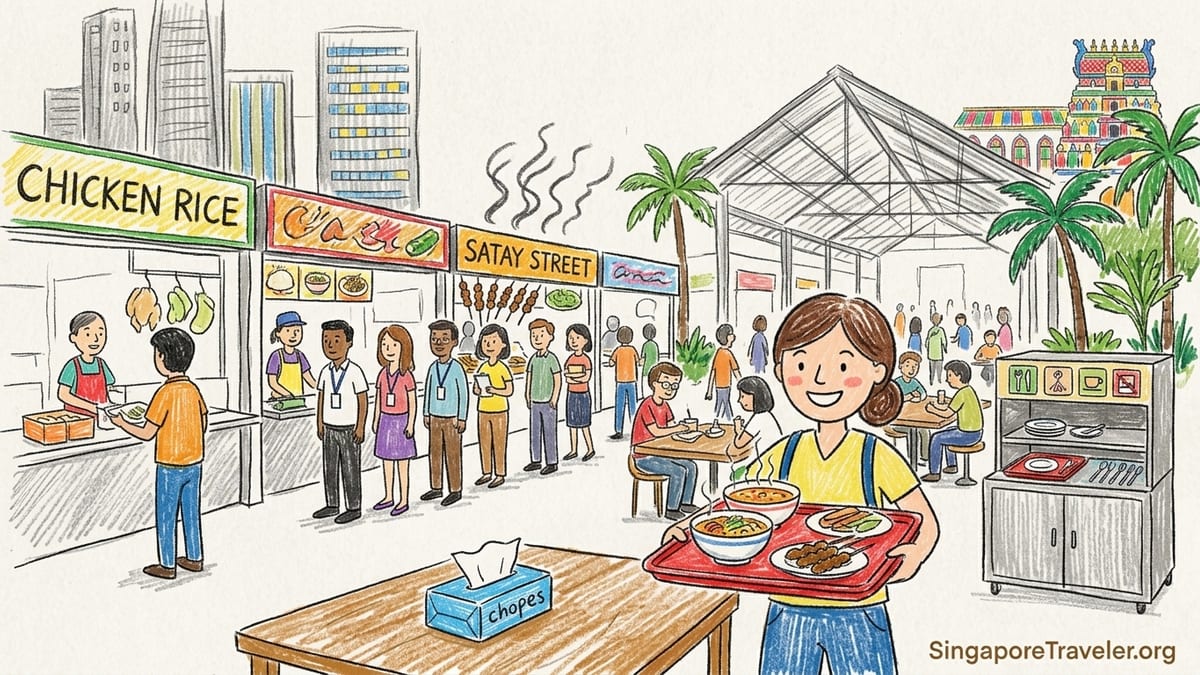
How Hawker Centres Work: Essential Etiquette for First-Timers
Before you start planning meals, it helps to understand how hawker centres operate. Each centre is an open hall filled with individual stalls, usually specialising in just a handful of dishes. You order and pay at the stall, then carry your tray to a shared seating area. Most stalls still accept cash, though many now take local QR payments. As of 2026, foreign credit cards are not always accepted at individual stalls, so carrying small notes and coins is still practical.
Singapore’s “chope” culture can confuse first-time visitors. Locals reserve tables by placing a tissue packet, umbrella or name card on the table while they go off to queue for food. It looks odd, but it is a widely accepted system. If you see a table with tissues or personal items, assume it is taken even if nobody is sitting there yet. If you are unsure, politely ask nearby diners “Anyone sitting here?” before taking the spot.
Queueing is part of the experience and a reliable quality filter. Long lines at a particular stall usually mean the food is trusted by regulars, not just hyped for tourists. At breakfast and weekday lunch you might queue 10 to 20 minutes at popular stalls such as chicken rice at Maxwell or soy sauce chicken at Chinatown Complex, especially just after office workers clock off. If you do not want to wait, look for shorter queues at neighbouring stalls that serve a similar style of food.
Most centres now require you to return trays and dishes to central collection points. You will see tray-return stations with signs and racks. After eating, carry your tray, plates and used tissues over rather than leaving them on the table. It keeps tables available and is part of Singapore’s broader push to keep hawker centres clean. Cleaning staff will wipe the table, but they are not there just to clear abandoned trays. Following these small habits makes you fit in quickly even on your first day.
Maxwell Food Centre: Classic Chinatown Stop for Hainanese Chicken Rice
Maxwell Food Centre sits between Chinatown and the business district and remains one of the most convenient hawker centres for visitors. It is a ground-floor, naturally ventilated hall with rows of stalls and a mix of tourists and office workers. The signature experience here is Hainanese chicken rice. Stalls like Tian Tian and neighbouring competitors draw queues, especially between 11.30 am and 1.30 pm on weekdays when office workers descend for lunch. A plate of chicken rice typically costs in the region of 5 to 8 Singapore dollars, depending on portion size and extras.
The best time to visit Maxwell is late morning or early lunch on a weekday, around 10.30 am to noon, when the full range of stalls is open but crowds are still manageable. Evenings from 6 pm can be lively but slightly less intense than the lunch rush and good for trying congee, oyster cakes, fruit juices and local desserts after a day of sightseeing. Many stalls close by 8 or 9 pm, so Maxwell is not a very late-night option.
Maxwell is especially strong for Chinese comfort food: chicken rice, minced pork noodles, fish soup, porridge and herbal soups. You can easily assemble a table of mixed dishes by ordering small portions from several stalls. The atmosphere is relatively friendly to first-timers, partly because stallholders are used to guiding tourists through ordering. Expect to share tables with strangers and to clear your tray promptly after eating.
The nearest MRT stops are Telok Ayer and Chinatown on the Downtown line, or Tanjong Pagar on the East West line, each roughly a 5 to 10 minute walk. Visitors often combine a Maxwell meal with temple visits nearby such as the Buddha Tooth Relic Temple, or a walking tour through Chinatown’s shophouses and market streets. Because Chinatown Complex is less than a 10 minute walk away, you can feasibly have lunch at Maxwell and then wander through Chinatown Complex to see how the atmosphere and crowd differ.
Chinatown Complex: Deep-Dive Hawker Experience With Local Vibe
Chinatown Complex Food Centre, perched on the second floor above a wet market, is Singapore’s largest hawker centre with hundreds of stalls. Despite its central location, the crowd still skews more local than tourist. Office workers from nearby towers, retirees and families make up much of the midday traffic. This is where you go when you want to see hawker culture in full, noisy operation rather than a polished, curated version.
Chinatown Complex is a powerhouse for traditional Chinese dishes. You will find everything from soy sauce chicken rice and noodle stalls that have appeared in international food guides, to claypot rice cooked over charcoal, Teochew braised duck with flat rice sheets, handmade fishball noodles, and fresh sugarcane juice. Prices remain very reasonable, often around 4 to 7 Singapore dollars for a filling bowl or plate. Craft beer fans also gravitate to a small cluster of beer stalls and bars in one corner, which stay busy into the evening.
The best time to visit is late breakfast to lunch, roughly 9.30 am to 1.30 pm. Many of the famous stalls sell out and close by mid-afternoon. On weekdays, you see strong but manageable lines and plenty of table turnover. Weekends can be more crowded, though the sheer size of the centre means you can usually find a seat if you are willing to walk a bit further from the busiest clusters. Evening visits are enjoyable for a more relaxed snack-and-beer session, but expect some popular food stalls to have closed.
The nearest MRT stations are Chinatown and Outram Park, each within a short walk. A meal here combines naturally with exploring the Chinatown Heritage Centre area, browsing traditional medicine shops, or stepping across to the Buddha Tooth Relic Temple and Sri Mariamman Temple. For many locals, Chinatown Complex beats Maxwell on depth and price while Maxwell wins for simplicity and ease. If you have time for only one and want the most local-feeling experience, Chinatown Complex is the stronger choice in 2026.
Lau Pa Sat: Atmospheric Night Satay in the Business District
Lau Pa Sat, housed in a restored Victorian cast-iron structure surrounded by skyscrapers, has evolved into a more polished, semi-tourist hawker destination. Inside, you will find a mixture of local favourites and international options at slightly higher prices than neighbourhood centres. A basic one-dish meal here usually runs from about 7 to 12 Singapore dollars, with seafood and satay platters costing more. Compared with Chinatown Complex or Old Airport Road, the crowd is heavier on tourists and office workers looking for a convenient lunch or after-work dinner near their offices.
The signature experience is Satay Street in the evenings. When Boon Tat Street is closed to traffic at night, satay stalls roll out grills and plastic tables onto the road, turning it into an open-air dining lane framed by the financial district skyline. This is one of the most photogenic hawker scenes in the city. The best time to go is from about 7 pm to 10 pm. Arrive early if you want less smoke and shorter waits for skewers. A mixed satay set with chicken, beef and prawn plus rice cakes might cost around 20 to 30 Singapore dollars for two, depending on how much you order and whether you add drinks.
In terms of food strengths, Lau Pa Sat is good for satay, grilled seafood, Indian roti and North Indian curries, and as an easy introduction to local dishes like laksa and Hokkien mee in a setting that feels accessible to first-timers. It is not the cheapest or most hardcore hawker centre, but it is walkable from many city hotels and offers covered seating, relatively good ventilation and extended evening hours.
Lau Pa Sat sits a few minutes’ walk from Raffles Place and Telok Ayer MRT stations, and can be combined with an evening stroll along Marina Bay or through the historic shophouse streets of Telok Ayer. If you are in Singapore only briefly and staying in the downtown core, one relaxed dinner at Satay Street is a convenient way to tick “hawker food under the skyscrapers” off your list. For deeper, cheaper eating, you can then move on to Old Airport Road or Tekka Centre on another day.
Old Airport Road Food Centre: Local Favourite for Classic Hawker Hits
Old Airport Road Food Centre, in the eastern part of the city, regularly appears near the top of local rankings for hawker variety and quality. It is not built around tourists. You will see families who have been eating here for decades, groups of friends sharing tables overloaded with plates, and office workers from the surrounding neighbourhoods. The layout is straightforward: long rows of stalls with seating in the middle, under a high, airy roof.
Food-wise, Old Airport Road is famous for traditional hawker staples done well. Visitors come for char kway teow fried with smoky wok hei, prawn noodles with rich broth, fried carrot cake, wanton noodles, satay, oyster omelette and a large selection of dessert and drink stalls. Stalls that have received mentions in local food awards or guides usually have clear queues during meal times, but prices remain approachable, often in the range of 4 to 7 Singapore dollars per plate or bowl.
The best times to visit are early lunch and early dinner. Lunch peaks from roughly 12 pm to 1 pm, while dinner crowds roll in from 6 pm. Going just before these peaks, around 11 am or 5.30 pm, lets you explore with fewer queues while still having many stalls open. The centre is covered but not air-conditioned, and can feel warm in the mid-afternoon heat, so most people avoid the dead hours between 3 pm and 5 pm unless they are just grabbing drinks or dessert.
The nearest MRT station is Dakota on the Circle line, roughly a 5 minute walk across a residential estate. Many visitors pair a meal here with exploring the old housing estates in the area or heading on to the East Coast Park waterfront for a stroll or bike ride. Compared with Maxwell or Lau Pa Sat, Old Airport Road feels more resolutely local, less polished and more focused on pure food. If you want one centre that reflects how Singaporeans actually eat on weekends, this is hard to beat.
Tiong Bahru Market: Brunch-Friendly Hawker with Heritage Charm
Tiong Bahru Market sits above a wet market in one of Singapore’s most photogenic residential neighbourhoods. The food centre was renovated in recent years and has wide walkways, good ventilation and a slightly calmer feel than some of the more hectic centres. It strikes a balance between serving long-time residents and welcoming a younger, café-hopping crowd. Prices are typical of mature estates, with a bowl or plate usually between 4 and 7 Singapore dollars.
Tiong Bahru is especially strong at breakfast and brunch. Popular stalls selling chwee kueh, lor mee, prawn noodles, Hainanese curry rice and wanton mee draw morning queues. Many stalls close after lunch, so the best window is roughly 8 am to 1 pm. Weekends see a mix of local families and visitors who then drift off to nearby cafés for coffee and pastries. If you want to see a slightly gentler side of hawker culture, arrive on a weekday morning when the atmosphere feels almost like a neighbourhood canteen.
The nearest MRT station is Tiong Bahru on the East West line, about a 10 minute walk through housing blocks and tree-lined streets. A visit here pairs naturally with a walking loop around the low-rise art deco buildings of the Tiong Bahru estate, including indie bookstores, bakeries and coffee shops. Compared with Chinatown Complex or Tekka, Tiong Bahru is not about sheer volume of choices but about a compact set of reliable stalls in a relaxed environment.
For first-time visitors who wake early due to jet lag, a morning at Tiong Bahru is a gentle introduction to hawker dining. You can share a table with retirees reading newspapers, watch the wet market in action downstairs, and then continue your day in quicker-paced parts of the city once the heat rises.
Tekka Centre: Best for Indian, Malay and Muslim Food in Little India
Tekka Centre anchors the Little India district and combines a wet market, shops and a busy food centre on the ground floor. The crowd here is one of the most diverse among the hawker hubs in this guide, with Indian, Malay, Chinese and migrant worker communities all represented. It is a very sensory place: the smell of spices and curry, the calls of stallholders and the sight of colourful ingredients from the wet market.
Tekka is particularly strong for South Indian and North Indian food, as well as Malay and Muslim dishes. You can order fish head curry, biryani served on banana leaves, tandoori platters, murtabak stuffed with minced meat, thosai with chutneys, nasi briyani and rojak from various stalls. Prices are attractive for the quality and size of portions, usually around 6 to 10 Singapore dollars for generous mains. Western-style coffee is limited, so be prepared to drink teh tarik or kopi instead.
The best times to visit Tekka Centre are late breakfast, lunch and early dinner. Midday can be crowded but is part of the experience. In the evenings around 6 to 8 pm, the atmosphere becomes more relaxed as people head there after work or shopping in Little India. As with most hawker centres, some stalls close one day a week, so if you have a specific biryani or curry stall in mind, it is wise to have a backup choice in the same row.
Tekka Centre sits next to Little India MRT station, making it an easy stop on any itinerary. Combine a meal here with a walk through the side streets of Little India, visits to temples and sari shops, or a stop at nearby shopping centres that cater to the local Indian community. Compared with Lau Pa Sat or Tiong Bahru, Tekka is less polished but more intense and flavour-driven, particularly if you want to dive into Indian or Malay food beyond the token dishes found elsewhere.
Amoy Street Food Centre and the CBD Lunch Rush
Amoy Street Food Centre, on the edge of the central business district, is a two-level hawker complex that shines on weekdays at breakfast and lunch. This is where you see city office life compressed into a tight window. From around 11.45 am to 1.30 pm, lines snake from popular stalls as suits and lanyards queue for their regular fish soup, nasi lemak, thunder tea rice or Japanese-inspired rice bowls. Prices are slightly above heartland levels but still affordable, often between 5 and 9 Singapore dollars for a main.
What sets Amoy apart is its mix of long-established hawker stalls and newer, younger-run concepts that appeal to office workers looking for lighter or more contemporary options. You might find traditional noodle soups and economic rice side by side with salad bowls, truffle-inflected dishes or specialty coffee stands. This makes it a good choice if you are travelling with someone less adventurous or if you want a somewhat lighter meal between meetings or sightseeing.
The food centre is at its best on weekdays. Many stalls close in the evenings and on weekends because their business depends on office crowds. If you visit outside weekday lunch hours, you will find far fewer options open. The nearest MRT stations are Tanjong Pagar and Telok Ayer, both a short walk away. You can combine a weekday lunch here with a self-guided walk through the shophouses of Amoy Street, Telok Ayer and Ann Siang Hill, then continue to Chinatown or Marina Bay on foot.
Compared with Maxwell or Chinatown Complex, Amoy Street has a more functional, get-in-and-out feel. People come with a clear purpose, eat quickly and leave. For visitors, that makes it a fascinating glimpse into the everyday rhythm of white-collar Singapore. If you are in the area around lunchtime on a weekday, it is worth squeezing yourself into the flow at least once.
East Coast Choices: East Coast Lagoon Food Village and Beyond
The east of Singapore offers several excellent hawker options that pair naturally with time by the sea. The best-known among visitors is East Coast Lagoon Food Village, set within East Coast Park and popular with families, cyclists and groups barbecuing by the beach. The mood here is much more holiday-like than at city-centre hawker halls, with open-air seating, sea breezes and clusters of satay and seafood stalls. Expect slightly higher prices than in residential estates, especially for barbecued stingray, chilli crab and other seafood dishes, which are often priced by weight.
East Coast Lagoon is strongest at dinner. Stalls start getting busy from around 6 pm as the sun drops and temperatures become more comfortable. Locals gather for barbecued seafood, satay, Hokkien mee fried with prawns and squid, and cold beer. A plate of Hokkien mee or satay set might cost in the region of 7 to 15 Singapore dollars, while seafood platters can run much higher depending on what you choose. Because seating is entirely open-air, the experience is weather dependent. On clear evenings, it feels like a beachside night market.
The nearest MRT access involves a short bus or taxi ride, as East Coast Park runs along the coast rather than directly above a train line. Many visitors arrive by bicycle from rental points along the park or combine dinner with an afternoon at the beach. If you prefer something closer to residential life, nearby neighbourhood centres and smaller hawker clusters in estates like Bedok also offer excellent local foods but with fewer English signs and fewer tourists.
For visitors already planning time on Singapore’s east coast for cycling, rollerblading or simply watching planes glide into Changi, building dinner at East Coast Lagoon into your plan is straightforward. It adds a different dimension to the hawker experience: the sound of waves, the smell of charcoal smoke and the sight of local families lingering long after the plates are empty.
Planning Your Hawker Route: Matching Centres to Your Itinerary
The easiest way to decide where to eat is to match hawker centres to the neighbourhoods you are already visiting. Near Chinatown and the city core, Maxwell, Chinatown Complex, Lau Pa Sat and Amoy Street form a compact cluster that can fill several meals in a short stay. Start your trip with Maxwell or Lau Pa Sat for user-friendly experiences, then graduate to Chinatown Complex once you are more comfortable navigating stalls and queues. If you are in town on weekdays, aim for Amoy Street at least once during the midday rush to see office workers in their natural habitat.
For a more local feel beyond the tourist core, plan half a day around Old Airport Road or Tekka Centre. Old Airport Road suits those who want a broad cross-section of classic dishes in a relatively old-school setting, while Tekka is best for visitors keen on Indian, Malay and Muslim food or exploring the colours and sounds of Little India. Both are on MRT lines that make them easy to reach without a car. Tiong Bahru Market slots nicely into a morning of wandering shophouse streets and cafés, especially if you are staying in the central or southern part of Singapore.
Cost-wise, most hawker meals still end up cheaper than eating in malls or hotel restaurants, even in 2026. A realistic budget is around 8 to 15 Singapore dollars per person for a satisfying meal with a drink at most centres, more if you are ordering seafood at Lau Pa Sat or East Coast Lagoon. Sharing several plates between two or three people is the best way to sample a range of dishes without overordering. Remember to bring tissues for “chope”, a reusable bottle if you want to refill water at your hotel, and enough small notes for stalls that remain cash-only.
If you are short on time, one practical three-meal snapshot could look like this: breakfast at Tiong Bahru Market, lunch at Chinatown Complex or Tekka Centre, and dinner at Lau Pa Sat or East Coast Lagoon. If you have longer, scatter Old Airport Road and Amoy Street across additional days. Each centre layers another angle on Singapore’s hawker culture, from heritage-heavy Chinatown to office-canteen Amoy and beachside East Coast. Taken together, they tell the story of a city that still eats remarkably well in plastic chairs under fluorescent lights.
FAQ
Q1. How much should I budget for a hawker centre meal in Singapore?
For most centres, budgeting around 8 to 15 Singapore dollars per person will comfortably cover a main dish and a drink. Seafood, satay feasts and barbecue at places like Lau Pa Sat or East Coast Lagoon can cost more, especially when items are priced by weight.
Q2. Do hawker stalls accept credit cards or contactless payment?
Many stalls in 2026 accept local QR-based payments, but foreign credit cards are still not universal. Some stalls remain cash-only. It is safest to carry cash, especially smaller notes and coins, and treat card or mobile payment as a bonus when available.
Q3. Which hawker centre is best if I only have one night in Singapore?
If you want maximum atmosphere with minimal navigation stress, Lau Pa Sat’s Satay Street at night is a strong single-evening choice, especially if you are staying near the business district or Marina Bay. For a more local-heavy crowd and deeper variety, Chinatown Complex or Old Airport Road are stronger but require a little more confidence and time.
Q4. Is it safe to drink water or ice from hawker stalls?
Tap water in Singapore is generally considered safe to drink, and most hawker drinks stalls use treated water. If you are sensitive, you can stick to bottled drinks or canned beverages. Ice from reputable stalls is typically produced commercially, but if in doubt, request your drink without ice.
Q5. How do I know what to order if I cannot read the menu?
Many stalls display photos of their dishes and have English translations. When they do not, you can observe what people in front of you are ordering and point, or say “same, please.” It is acceptable to ask the stallholder “What is popular?” and let them guide you to a house favourite.
Q6. Are hawker centres suitable for vegetarians or people with dietary restrictions?
Vegetarians can usually find options such as Indian vegetarian meals, economic rice with vegetable dishes, or specific vegetarian stalls. However, cross-contamination is possible, and vegan or gluten-free diners will need to ask more questions and may have a narrower range of options. Tekka Centre and some Chinatown and heartland centres tend to have more vegetarian-friendly choices.
Q7. What time do hawker centres usually open and close?
Hours vary by stall and centre. Breakfast-focused places like Tiong Bahru Market and Tekka Centre start early, around 7 or 8 am. Many centres quieten mid-afternoon as stalls restock or close. Dinner stretches to around 9 or 10 pm at most places, with late-night options concentrated at specific centres such as Lau Pa Sat and East Coast Lagoon.
Q8. Do I need to tip at hawker centres?
No tipping is expected or required at hawker centres in Singapore. Prices are all-inclusive. Locals simply pay the posted price, collect their food and clear their trays. If you feel strongly about showing appreciation, returning as a repeat customer or giving a verbal thank you is sufficient.
Q9. Can I share one dish between two people at a hawker stall?
Yes, sharing is normal and often encouraged so you can try more dishes. Many groups will order several plates from different stalls and share everything family-style. Just be considerate about not occupying a large table for a long time if you have ordered very little during peak hours.
Q10. How do I avoid the longest queues without missing out on good food?
Arrive slightly before peak meal times, such as 11 am for lunch or 5.30 pm for dinner. Look for stalls with steady but not extreme queues and observe who is in line; if you see office workers or older locals, that is usually a positive sign. At heavily visited places like Maxwell or Chinatown Complex, you can also aim for less-famous stalls that serve similar dishes with far shorter waits.