


Singapore is one of Asia’s easiest hubs to fly into, yet its immigration rules are precise and strictly enforced. Whether you are coming for a weekend of shopping on Orchard Road, a business conference at Marina Bay Sands or a long layover at Changi Airport, you need to understand how passport validity, visa rules and the SG Arrival Card fit together. This guide walks you through what to do before you fly so that immigration, customs and health checks on arrival are as smooth and quick as possible.
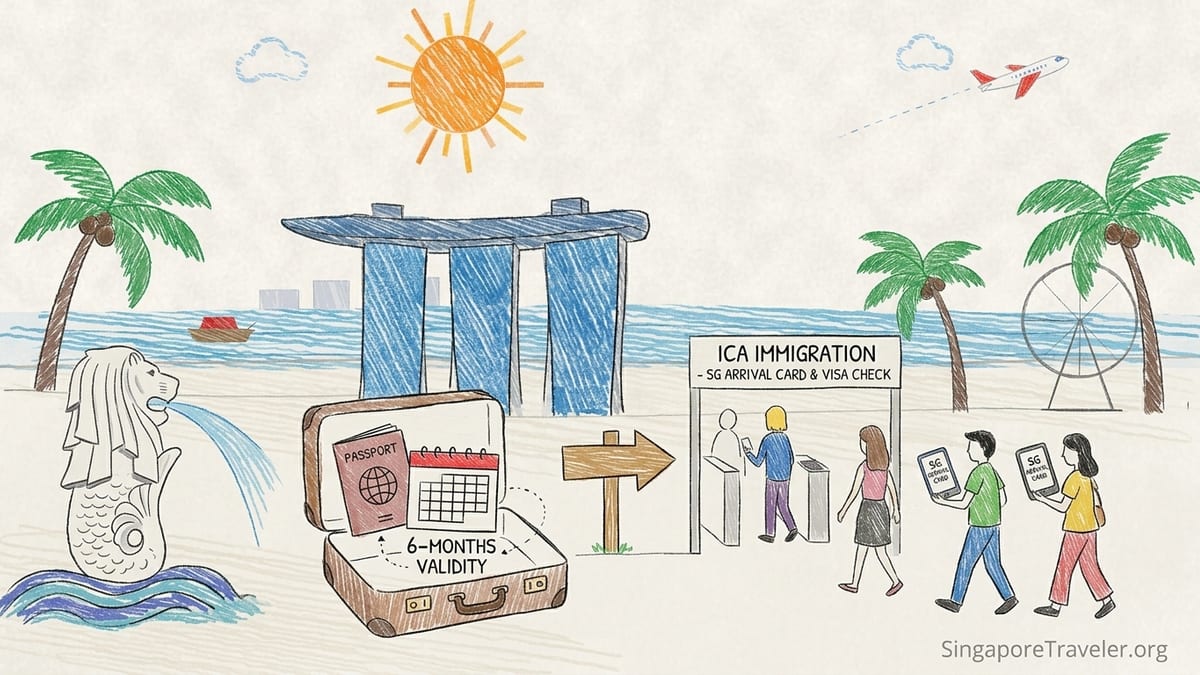
Passport Validity: The Six-Month Rule in Practice
Singapore’s Immigration & Checkpoints Authority (ICA) requires most foreign visitors to hold a passport that is valid for at least six months from the date of entry. This is not a flexible suggestion. Airlines check this before boarding, because carrying someone who is later refused entry can result in fines and the cost of returning the passenger. In practical terms, if you plan to arrive in Singapore on 15 October, your passport should be valid until at least 15 April the following year.
Consider a traveler from New York flying to Singapore for a five-day holiday in December. Her passport expires in early April. Even though she plans to stay less than a week, the passport does not meet the six-month threshold at the time of entry, so the airline can refuse to check her in. She would need to renew her passport before traveling. A similar situation commonly arises for students attending short courses or conferences who realize too late that their passport will expire soon after their trip.
The six-month rule also affects visa applications. If you are a national who requires a Singapore visa, you will usually not be able to apply unless your passport already has six months of remaining validity from your intended date of arrival. Travelers renewing their passport should wait for the new document details before submitting any visa or SG Arrival Card information, to avoid mismatches between passport numbers.
For frequent travelers, it is sensible to build in a personal buffer beyond six months. Many visitors who combine Singapore with other destinations in the region, such as Indonesia or Thailand, find that those countries also follow similar six-month policies. Renewing your passport once it drops below nine months of validity can help you avoid repeated last-minute checks and airline staff questioning your eligibility to board.
Who Needs a Singapore Visa and Who Is Visa-Free
Singapore operates a mixed system of visa-free entry and visa-required nationalities. Many travelers, such as those holding passports from the United States, Canada, most European Union countries, Japan, South Korea, Australia and New Zealand, can usually enter visa-free for short visits as tourists or business visitors. They receive a Visit Pass on arrival which sets the maximum duration of stay, often up to 30 or sometimes 90 days, depending on ICA’s assessment at the checkpoint.
Other nationalities must obtain an entry visa in advance. ICA provides an official online checker where travelers can confirm current visa requirements for their specific passport. This is important because visa policy can change and there is no guarantee that a country that was visa-free in previous years will still be so today. For example, a traveler from India or certain parts of the Middle East typically needs a Singapore visa, applied for through an authorized agent or local contact, before boarding a flight. The visa itself generally allows you to travel to Singapore and seek entry; it does not guarantee that you will be admitted, which still depends on immigration officers at the border.
Many travelers confuse the visa with the Visit Pass. The visa, if required, is usually issued electronically and linked to your passport. The Visit Pass is what you actually receive when you arrive in Singapore, usually in digital form via an email from ICA. It sets out the exact number of days you are allowed to stay and your last day in the country. Overstaying the Visit Pass, even by a short period, can lead to fines, detention, or problems entering Singapore in the future, so it is critical to check this email carefully.
Because visa policies depend on nationality, previous travel history and sometimes the type of travel document, travelers should always rely on ICA’s official guidance shortly before booking. A traveler planning a multi-country Southeast Asia trip might discover that while they do not need a visa for Singapore, they may need one for neighboring countries. Building in enough time to secure these approvals is just as important as finding a good flight deal or hotel rate.
Understanding the SG Arrival Card: What It Is and What It Is Not
The SG Arrival Card is Singapore’s digital replacement for the old paper disembarkation and embarkation form that visitors once filled out on the plane. It is an online submission that collects your personal details, travel information and a short health declaration. ICA currently requires most travelers to submit the SG Arrival Card within three days before arrival, including the day of arrival. That means if you land on a Friday, you can submit the card as early as Wednesday, or even a few hours before your flight, as long as it is before you reach immigration.
It is crucial to understand that the SG Arrival Card is not a visa. Submitting the form does not grant you permission to enter Singapore and does not replace any visa requirement. A traveler from France who is visa-free and a traveler from a visa-required country like India both need to complete the SG Arrival Card, but the second traveler must also hold a valid visa where required. Immigration officers will look at your SG Arrival Card submission alongside your passport, visa status, and travel plans when making an entry decision.
In practice, completing the SG Arrival Card is straightforward. For example, a couple flying from London to Singapore for a honeymoon can open the official form a day or two before departure, enter their passport details exactly as shown in the biodata page, provide their flight number, and give their intended address in Singapore, such as a hotel in the Marina Bay area. They will also answer a few health-related questions, like whether they have any symptoms of specific infectious diseases or recent travel to certain high-risk areas. The whole process often takes less than ten minutes once they have the necessary details at hand.
Once submitted, the SG Arrival Card is tied electronically to your passport. When you reach Changi Airport and scan your passport at an automated immigration lane, the system pulls up your arrival card data automatically. You will not receive a paper endorsement in your passport; instead, your Visit Pass details are usually sent to you via email. Keeping a copy of that email on your phone makes it easy to check your permitted stay if you decide to extend your trip or rebook your flight.
Who Must Submit the SG Arrival Card and Key Exemptions
Most people entering Singapore need to submit an SG Arrival Card, but there are important exemptions. Travellers who simply transit through Changi Airport without clearing immigration and without entering Singapore do not need to submit the card. A typical example is a passenger flying from Los Angeles to Bangkok via Singapore who remains airside in the transit area the whole time. As long as they do not pass through passport control, they are considered a transit passenger and the SG Arrival Card is not required.
Singapore citizens, permanent residents and most long-term pass holders who enter via land checkpoints, such as Woodlands or Tuas coming from Malaysia, may also be exempt from the SG Arrival Card requirement under current ICA arrangements. This reflects the large number of daily commuters who travel between Singapore and Malaysia for work or study. However, Singapore residents returning by air or sea generally still have to submit the SG Arrival Card, so many frequent travelers now keep their details stored in the official mobile app to speed up repeat submissions.
Foreign visitors entering Singapore by air or sea for tourism, business trips, visits to friends and relatives or short-term courses should assume that they must submit the SG Arrival Card unless they are certain they are only transiting without clearing immigration. This includes travelers arriving on full-service carriers like Singapore Airlines as well as low-cost airlines. For instance, a backpacker from Germany flying regional budget airlines between Bali and Singapore still needs to complete the SG Arrival Card when arriving for a few days in the city, even if the ticket was very cheap.
Because aviation schedules and plans can change, it is wise to think about the SG Arrival Card whenever you change a booking. If your connecting flight is canceled and you are rerouted with a long overnight layover in Singapore that requires you to clear immigration and stay in an airport hotel, you will then need to submit the SG Arrival Card even though you were originally just transiting.
When and How to Complete the SG Arrival Card
ICA advises travelers to submit the SG Arrival Card within three days before their date of arrival, including the arrival day. This timeframe can be confusing. It is not a latest cut-off date; it is a window during which you are allowed to send your information. For example, if you are landing on a Monday, you can submit the card on Saturday, Sunday, or Monday itself, even shortly before boarding your flight. You cannot, however, submit it a week in advance and expect it to remain valid.
In real life, many travelers choose to complete the SG Arrival Card around 24 to 48 hours before departure, once their flight details are confirmed. A family flying from Sydney might sit down on Sunday evening to prepare for their Tuesday morning flight, gather all the passports together, and submit SG Arrival Cards for each family member. Parents can complete the forms on behalf of children. Doing this at home on a stable internet connection is usually smoother than relying on airport or inflight Wi-Fi.
If you forget to submit in advance, ICA allows you to complete the SG Arrival Card on arrival using airport Wi-Fi at Changi, as long as you do it before you reach immigration. Travelers report that it is common to see people at the arrival hall standing aside to submit their forms on smartphones before joining the queue for automated lanes. This is possible, but it can add stress and delays, particularly after a long overnight flight when your phone battery is low or your roaming plan is not yet active.
When filling in the SG Arrival Card, triple-check that your passport number, expiry date and personal details exactly match your passport. Mistyped numbers are a common cause of problems at immigration. Make sure your email address is correct too, as your electronic Visit Pass is typically sent to that inbox. If you will not have reliable access to email during your trip, consider forwarding the e-Pass email to a travel companion or saving a copy in your phone’s files.
What to Prepare Before Completing the SG Arrival Card
Preparing a few key pieces of information before you sit down to complete the SG Arrival Card can make the process quick and painless. First, have your passport with you so you can enter your full name, passport number, country of issue and expiry date accurately. Do not rely on an old photo of your passport or on memory; even a single incorrect digit can cause mismatches in ICA’s system. If you have recently renewed your passport, ensure you are using the new passport details.
Second, have your travel details ready. You will need your flight number, intended date of arrival and departure, and where you plan to stay in Singapore. For many tourists this will be the name and address of a hotel in areas such as Orchard, Clarke Quay or Sentosa. If you are staying with friends or relatives, use their residential address. Business travelers coming for meetings at office towers around Raffles Place or one-north should know either their hotel address or the contact address of their host company.
Third, prepare information that may be relevant to the health declaration and customs side of your trip. While the SG Arrival Card focuses on immigration and health, your arrival process in Singapore is closely linked to customs rules. If you are carrying items that could be dutiable or controlled, such as large quantities of alcohol or tobacco, high-value electronics, or certain medications, you should be ready to declare them at customs after immigration. Travelers who do their homework beforehand, such as checking what quantity of wine or perfume qualifies for duty-free relief, typically move through the airport more smoothly.
Finally, think about your onward travel. ICA may ask for proof of your departure plans, such as a return ticket to your home country or an onward ticket to a third destination like Kuala Lumpur or Tokyo. Having a printed copy of your itinerary or a screenshot on your phone can be helpful if an officer asks to see it during an interview at the immigration counter.
Arrival, Immigration, Customs and Health Considerations
The typical arrival sequence at Changi Airport starts when you disembark and follow signs to immigration. If you have already submitted your SG Arrival Card, you can usually proceed directly to the automated lanes, scan your passport, look into the facial recognition camera, and complete immigration within a few minutes. Travelers often comment that queues move quickly compared with many other major airports, but during peak times, such as evenings when multiple long-haul flights land together, some waiting is still possible.
After immigration, you collect your baggage from the carousel and then walk toward customs. At this point you choose between the green channel for “Nothing to Declare” and the red channel for “Goods to Declare.” Singapore takes customs compliance seriously. As a real-world example, a traveler arriving from Europe with several high-end cameras and laptops bought tax-free overseas should not assume everything can pass without declaration. Depending on total value, they may need to pay Goods and Services Tax on certain items. Similarly, limits apply to duty-free tobacco and alcohol, such as the number of bottles of wine or spirits.
Health declarations, now integrated within the SG Arrival Card process, are used by Singapore to monitor and control the importation of infectious diseases. If you recently visited regions where diseases such as yellow fever are present, you may be required to show a valid vaccination certificate. Travelers who declare symptoms of illness, such as a fever or respiratory issues, may be asked additional questions by officers or directed to a separate area for further screening. While this can be inconvenient after a long journey, it is part of Singapore’s wider public health strategy to protect residents and visitors alike.
For many travelers, the entire process from disembarking to exiting the airport takes less than an hour when documentation is in order. As soon as you leave customs, the airport opens up to transport options including taxis, rideshare pick-up points, the MRT train into the city and hotel shuttle counters. Having completed your SG Arrival Card properly and complied with customs rules means you can concentrate on enjoying Singapore rather than worrying about administrative issues.
The Takeaway
Singapore’s entry system is designed to be efficient, but it demands careful preparation from travelers. Understanding the relationship between passport validity, visa requirements and the SG Arrival Card is just as essential as booking your hotel or deciding which hawker center to visit first. Almost all foreign visitors need a passport valid for at least six months from the date of entry, and many nationalities must secure a visa in advance based on up-to-date ICA guidance rather than old assumptions.
The SG Arrival Card, while mandatory for most air and sea arrivals, is not a visa. It is a digital arrival and health declaration that must be submitted within three days of arrival, including the day you land. Knowing who is exempt, such as transit passengers who do not clear immigration, helps you avoid unnecessary worry. Submitting the form correctly and on time reduces delays at Changi’s automated lanes and ensures that your electronic Visit Pass is issued without complications.
By gathering key information in advance, respecting customs and health requirements, and double-checking official ICA advice close to your travel date, you can make your entry into Singapore smooth and stress-free. That leaves you free to focus on the experiences that matter most, from strolling through the Gardens by the Bay to sampling chili crab by the Singapore River, confident that the administrative side of your journey is under control.
FAQ
Q1. Is the SG Arrival Card the same as a visa for Singapore?
The SG Arrival Card is not a visa. It is an online arrival and health declaration that most travelers must complete before entering Singapore. If your nationality requires a visa, you must still obtain that visa separately following ICA’s official guidance.
Q2. How long before my trip can I submit the SG Arrival Card?
ICA currently allows travelers to submit the SG Arrival Card within three days before their date of arrival, including the day they land. For example, if you arrive on a Friday, you can submit the form on Wednesday, Thursday or Friday before reaching immigration.
Q3. Do I need to submit an SG Arrival Card if I am only transiting through Changi Airport?
If you remain in the transit area and do not clear immigration, you are treated as a transit passenger and generally do not need to submit the SG Arrival Card. If you plan to enter Singapore during your layover, even just to stay at an airport hotel outside the transit area, you must complete the form.
Q4. What passport validity do I need to enter Singapore?
Most foreign visitors must hold a passport that is valid for at least six months from the date of entry into Singapore. Airlines often check this before boarding, and you may be denied boarding if your passport does not meet this requirement.
Q5. How can I check if I need a visa for Singapore?
Visa needs depend on your nationality and type of travel document. ICA provides an official visa requirement checker where you can confirm whether you need an entry visa before traveling. Always rely on the latest ICA information rather than informal online lists.
Q6. What information do I need to complete the SG Arrival Card?
You will need your passport details, flight number, intended dates of arrival and departure, and your address in Singapore such as a hotel or residence. You must also answer a short health declaration and provide a valid email address to receive your electronic Visit Pass.
Q7. What happens if I forget to submit the SG Arrival Card before landing?
If you forget, you can usually complete the SG Arrival Card online after you land, using airport Wi-Fi, as long as you do it before you reach immigration. This may cause delays, so it is better to submit the form at least a day before travel whenever possible.
Q8. Are Singapore citizens and residents required to submit the SG Arrival Card?
Singapore citizens, permanent residents and some long-term pass holders may be exempt at certain land checkpoints, but many still need to submit the SG Arrival Card when arriving by air or sea. Requirements can evolve, so residents should check ICA’s latest guidance before returning to Singapore.
Q9. Does the SG Arrival Card affect how long I can stay in Singapore?
The SG Arrival Card itself does not set your length of stay. Your permitted stay is determined by the Visit Pass granted at entry. Details of that pass, including your last allowed day in Singapore, are usually sent to you as an electronic notice by email after immigration clearance.
Q10. Do children need their own SG Arrival Card submission?
Yes, children generally need their own SG Arrival Card, but a parent or guardian can complete the form on their behalf. Families often fill out all cards together before travel, using one email address to keep track of the electronic Visit Pass messages for each child.