


Two of Marina Bay Sands’ most talked-about attractions are created by the same Japanese art collective, teamLab, yet they deliver very different experiences. Future World at ArtScience Museum is a multi-room immersive journey through digital art, while Digital Light Canvas is a compact interactive light installation on the mall floor of The Shoppes. For visitors seeing both heavily promoted within Marina Bay Sands, understanding how they really compare in scale, cost and experience can help decide which one deserves your time and ticket money.
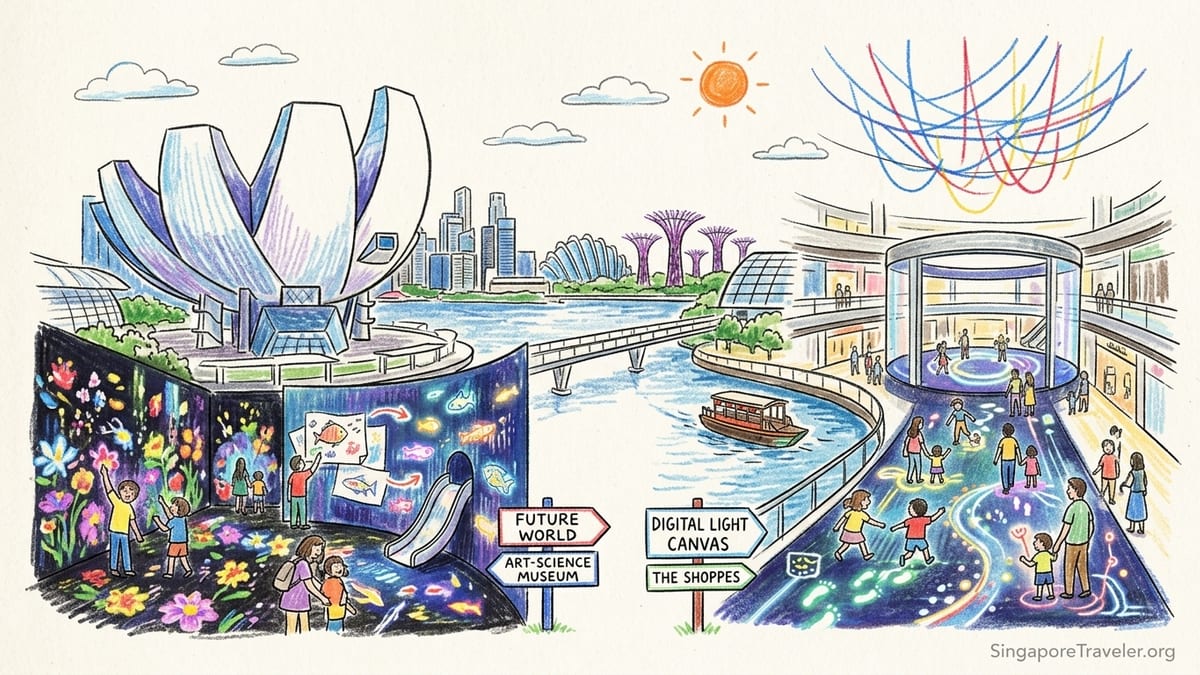
Future World vs Digital Light Canvas at a Glance
Both attractions carry the teamLab name and the vivid, interactive style the collective is known for, but they sit at opposite ends of the spectrum in terms of size and depth. Future World is a permanent exhibition inside ArtScience Museum, typically experienced like a full museum visit. It spreads across multiple darkened galleries filled with floor-to-ceiling projections, responsive walls and play areas. Many visitors treat it as a half-day highlight of their Marina Bay itinerary, often combining it with other ArtScience exhibitions or a walk along the waterfront.
Digital Light Canvas, by contrast, is a single circular installation on the B2 level of The Shoppes at Marina Bay Sands, next to the Rasapura Masters food court and the Sampan Rides. It is essentially a luminous digital floor and overhead light sculpture that reacts to footsteps and movement. Marina Bay Sands currently suggests visitors typically spend about 30 minutes inside the roped-off area, although the ticket technically allows a longer continuous visit if capacity permits. In practice, many people drop in while shopping or before dinner, rather than planning an entire afternoon around it.
This difference in scale shapes almost every other comparison. Future World feels like a full-fledged museum experience that you book timed tickets for and work into your day. Digital Light Canvas feels more like an add-on: a short, playful stop while exploring the integrated resort, with many mall shoppers simply viewing it for free from the upper levels without entering the paid area.
Because they are so different, some travellers will find that one clearly fits their style better. Families with young children often gravitate toward Future World for its larger play-based zones, while couples on a shopping and dining day might prefer the lighter commitment of Digital Light Canvas. Understanding how each one works in practice makes it much easier to choose.
Ticket Prices and Combination Deals
Pricing is one of the most immediate differences between the two experiences. As of late August 2026, standard tourist tickets for teamLab Future World at ArtScience Museum start from around S$32 for adults and about S$26 for concessions such as children, students or seniors. Singapore residents pay slightly less, with adult prices from roughly S$26. These are dynamic “from” prices that may vary by date and special promotions, but they give a realistic sense of the baseline cost for a standalone Future World visit.
Digital Light Canvas is considerably cheaper for a quick visit. Current signage and official information indicate that standalone admission starts from S$12 per person for basic entry into the interactive zone on the light floor. There are higher-priced options that bundle small souvenirs, such as entry with a collectible badge from around S$15, or with a tote bag or T-shirt from around S$30 to S$35. However, many casual visitors opt for the simple S$12 entry, particularly if they are just curious to try the interaction for a short time.
For travellers interested in both attractions, Marina Bay Sands promotes a dedicated tourist combination ticket for “teamLab Future World and Digital Light Canvas.” At the time of writing, this combo is listed at S$37 for an adult. That means that, for a typical tourist, adding Digital Light Canvas to a Future World visit costs only a modest amount more than Future World alone, effectively discounting the mall installation compared with its standalone S$12 entry. Families should check the latest child and concession combo prices on site or via official channels, as children’s bundled rates are often notably lower than buying both separately.
Realistically, if you are already planning to visit Future World, the combo ticket is usually the best-value way to sample Digital Light Canvas on the same day. On the other hand, if you are just passing through The Shoppes with limited time and no interest in a full museum experience, buying a single S$12 Digital Light Canvas ticket can be a low-cost way to try a teamLab work without committing to the higher-priced exhibition.
How Much Time to Spend at Each Attraction
Time commitment is where these two experiences diverge sharply. Future World is structured as a multi-room gallery exhibition, and many visitors report spending 1.5 to 2 hours inside, especially those with children who linger in the play zones. ArtScience Museum’s general opening hours for this exhibition currently run from 9 am to 6 pm daily, with last entry at 5 pm. Timed entry slots are required for Future World, and you are encouraged to arrive within your chosen window. Once inside, you can move at your own pace, revisiting favourite rooms and waiting for less crowded moments if you want cleaner photographs.
Digital Light Canvas, on the other hand, is deliberately framed as a shorter stop. Marina Bay Sands notes that visitors typically spend around 30 minutes in the space. In practice, staff manage capacity by limiting how many people can be on the floor at once. Official conditions of entry state that a ticket grants up to 60 minutes of continuous access, but most guests experience the piece more like a 15 to 30 minute interactive play session. Children often run around chasing digital fish or triggering blooming flowers, while adults take photos and videos from different angles before moving on to their next activity, such as a sampan ride or lunch nearby.
For itinerary planning, this creates very different patterns. If you have only one afternoon in the Marina Bay area, you could comfortably book a late-morning Future World slot, spend two hours there, enjoy lunch at one of the many restaurants along the promenade, and then head to Gardens by the Bay or the SkyPark Observation Deck. Digital Light Canvas fits into the little slivers of time in between: waiting for a dinner reservation, entertaining children after shopping, or filling a gap before an evening light show at Marina Bay waterfront.
Because of this, some travellers choose to keep Digital Light Canvas flexible. Even if you have the combo ticket, it can be wise to use your timed slot for Future World first and then walk over to The Shoppes later in the day when everyone still has some energy left but you are not ready to commit to another major attraction. The short duration makes it a low-risk addition, but you should still factor in a potential queue during peak weekend hours.
Experiences for Children and Families
Both attractions are clearly designed with children in mind, but they cater to families in subtly different ways. Future World includes several dedicated family-friendly zones where kids can run, draw, and physically interact with the digital art. A classic example is the “Sketch Aquarium” concept: children draw sea creatures on paper, which are then scanned and projected into a large digital ocean that swims around the room. Parents often enjoy spotting their child’s glowing fish or turtle on the walls as it reacts to other creatures. There are also areas with slides, climbing surfaces and motion-tracking projections that respond as children move through the space.
Because Future World is housed in a proper museum environment, it benefits from air conditioning, clear crowd flow and staff who are used to shepherding school groups and families. Strollers are generally manageable, though parents may prefer baby carriers in the darker galleries. Quiet corners offer brief breaks if younger children become overstimulated. Families often describe the overall experience as immersive but manageable, with enough variety that older children and parents remain engaged alongside toddlers.
Digital Light Canvas is more compact but still engaging for kids. Once you step onto the LED floor, your footprints disturb virtual schools of fish, cause flowers to bloom, or leave trails of light across the surface. Young children often delight in chasing these effects in circles, and the raised viewing platforms above let parents or grandparents watch and take photos from a distance if they do not want to enter the installation themselves. There are no multiple rooms or long corridors to navigate, which can be a blessing for families juggling shopping bags or post-meal energy dips.
The trade-off is depth. While Digital Light Canvas is excellent for a brief burst of activity, it does not offer the same variety of experiences or educational framing as Future World. A typical family might spend 20 minutes at Digital Light Canvas compared to 90 minutes or more at Future World. For parents deciding where to spend on paid attractions, Future World usually delivers more value per ticket, especially if you are travelling with children who love to touch, explore and ask questions about what they see.
Interactivity, Atmosphere and Photography
teamLab is renowned for making digital art feel alive, and both Marina Bay Sands experiences deliver on interactivity, though in different flavours. Future World features rooms where walls and floors respond to your gestures, where projected flowers grow and scatter as you walk by, and where galaxies of light appear when you touch certain surfaces. In some zones, the behaviour of the artwork changes depending on how many visitors are present, encouraging collaboration. Children might discover that stepping on projected symbols triggers cascading waterfalls of colour, while adults test how slowly they can move to create more delicate patterns.
Digital Light Canvas streamlines that interactivity into a single, clearly defined arena. The main input is your movement across the floor. As you step, digital elements ripple away or gather around your feet. Overhead, the hanging light sculpture may shift colours and patterns in response to the evolving scene below. In effect, the entire space becomes a responsive stage on which each visitor’s footsteps play a role. It is less about discovery across multiple rooms and more about improvising within one shared canvas, which can be particularly fun when several friends or family members are moving together.
Photography is a central draw for both attractions. At Future World, you will find numerous Instagram-friendly scenes: glowing lamps, fields of projected flowers, mirrored spaces and corridors of light. Because the rooms are dark and the projections can be fast-moving, travellers with smartphones often switch to night mode or adjust exposure manually to avoid blown-out highlights. Using a mid-range phone such as an iPhone or Samsung Galaxy usually yields good results if you keep still for a moment. Tripods are generally not allowed, but handheld shots are more than adequate for social media, and the variety of rooms means you leave with a diverse gallery of images.
Digital Light Canvas produces a different look: photos from above capture small figures walking through a sea of light, while images from the floor level show close-ups of glowing footprints and shifting colours underfoot. Many visitors lean on glass railings one or two levels above to capture wide shots of the circular installation with Marina Bay’s architecture in the background. Because the space is semi-open to the mall, ambient light can be brighter than in Future World, making it a bit easier for phones to focus and expose correctly. If your primary goal is a single dramatic shot for social media, a ten-minute session at Digital Light Canvas may be enough, whereas Future World rewards more patient photographers with a larger variety of backdrops.
Location and How Each Fits into a Marina Bay Day
Location is one of the reasons both attractions are so prominent in Marina Bay Sands marketing, but they still occupy distinct corners of the complex. Future World sits inside ArtScience Museum, the iconic lotus-shaped building on the waterfront. The museum is accessible from Bayfront MRT via an indoor path and short outdoor walk along the promenade. Many visitors combine a morning or afternoon at ArtScience with nearby sights such as the Helix Bridge, the Spectra light and water show, or Gardens by the Bay just across the road.
Digital Light Canvas is located deep inside The Shoppes at Marina Bay Sands on Basement 2, near the Rasapura Masters food court and the canal where sampan boats glide past designer boutiques. It is more directly tied into the retail and dining environment: you might spot it while heading for a bowl of laksa or after browsing luxury stores, then decide on the spot to purchase tickets at the small counter next to the installation. This spontaneity sets it apart from Future World, where timed tickets and museum opening hours encourage more deliberate planning.
In terms of logistics, doing both on the same day is straightforward. From ArtScience Museum, you can walk indoors to The Shoppes in a matter of minutes, following signage toward the mall’s central atrium and then down to B2. Many travellers plan a late-morning Future World visit, followed by lunch in The Shoppes or at the Rasapura Masters hawker-style food court, then a short Digital Light Canvas session before continuing to other attractions. Because both are entirely indoors and air-conditioned, they are particularly attractive options in Singapore’s hot, humid weather or during afternoon rainstorms.
If your time in Marina Bay is limited to a quick evening visit, Digital Light Canvas is easier to fit around fixed-time events like rooftop cocktails or the Spectra light show on the bay. Future World, with its earlier last-entry time, is generally better scheduled for daytime hours. Keeping these patterns in mind helps you avoid disappointment, especially if you tend to explore spontaneously rather than planning every ticket in advance.
Is It Worth Doing Both Attractions?
Whether you should do both Future World and Digital Light Canvas depends heavily on your interests, budget and available time. If you are already intrigued by digital art and interactive installations, Future World alone is a strong recommendation. It offers enough variety and scale to feel like a signature Singapore experience, particularly when paired with a stroll around Marina Bay and a visit to Gardens by the Bay. Many visitors leave feeling they have seen one of the city’s standout indoor attractions, comparable in impact to the Cloud Forest dome or the SkyPark Observation Deck, even if the subject matter is entirely different.
Adding Digital Light Canvas via the official combination ticket makes particular sense for two groups. The first is families with energetic children who will appreciate a second, more active play space later in the day. After engaging with Future World’s more structured galleries, they can blow off steam running around the luminous floor while parents relax nearby with a drink or snack. The second group is social-media-focused travellers who want a variety of visually striking backdrops. The contrast between Future World’s enclosed galleries and Digital Light Canvas’s open mall setting produces a more diverse photo set than either attraction alone.
If you are travelling on a tight budget or only have a few hours in the area, choosing just one is entirely reasonable. In that case, most visitors will get better value from Future World, as the higher ticket price correlates with a longer and more varied experience. Digital Light Canvas can be sampled visually from the surrounding mall balconies without paying, and some travellers decide that watching others on the floor is enough. On the other hand, if you are staying at Marina Bay Sands or spending an entire day in the integrated resort, the incremental cost of the combo ticket is relatively modest for the extra 20 to 30 minutes of active fun.
One practical strategy is to book Future World in advance, then decide on Digital Light Canvas closer to the day. If you find yourself drawn to the idea of more interactive light art after the museum visit, check whether the combo ticket or any on-site promotions are still available. If everyone is tired or prefers to move on to other activities, you will still have experienced the more substantial of the two teamLab offerings without feeling you missed something essential.
The Takeaway
In a direct comparison, teamLab Future World is the larger, deeper and more time-intensive experience, while Digital Light Canvas is a compact, playful installation that fits neatly into a shopping or dining itinerary. Future World suits travellers who appreciate immersive art, want to explore multiple interactive rooms and are willing to dedicate at least an hour and a half to a single attraction. Its higher ticket price reflects this scope, and for many visitors it becomes one of the standout memories of their time in Singapore.
Digital Light Canvas shines as a flexible, low-commitment option. With standalone tickets from about S$12 and a typical visit lasting around 30 minutes, it is easy to slot in between meals, shopping and other Marina Bay Sands activities. For families staying nearby or couples exploring The Shoppes, it can add a burst of colour and movement without the need to pre-book timed entry or rearrange the day.
If you have the time and budget, the official combination ticket at around S$37 for tourists is usually the most efficient way to experience both attractions in one visit. You gain the richness of Future World’s museum-scale exhibition and the spontaneity of Digital Light Canvas’s mall-floor magic, all within a short walk inside the same integrated resort. If you must choose just one, however, Future World is the more comprehensive introduction to teamLab’s world, while Digital Light Canvas is best treated as a fun, optional extra.
FAQ
Q1. Which is better overall: teamLab Future World or Digital Light Canvas?
Future World is generally the better choice if you want a substantial, immersive art experience with multiple rooms and installations. Digital Light Canvas is more of a short, fun add-on that works well if you are already at The Shoppes and have 20 to 30 minutes to spare.
Q2. How much do tickets cost for each attraction?
As of late August 2026, tourist tickets for Future World start from about S$32 for adults, while Digital Light Canvas standalone entry starts from about S$12. Prices can vary by date and promotion, and there is also a combination ticket around S$37 for an adult that covers both attractions.
Q3. How long should I plan to spend at Future World?
Most visitors spend between 1.5 and 2 hours inside Future World. Families with children or photography enthusiasts may stay even longer, as there are several interactive rooms and play areas that reward unhurried exploration.
Q4. Is Digital Light Canvas really only a 30-minute experience?
Marina Bay Sands suggests visitors typically spend about 30 minutes at Digital Light Canvas. Officially, a ticket allows up to 60 minutes of continuous access, but in practice most guests are satisfied after 15 to 30 minutes of walking, playing and taking photos on the interactive floor.
Q5. Is Future World suitable for young children?
Yes, Future World is very popular with families. It features child-friendly interactive zones, projected play areas and engaging visuals that appeal to toddlers through to teenagers. Parents should be prepared for dark rooms and moving projections, but staff and signage are generally helpful for managing younger visitors.
Q6. Can I just watch Digital Light Canvas without paying?
Yes. The installation is visible from the surrounding levels of The Shoppes at Marina Bay Sands, and many people enjoy watching it for free from above. However, you need a paid ticket to enter the roped-off area on the light floor and fully interact with the projections.
Q7. Is it worth buying the combination ticket for both attractions?
If you are already planning to visit Future World and have time the same day, the combination ticket is usually good value. It adds Digital Light Canvas for only a modest extra cost compared with buying separate tickets, and lets you experience two different styles of teamLab art within one visit to Marina Bay Sands.
Q8. Do I need to book in advance?
For Future World, advance booking is strongly recommended, especially on weekends and holidays, because entry is by timed slot and popular times can sell out. Digital Light Canvas is more flexible, and many visitors simply buy tickets on site, though there can still be short waits during busy periods.
Q9. Which attraction is better for photography and social media?
Both work well for photos, but in different ways. Future World offers a wide range of backdrops across multiple rooms, ideal if you want a varied gallery of images. Digital Light Canvas is excellent for a few striking shots from above or on the glowing floor, but it is a single space rather than a full photo tour.
Q10. Can I comfortably do both Future World and Digital Light Canvas in one day?
Yes. Many visitors schedule a morning or early afternoon slot at Future World, then walk to The Shoppes for lunch and a 20 to 30 minute session at Digital Light Canvas later in the day. Because both are indoors and close together, combining them makes logistical sense as part of a wider Marina Bay Sands itinerary.