


Merlion Park is one of Singapore’s most photographed spots, yet many visitors later admit they rushed there, snapped the iconic skyline shot and left wondering if it was really worth the detour. The truth is that the statue itself demands only a short stop, but when you weave it into a wider Marina Bay walk, it becomes a rewarding part of a classic Singapore day or evening. This guide focuses on how to see Merlion Park efficiently, where to stand for the best photos, and how to link it naturally with nearby sights so you do not burn precious city time on a single statue.
Merlion in a Nutshell: Meaning, History and What to Expect
The Merlion is a 70-ton statue with the head of a lion and the body of a fish, spouting water into Marina Bay. The fish body nods to Singapore’s origins as a fishing village once known as Temasek, while the lion head refers to the “Lion City” legend that gave the city its modern name. You will see this hybrid creature on souvenirs, tourism logos and airport posters all over the country, but the Merlion at Merlion Park is the original and most famous version.
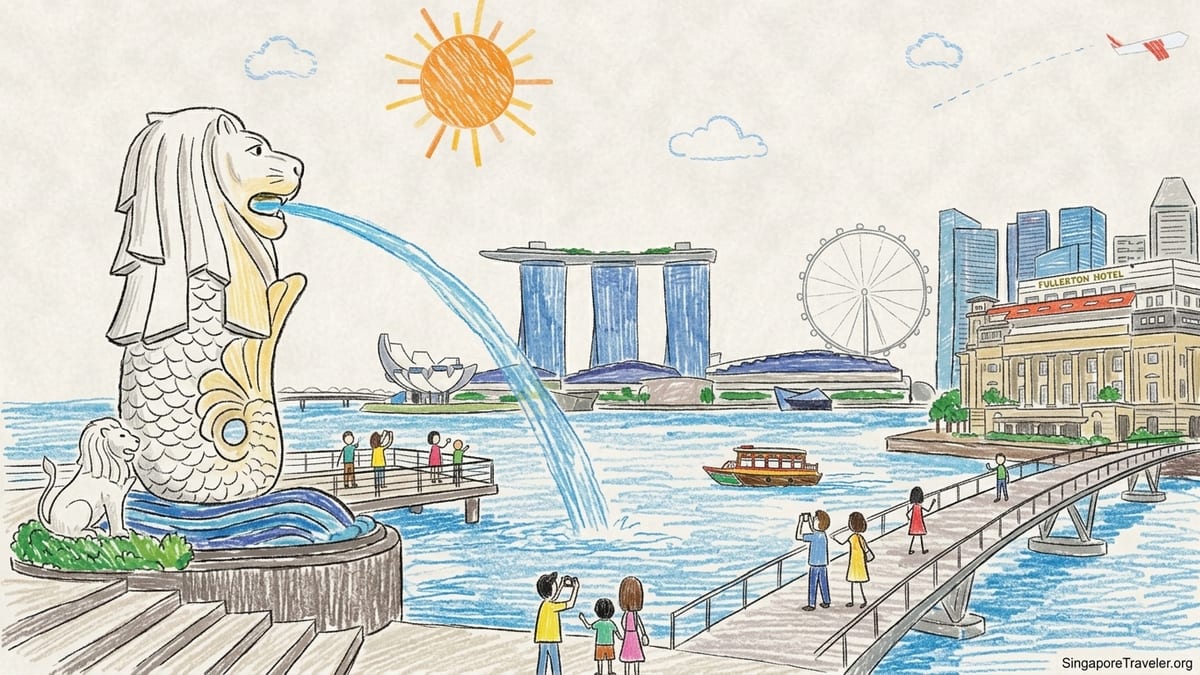
The statue did not always stand where you see it today. It was originally installed at the mouth of the Singapore River in 1972, then moved in the late 1990s to its present waterfront position in front of The Fullerton Hotel after the Esplanade Bridge blocked the view from the bay. Today the park is a purpose-built viewing terrace facing Marina Bay Sands, the ArtScience Museum and the Singapore Flyer, with a smaller “Merlion cub” beside the main statue.
There is no entry fee and no formal gate. Merlion Park is essentially an open-air promenade built around the statue, with a paved viewing area, a jetty that extends toward the bay, some seating along the sea wall and a cluster of waterfront restaurants nearby. You can come at any hour of the day or night, walk straight up, take your photos and leave within 20 to 30 minutes if you are efficient. The key to making it feel “worth it” is timing your visit and combining it with the rest of the Marina Bay circuit.
Best Photo Spots: Where to Stand for That Classic Skyline Shot
Most visitors instinctively walk directly in front of the Merlion and point their phone at the statue, but the better angles are a few steps off that obvious spot. For the classic shot with Marina Bay Sands in the background, stand on the right-hand side of the viewing platform when you face the water. From there you can frame the Merlion on one side of the image and Marina Bay Sands on the other, with the ArtScience Museum and Helix Bridge peeking in. Photographers often bring a wide-angle lens in the 16–24 mm range to capture everything in one frame.
If you want the playful “drinking from the Merlion” or “catching the water in your hands” photo, you need to move further back along the jetty or the lower steps nearest the water. Watch how tour groups line up: they position their subject several meters away from the statue and angle the camera so the water stream appears to land in a cup, hat or open mouth. Expect to wait your turn if you visit between late morning and sunset on a weekend. Patience and a bit of choreography with nearby visitors will go a long way here.
For wider cityscapes, walk a minute or two away from the statue along the promenade in front of One Fullerton or onto the Jubilee Bridge. From this vantage point you can capture the Merlion in the foreground with the Central Business District skyline behind it, or flip your perspective and focus on Marina Bay Sands with the Merlion reduced to a small but recognizable element in the frame. Serious photographers sometimes set up tripods in these quieter corners at blue hour to blur the water and capture office lights flickering on across the bay.
Do not forget to turn around. Many visitors keep their eyes locked on Marina Bay Sands and miss the more historic side of the view: The Fullerton Hotel, Anderson Bridge, Boat Quay and the low colonial-era buildings that line the Singapore River. A simple shot looking back from the Merlion steps toward the hotel gives you a completely different mood, especially in soft early-morning light before the financial district wakes up.
MRT Access and Practical Ways to Arrive
The simplest way to reach Merlion Park is by MRT to Raffles Place station. From there it is an 8 to 10 minute walk following signs toward the river and The Fullerton Hotel. Many first-time visitors exit at Raffles Place, walk along the covered walkways of One Raffles Place and Change Alley, and emerge almost directly opposite Anderson Bridge. Once you see the grand facade of The Fullerton Hotel, it is just a matter of crossing the road and following the path down to the water.
If you are already exploring Suntec City or the Esplanade area, Esplanade or City Hall MRT stations work just as well in practice. From Esplanade station you can walk through the mall and out toward the waterfront in about 10 to 15 minutes, then cross the Jubilee Bridge to arrive at the Merlion. This route is convenient if you want to start or end your visit with a performance or dinner near Esplanade Theatres on the Bay. City Hall offers easy underground connections to Raffles City and the National Gallery area, making it a good choice if you are combining heritage sites with the bayfront.
On the Marina Bay Sands side of the water, Bayfront MRT is your natural entry point. Many visitors staying at Marina Bay Sands or visiting Gardens by the Bay walk from Bayfront station through the hotel or the underground mall, then follow signs outside to the waterfront promenade. From there you can circle the bay counterclockwise across the Helix Bridge, past the ArtScience Museum and along the waterfront until you reach Merlion Park on the opposite side. This loop is flat, stroller friendly and popular with evening joggers, and it turns a single viewpoint into a full city walk.
Taxis and ride-hailing services such as Grab or Gojek can drop you at The Fullerton Hotel or One Fullerton if you are traveling with luggage or small children. Traffic is usually manageable outside weekday rush hours and major events such as the Formula 1 Singapore Grand Prix. If you are on a tight layover from Changi Airport, a taxi can get you to the Merlion area in roughly 20 to 30 minutes in light traffic, leaving enough time for a 60 to 90 minute wander around Marina Bay before heading back.
Sunrise, Evening and the Spectra Light Show
The way Merlion Park feels changes dramatically with the time of day. Sunrise between around 7:00 and 7:30 am often brings soft pastel skies and relatively cool temperatures, especially between November and February when the sun tends to rise behind Marina Bay Sands. On weekdays the park can be almost empty at this hour apart from a few joggers and photography enthusiasts. If you want unobstructed tripod space or a quiet moment by the water before tackling busy attractions, early morning is by far the most peaceful option.
By late afternoon, the heat eases and most visitors drift in between 4:00 pm and 7:30 pm. This is when the classic skyline shots are easiest to expose on a phone without blown-out highlights, and when the buildings across the bay begin to light up. Crowds are heavier but still manageable on weekdays, with more local office workers strolling the waterfront and small group tours gathering for photos. Weekend evenings, especially Saturdays, can feel packed as bus tours, families and couples all converge around sunset.
After dark, Marina Bay Sands puts on its free “Spectra” light and water show on the opposite side of the bay, which many visitors watch either directly outside the Shoppes at Marina Bay Sands or from around Merlion Park. Exact timings can change, but there are usually multiple showings each evening, typically starting around 8:00 pm. Watching from Merlion Park gives you a wide, panoramic view of the lasers, fountains and projected lights playing out above the water, but expect dense crowds pressed against the railings during show times and the half hour beforehand.
For most travelers, the sweet spot is to arrive about an hour before the first evening light show. That gives you time to take your Merlion photos in the golden and blue hour, then either walk across the bay to watch Spectra up close or stay put and enjoy a more panoramic view from the promenade. If the thought of shoulder-to-shoulder crowds and humid evenings sounds miserable, plan a dawn visit instead, then return to the Marina Bay side another night solely for the light show.
How Much Time You Really Need and When It Is Worth It
Standing in front of the statue itself typically takes no more than 20 to 30 minutes, even if you pause to compose a few creative shots. There is no museum to tour, no queue to enter and no paid tickets to purchase unless you decide to dine in the surrounding restaurants. If you detour by taxi just to stand on the platform, snap two photos and leave, it may well feel underwhelming compared to attractions like Gardens by the Bay or the Singapore Zoo, which demand several hours each.
Where Merlion Park shines is as part of a broader Marina Bay walk. For example, if you are staying near Orchard Road or Bugis, you could spend a late afternoon at the National Gallery Singapore, walk down to the Padang and Esplanade Park, cross Jubilee Bridge as the sun sets, then loop around the Merlion before following the waterfront to Marina Bay Sands for dinner. In this scenario the Merlion is a scenic stop and an anchor for your photos rather than the sole reason for your outing.
For a short layover, Merlion Park can serve as an efficient snapshot of the city. Travelers with 6 to 8 hours between flights often take a taxi from Changi, stroll around Merlion Park, walk part of the bayfront, maybe ride the Singapore Flyer or pop briefly into a mall, then head back. As long as you keep moving and avoid peak rush-hour traffic in and out of the city, you can comfortably fit this into a half-day without feeling rushed.
If your time in Singapore is extremely limited and you are choosing between Merlion Park and a uniquely Singaporean food experience at a hawker centre, many repeat visitors would argue that the food wins. The best compromise is to see the Merlion as you are already passing through the area for other reasons, such as heading to a rooftop bar at Marina Bay Sands, attending a conference at Suntec City, or visiting Gardens by the Bay. Think of it as a bonus icon along your route, not as the main event.
Linking Merlion Park with Fullerton, Jubilee Bridge and the Esplanade
One of the easiest ways to make Merlion Park feel more substantial is to pair it with The Fullerton Hotel and the historic civic district. After taking your photos at the water’s edge, walk up the steps toward The Fullerton’s grand facade. This former General Post Office building has been carefully restored as a luxury hotel, and even if you are not staying there, stepping inside the lobby for a few minutes lets you admire its high ceilings and colonnades. Many travelers grab a coffee or an ice cream sandwich from nearby stalls to cool off before continuing.
From The Fullerton, it is a short walk to the Anderson and Cavenagh bridges and the Asian Civilisations Museum on the far side of the river. This route lets you see both the financial district towers and low-rise colonial architecture in a single 15 to 30 minute detour. In the late afternoon, you will pass office workers heading to Boat Quay for drinks, joggers circling the river and tourists angling for sunset shots from the bridges, which gives you a good feel for downtown Singapore life.
Alternatively, turn your back on The Fullerton and follow the waterfront toward the Jubilee Bridge. Opened in 2015 as a wide, gently curving pedestrian link between Merlion Park and Esplanade Theatres on the Bay, the bridge is designed for views rather than traffic. It is flat, barrier-free and wide enough for strollers and wheelchairs, and it offers some of the most photogenic angles of Marina Bay when you stop halfway and look back. Evening walkers often pause here to watch office windows light up, boats crisscross the bay and the last tour groups file out of Merlion Park.
Once you reach the Esplanade side, you can wander past the durian-shaped domes of the performing arts center, cut through Esplanade Park to the Padang and the National Gallery, or continue onward toward Suntec City and the Fountain of Wealth. In practical terms, this means you never have to make a separate, dedicated trip to Merlion Park: you simply include it as one of several natural waypoints on a loop that is already rich with architecture, food and city life.
Walking the Marina Bay Waterfront from Merlion to Marina Bay Sands
If you start your stroll at Merlion Park and have an hour or two, a full Marina Bay loop is one of the best low-effort ways to see central Singapore. From the statue, follow the water east toward the Jubilee Bridge, then continue along the promenade past the Esplanade and around the edge of Marina Bay. The path is flat, paved and lined with benches, and you will be sharing it with runners, families and couples, especially after sunset when the heat drops.
As you approach Marina Bay Sands, you pass the ArtScience Museum, the lotus-shaped building that often hosts big traveling exhibitions, and the Helix Bridge, whose double-helix structure is especially striking at night under blue and purple lights. The bridge leads toward the Singapore Flyer and the Marina Bay Sands mall, where air-conditioned cafes and food courts offer a welcome break from the humidity. Many visitors time their walk to end here so they can grab an early dinner before attending the Spectra light show beside the water.
If you are staying near Marina Bay Sands, you can easily reverse this route. Start in the late afternoon at the Helix Bridge, work your way around the waterfront, then arrive at Merlion Park for blue-hour photos and city lights reflected in the bay. From there you can either walk across Jubilee Bridge and catch the MRT from Esplanade or City Hall, or head inland past The Fullerton into the Raffles Place area for a quick hawker-centre dinner.
The full loop from Merlion Park to Marina Bay Sands and back across the Helix Bridge is roughly 3 to 4 kilometers depending on how much you zigzag for photos. Most reasonably fit travelers can do it in an hour at a relaxed pace, longer if you stop often. Because the route is exposed to sun and rain with limited shade, bring water, sunscreen and a light rain jacket or umbrella, especially during the wetter months from November to January.
The Takeaway
Merlion Park is not an all-day attraction, and it is not trying to be. The statue itself is a quick, free stop that delivers an instantly recognizable view of Singapore, then invites you to keep walking. If you treat it as a standalone destination, you may walk away underwhelmed; if you fold it into a wider circuit around Marina Bay, it becomes a memorable anchor point in a half day that also includes architecture, skyline views, art, shopping or dining.
For many visitors, the best strategy is simple. Reach the area by MRT, give the statue 20 to 30 minutes for photos and people-watching, then immediately expand your radius: step into The Fullerton for a glimpse of old Singapore, cross the Jubilee Bridge to the Esplanade, or trace the waterfront to Marina Bay Sands and Gardens by the Bay. In doing so, you see Merlion Park not as a single postcard stop, but as one of several perspectives on how Singapore has grown from fishing village to global city in just a few generations.
FAQ
Q1. Is Merlion Park really worth visiting if I have limited time in Singapore?
It is worth it if you can combine it with a wider Marina Bay walk. The statue alone takes about 20 to 30 minutes, but when paired with The Fullerton, Jubilee Bridge, the Esplanade and Marina Bay Sands, it becomes a satisfying snapshot of central Singapore. If you are choosing between only the Merlion and a major attraction like Gardens by the Bay, prioritize the larger attraction and try to fit Merlion Park in as a stop along the way.
Q2. How long should I plan to spend at Merlion Park?
Plan roughly 20 to 30 minutes for the statue and immediate viewpoints if you are focused on photos. Add another 30 to 60 minutes if you hope to stroll along the waterfront toward the Esplanade or Marina Bay Sands, or if you want to watch the evening Spectra light show from the promenade.
Q3. What is the best time of day to visit Merlion Park for photos and smaller crowds?
Early morning between about 7:00 am and 9:00 am usually brings the smallest crowds and cooler temperatures, especially on weekdays. Late afternoon and early evening offer more dramatic skies and city lights but also significantly more people, particularly on weekends and during the Spectra light show.
Q4. Which MRT station is best for reaching Merlion Park?
Raffles Place MRT is generally the most convenient, with an 8 to 10 minute walk to the statue via The Fullerton Hotel. Esplanade and City Hall are good options if you are approaching from the civic district or Suntec City, while Bayfront MRT makes sense if you are staying at or visiting Marina Bay Sands and want to walk the waterfront loop across the Helix Bridge.
Q5. Can I see Merlion Park and Marina Bay Sands in a single visit?
Yes, many travelers do exactly this. A common route is to start at Merlion Park, walk along the waterfront past the Esplanade and ArtScience Museum, then end at Marina Bay Sands for shopping, dinner or the Spectra light show. Reversing the loop works just as well if you are staying on the Marina Bay Sands side.
Q6. Is Merlion Park open 24 hours, and is there an entrance fee?
Merlion Park is an open public space with no gates, so you can visit at any hour of the day or night. There is no entrance fee to see the statue or walk along the promenade. You only pay for any food, drinks or boat tours you choose to add.
Q7. What should I bring with me when visiting Merlion Park?
Bring water, sunscreen, a hat and possibly a small umbrella or rain jacket, as the waterfront is exposed with limited shade and sudden showers are common. Comfortable walking shoes are useful if you plan to continue around Marina Bay, and a power bank helps if you expect to take a lot of photos or videos.
Q8. Are there good food options near Merlion Park?
Yes, there are waterfront restaurants and cafes around One Fullerton and The Fullerton Hotel, which are convenient but typically priced above hawker-centre levels. If you prefer local food at more modest prices, you can walk or take a short MRT ride to nearby hawker centres such as Lau Pa Sat or Makansutra Gluttons Bay near the Esplanade, both popular with locals and visitors.
Q9. Is Merlion Park suitable for families with children or visitors with limited mobility?
Yes. The park is flat, largely step-free and stroller friendly, and the Jubilee Bridge provides a wide, barrier-free connection to the Esplanade side. Railings along the promenade and frequent benches make it comfortable for visitors who need to rest often, though the heat and humidity can be tiring in the midday sun.
Q10. Can I fit Merlion Park into a short airport layover?
It is possible on a 6 to 8 hour layover if you are comfortable leaving the airport. A taxi to the Merlion area can take around 20 to 30 minutes in light traffic, leaving time for a 60 to 90 minute walk around Marina Bay before returning to the airport. Always allow a generous buffer for immigration, transport and security when planning a layover visit.