


ArtScience Museum at Marina Bay Sands is one of Singapore’s most popular paid cultural attractions, but its ticketing can be confusing. Between teamLab’s immersive Future World, rotating blockbuster exhibitions and multi-exhibition Museum Tickets with peak and non-peak pricing, the best-value option depends very much on what you want to see and when you visit. This guide breaks down the current ticket types, prices and timing so you can choose smartly and avoid overpaying at the lotus-shaped museum on Marina Bay.
Key ticket types at ArtScience Museum
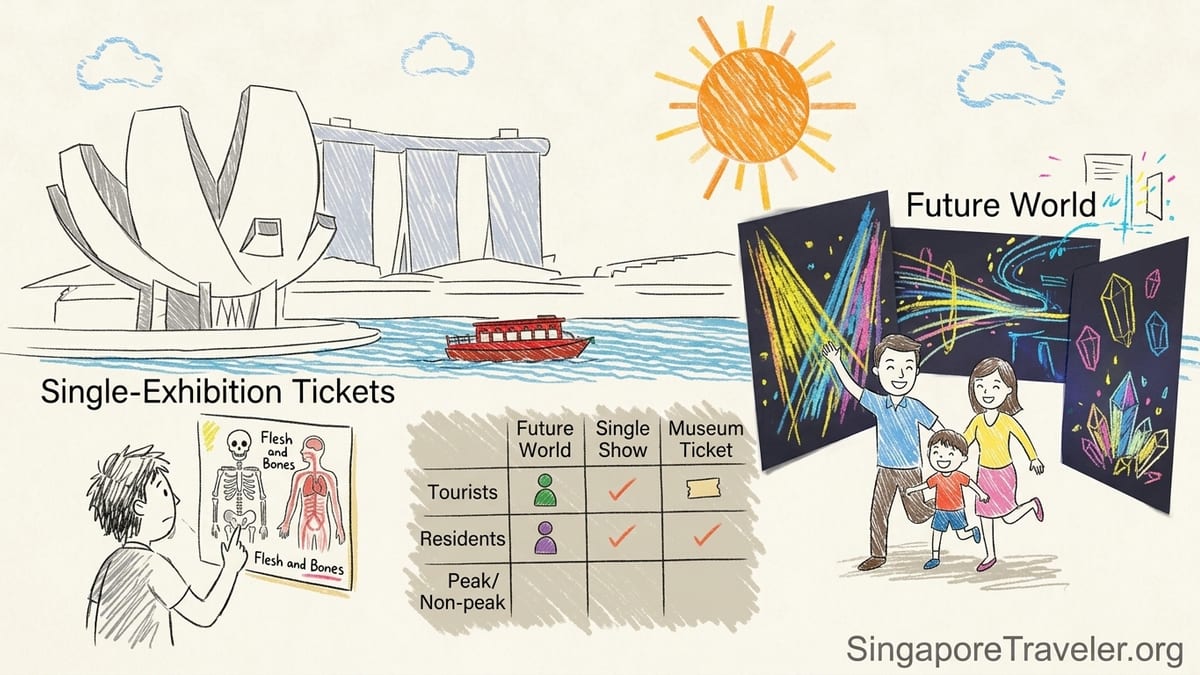
ArtScience Museum sells access mainly on a per-exhibition basis. Instead of one flat entrance fee, you choose between tickets for individual exhibitions, dedicated admission to teamLab’s Future World, or a multi-exhibition Museum Ticket that bundles several shows. On top of that, prices differ for tourists versus Singapore residents, and are higher on peak dates such as Fridays, weekends, school holidays and public holiday periods.
The simplest option is a single-exhibition ticket. This buys you entrance to one temporary show such as Flesh and Bones: The Art of Anatomy, which runs from March to mid-August 2026, or another current feature exhibition in the galleries above the lobby. If you only care about one specific topic and have limited time, this is the most straightforward product, but it can add up quickly if you want to see more than one show.
Future World has its own standalone ticket. This is the long-running collaboration with Japanese art collective teamLab, an immersive digital playground of light, projections and interactive rooms on Basement 2. Because it is the museum’s best-known crowd magnet and is often sold through third-party platforms as a timed entry, Future World is priced differently from most other exhibitions and is always a separate line on the ticket board.
The third major option is The Museum Ticket, a multi-exhibition product that bundles Future World with selected current exhibitions for one higher but potentially better-value price. In mid 2026, for example, The Museum Ticket covers Future World plus at least two other major shows, and is sold in both peak and non-peak versions with different prices and validity periods.
Future World tickets: prices, timing and who they suit
Future World: Where Art Meets Science is treated almost like its own attraction within the museum. As of mid 2026, a standard adult tourist pays around S$35 on non-peak dates and S$39 on peak dates for a Future World ticket, while Singapore residents with valid ID pay a few dollars less, at roughly S$28 non-peak and S$32 peak. Concession and family tickets are available, but the key thing for most visitors is that peak dates attract noticeably higher pricing than weekday non-peak days.
In practice, Future World can easily fill 60 to 90 minutes if you take time to interact with the artworks, especially in the sketch-and-scan areas where children can see their own drawings come alive on the walls. Many families with younger kids end up staying closer to two hours because children want to revisit favorite installations. Adults visiting without children may move faster, spending about 45 to 60 minutes if they are mainly interested in photography and a quick immersive taste rather than lingering play.
Future World is particularly beneficial for children and teens. The exhibition is organised into zones like Nature, Town and Park, where responsive digital installations react to movement, touch and drawing. Younger kids often enjoy the slide with projected animations, the crystal-like LED room and the sketch aquarium where fish they color appear swimming on the walls. Parents should be prepared for dark spaces and sensory overload, but staff are generally helpful and visitors can step out to the circulation areas if a break is needed.
Because capacity is controlled and certain artworks periodically close for upgrades, such as two Gallery 1 pieces being unavailable until late August 2026, it is worth booking Future World tickets in advance for weekends or school holidays. Timed entry slots in the late morning or early afternoon tend to be popular with families, while late afternoon sessions can feel slightly calmer, which is helpful if you prefer more space around the installations.
Single-exhibition tickets: when they make sense
Aside from Future World, the rest of ArtScience Museum operates on a per-exhibition model. Each major exhibition has its own ticket type and pricing tier, which differs for standard tourists, Singapore residents, concessions and sometimes families. For example, a high-profile show such as Flesh and Bones: The Art of Anatomy typically starts from the low to mid twenties in Singapore dollars for residents and a few dollars more for tourists on non-peak dates, and then jumps slightly on peak days.
Single-exhibition tickets work best for visitors who are strongly interested in a particular theme and do not have time for more. A science and medicine enthusiast might buy only a ticket to Flesh and Bones and spend a focused 60 to 90 minutes studying the artworks, anatomical drawings and multimedia installations without visiting Future World at all. Similarly, if there is a photography or design exhibition that appeals to you but you are short on time, paying for that one show is often more efficient than committing to the full museum bundle.
Time-wise, most single exhibitions at ArtScience Museum are designed so that an average visitor spends about one hour, with some people lingering up to 90 minutes if they read every wall label and engage with multimedia components. Families with young children often move more quickly through text-heavy exhibitions, sometimes completing them in 40 to 50 minutes, especially if there are fewer interactive elements compared with Future World.
Cost-wise, though, separate single-exhibition tickets can quickly become poor value. If you visit Future World plus two or more temporary exhibitions, buying three or four different tickets individually can easily add up to more than the price of The Museum Ticket. The museum’s own price table as of mid 2026 shows that once you go beyond one or two exhibitions, the multi-exhibition ticket is usually the more economical choice for most adults.
The Museum Ticket: multi-exhibition value explained
The Museum Ticket is ArtScience Museum’s way of bundling Future World with other current exhibitions for one combined price. In mid 2026, there is a clear separation between peak and non-peak Museum Tickets. On peak dates between June and mid August 2026, a standard adult tourist Museum Ticket is priced in the high seventies, while from late August to early November non-peak Museum Tickets are significantly cheaper, in the high forties to low fifties depending on date and whether there has been a minor price revision.
For a typical tourist adult visiting on a non-peak weekday after 17 August 2026, The Museum Ticket at about S$49 to S$51 gives access to Future World and multiple exhibitions such as Flesh and Bones and at least one other concurrent show. If you were to purchase Future World at roughly S$35 plus two separate exhibitions at around S$25 each, you would already be at S$85, far above the multi-exhibition price. Even if your chosen exhibitions are slightly cheaper than that, The Museum Ticket generally saves money as soon as you enter your second non-Future World exhibition.
On peak days, such as a Saturday in late July 2026, the calculus is similar but the numbers are higher. A peak Museum Ticket for a standard adult tourist is in the high fifties to mid seventies depending on the exact season, compared with a roughly S$39 Future World peak ticket and S$28 to S$30 individual exhibition tickets. A visitor who wants to do Future World plus two exhibitions would be looking at more than S$95 if paying individually, so a peak Museum Ticket around S$58 to S$77 is still the more rational choice for a full day.
Where The Museum Ticket is less compelling is if you are certain you will only enter one additional exhibition besides Future World, or if one of the current exhibitions does not appeal to you at all. In that case, comparing the total of a Future World ticket plus a single-exhibition ticket against the Museum Ticket price for your specific date is important. For some weekday lunchtime visits where you only manage Future World and one small exhibition, the multi-exhibition bundle may not necessarily pay off.
Peak vs non-peak pricing and the new opening hours
ArtScience Museum uses a clear peak and non-peak pricing system that affects Future World, single exhibitions and The Museum Ticket. Traditionally, non-peak dates cover most Mondays to Thursdays outside school holidays and major events, while peak periods include Fridays, weekends, public holidays and sometimes extended school holiday blocks. The practical effect is that the same Future World ticket can be a few dollars cheaper on a Wednesday afternoon than on a Saturday morning in July.
From September 2026, the museum is standardising its daily opening hours to 9 am to 6 pm. This means last entry will typically be in the late afternoon, and ticket counters or online sales for same-day visits may close roughly an hour before the official closing time. For travelers, this shift makes the morning slot more attractive if you want to fit both Future World and at least two exhibitions into a single day without rushing.
Non-peak weekday mornings are particularly good value and tend to be quieter. A visitor arriving soon after 9 am can complete Future World by 10.30 or 11 am, then see two more exhibitions with a break for lunch at Marina Bay Sands, finishing by around 4 pm. The same plan on a Saturday of the school holidays will be more expensive and more crowded, so if you have scheduling flexibility, aligning your visit with non-peak dates makes both financial and crowd-sense.
Because prices and what counts as peak can change with special events, it is always wise to check the official price calendar shortly before you book. Third-party platforms sometimes bundle Future World with extras like Digital Light Canvas or virtual reality experiences at promotional rates, but these are still based on the museum’s underlying peak and non-peak categories.
How long to budget and which combinations work best
In practical terms, Future World plus two major exhibitions is about as much as most visitors will comfortably handle in a single day. Future World usually takes 60 to 90 minutes, each temporary exhibition about an hour, and you will need additional time for queuing, short rests and moving between floors. A realistic schedule for a comprehensive visit is roughly four to five hours inside the museum, not counting meals or a walk along the bay.
For families with children under 10, Future World is the clear priority. Many parents choose a Future World ticket plus The Museum Ticket if their kids have the stamina, then decide on the day whether to do all bundled exhibitions or just pick one extra that looks visually engaging. Exhibitions heavy on reading or medical imagery, such as Flesh and Bones, might be more suitable for older children and teenagers who can cope with anatomical content and longer text panels.
Adults traveling without children often invert that logic. A pair of travelers who are fans of contemporary art may start with a highlight exhibition upstairs, then dip into Future World for a taste of the immersive digital rooms before finishing with a third show if energy allows. In this case, The Museum Ticket spreads the cost across multiple interests and normally ends up cheaper than purchasing three standalone entries, especially on peak dates.
If you only have two to three hours in your day, the best use of time is usually to focus on Future World and one carefully chosen exhibition. For example, a visitor with a late afternoon flight might arrive at the museum at 9 am, spend 75 minutes in Future World, and then dedicate the remaining time to Flesh and Bones before leaving around noon. In such cases, check prices for a Future World ticket plus one single exhibition against the Museum Ticket to see which combination is cheaper for your specific date.
Current exhibitions and how they affect ticket choice
Because ArtScience Museum’s programme changes regularly, the exact mix of exhibitions you can bundle under The Museum Ticket will differ depending on when you visit. In 2026, one of the headline shows is Flesh and Bones: The Art of Anatomy, which examines how artists, scientists and physicians have visualised the human body over centuries. Other slots on the exhibition calendar are filled by design, technology and popular culture shows that may range from immersive media art to collaborations with film studios or fashion brands.
The nature of the current exhibitions should strongly influence whether you buy a Museum Ticket or just single-exhibition access. If the line-up includes two or three topics that genuinely interest you, such as anatomy, digital culture and environmental art, then the multi-exhibition bundle represents good value and allows you to move flexibly between shows during your visit. If, on the other hand, only one exhibition really appeals, you may save money by skipping the bundle and paying solely for that show plus Future World, or even skipping Future World entirely if you have already experienced teamLab in Japan or elsewhere.
It is also worth considering how intense or specialised each exhibition is. A visually rich but conceptually light show can provide a good balance after the sensory overload of Future World, while a dense science or history exhibition might be better tackled when you are still fresh. When checking the current programme for your travel dates, think not only about price but also about how the subjects will feel in combination over several hours.
Because exhibitions and prices change regularly, travelers visiting later in 2026 or beyond should always re-check the official listings and ticket tables just before booking. Treat the price examples in this guide as indicative rather than fixed figures; what is consistent is the pattern that multi-exhibition tickets become better value as soon as you add more than one additional show to Future World.
The Takeaway
The main decision at ArtScience Museum is not whether to go, but which ticket structure suits your priorities and timing. Future World is the star attraction, particularly for families and for anyone who has never experienced a teamLab installation, but it is priced accordingly, with peak dates costing several dollars more than weekdays. Temporary exhibitions rotate and range from anatomy and science to design and pop culture, and each has its own ticket price that can quickly add up if you chase them individually.
As a rule of thumb, if you plan to visit Future World and at least two other exhibitions on the same day, The Museum Ticket is usually the best value, especially on peak dates. If your schedule or interest stretches only to Future World plus one additional show, do the sums for your exact date and visitor category, as buying separately can sometimes be cheaper, particularly on non-peak weekdays. Travelers who care about just one text-heavy exhibition might skip Future World altogether and purchase only a single-exhibition ticket instead.
Finally, pay attention to peak and non-peak calendars, as well as the new 9 am to 6 pm daily hours from September 2026. Planning your visit on a non-peak weekday morning not only reduces ticket costs but also gives you more breathing room in Future World’s popular rooms. With a little advance thought and the right combination of tickets, you can experience the best of ArtScience Museum without overspending or feeling rushed.
FAQ
Q1. What is the difference between a Future World ticket and The Museum Ticket? A Future World ticket only covers the teamLab exhibition in the basement, while The Museum Ticket bundles Future World with several current exhibitions in the upper galleries for one combined price.
Q2. How do peak and non-peak prices affect what I should buy? Peak prices on Fridays, weekends and holidays are noticeably higher. The more you see on a peak day, the more a Museum Ticket tends to save compared with buying separate Future World and single-exhibition tickets.
Q3. Is Future World worth it if I am traveling without children? Yes, many adults visit Future World for the immersive rooms and photography opportunities. Expect to spend about an hour if you move steadily, or longer if you like to linger.
Q4. How much time should I budget for a full museum visit with The Museum Ticket? For Future World plus two major exhibitions, allow at least four to five hours including short breaks. This gives you time to explore without rushing between floors.
Q5. Do children get more out of Future World than the other exhibitions? Generally yes. Future World is highly interactive, with digital slides, responsive projections and drawing stations that appeal to kids. Many temporary exhibitions are more text-based and suit older children, teens and adults.
Q6. When will the museum’s new 9 am to 6 pm opening hours apply? From September 2026, ArtScience Museum plans to operate daily from 9 am to 6 pm, so visitors should aim to arrive by mid-afternoon at the latest for a meaningful visit.
Q7. As a tourist, can I access resident pricing by buying tickets on-site? Ticket categories are officially based on your status as a tourist or Singapore resident, verified by ID. Some third-party platforms may show slightly different prices, but you should not rely on being granted resident rates without valid documentation.
Q8. Is it poor value to buy several separate single-exhibition tickets instead of The Museum Ticket? Once you combine Future World with two or more exhibitions, buying separate tickets is usually more expensive than the Museum Ticket, especially on peak dates. The bundle is designed to make multi-exhibition days better value.
Q9. Should I book Future World and Museum Tickets in advance? Advance booking is strongly recommended for weekends, holidays and school breaks, as Future World uses timed entry and popular slots can sell out. Weekday non-peak slots are more forgiving but still benefit from pre-booking.
Q10. What if an exhibition I want to see closes or changes before my trip? ArtScience Museum’s programme shifts regularly, so always check the current exhibitions and ticket inclusions close to your visit. If a headline show ends before you arrive, reassess whether a Museum Ticket still offers good value or if single-exhibition access and Future World are enough.