


The Singapore Flyer is more than a giant observation wheel on Marina Bay. A standard ticket today combines the Time Capsule multimedia journey with a calm 30 minute rotation up to 165 metres, plus a growing menu of premium options that layer on champagne, Singapore Slings or full revolving dinners. This guide focuses on practical ticket choices, timing and visibility so that travellers who have already decided to ride the Flyer can book with confidence and realistic expectations.
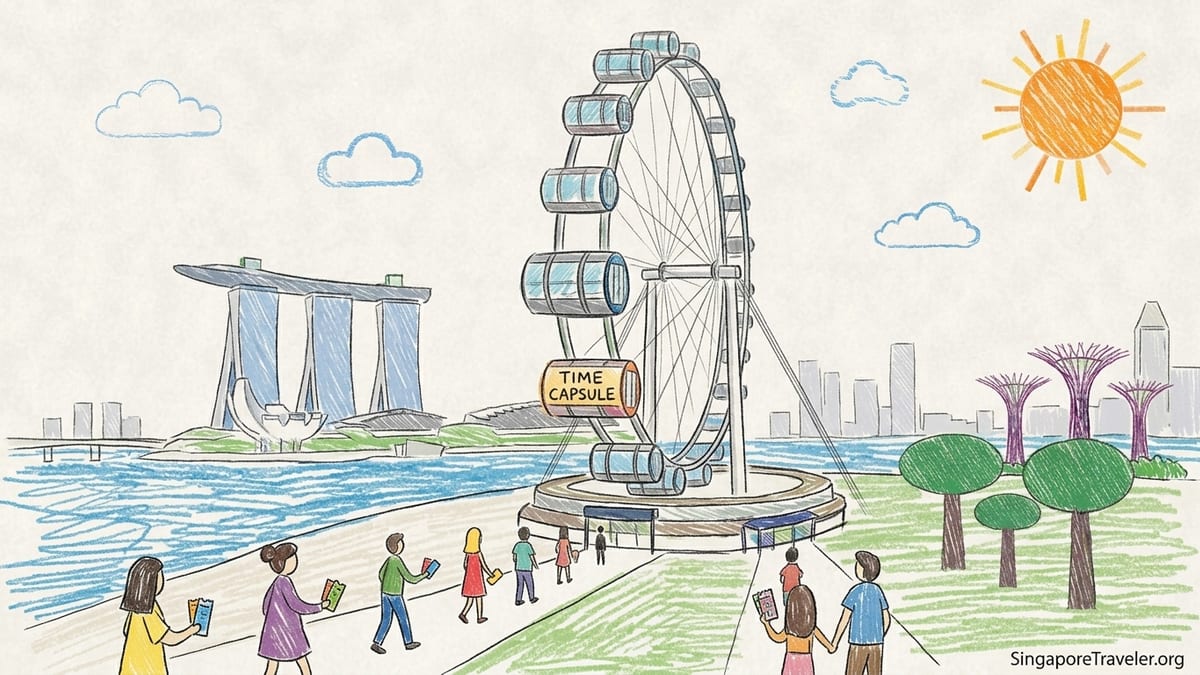
How Singapore Flyer tickets work today
The current core product is simple: one standard Singapore Flyer ticket that includes entry to Time Capsule, followed by a single shared-capsule flight of roughly 30 minutes at up to 165 metres above Marina Bay. In practical terms, most visitors now experience the attraction as a combined one to one-and-a-half hour visit that starts indoors and ends with the slow rotation above the bay, without having to choose separate add-ons for the basic walkthrough and ride.
On the official ticketing channels the standard adult ticket is typically sold as “Singapore Flyer + Time Capsule” for one fixed price, with the same headline rate for overseas visitors and Singapore residents. Third-party resellers sometimes package the same standard ticket with other Marina Bay attractions such as Gardens by the Bay conservatories or ArtScience Museum, but the underlying Flyer product is still that same Time Capsule plus one flight in a shared capsule. When comparing prices, check that the ticket explicitly mentions both the Flyer and Time Capsule so you are not buying an outdated ride-only product.
Boarding is on a continuous basis rather than timed to the minute. You will usually pass through a short pre-boarding area before stepping into the slowly moving capsule. Queues vary widely: on a quiet Tuesday afternoon you may walk straight on, while on a Saturday around sunset the wait can stretch to 30 minutes or more. If your schedule is tight, factor in this variability rather than assuming a fixed boarding time.
Families should note that each air-conditioned capsule is large, standing-room based and shared with other visitors unless you book a private product. There is space for strollers folded down, and wheelchair users can roll on with staff assistance, but the general experience is closer to a glass viewing lounge than to a compact amusement-park gondola. For most visitors that shared-capsule format is the best value way to experience the views.
What to expect at Time Capsule
Time Capsule is positioned as the starting point of the Singapore Flyer experience and is included in the standard ticket. It is an indoor, multimedia walkthrough that uses projection mapping, soundscapes and interactive elements to sketch Singapore’s past and future in a stylised way. Visitors move through themed spaces rather than a traditional museum gallery, which means there is no fixed pace: you might spend as little as 20 minutes or well over 40 depending on how thoroughly you engage with each zone.
In practice, many travellers treat Time Capsule as a warm-up for the ride. For example, a family with school-age children might use the early sections, which show a whimsical version of old Singapore streets and harbour scenes, as a way to introduce the city’s history before heading up to see the real skyline. Couples visiting in the evening often move more quickly through the displays to avoid missing their preferred sunset slot on the wheel, pausing mainly in the more visually dramatic rooms with animated cityscapes.
The attraction is indoors and fully air-conditioned, which makes it a useful buffer against Singapore’s humid heat and sudden showers. If a heavy downpour sweeps over Marina Bay just before your booked time, you can slow down inside Time Capsule until visibility improves outside. That flexibility is particularly handy in the late afternoon during the wetter months, when brief but intense thunderstorms are common.
Most visitors find Time Capsule pleasant rather than unmissable. It is not as content-dense as the National Museum or National Gallery, and there is less text and artefact-style display. Instead, think of it as an atmospheric pre-show that adds context and value to the ticket you have already bought. Skipping it entirely usually only makes sense if you are racing to catch the last flight of the night.
Ride duration, timing and total visit time
The Singapore Flyer’s wheel completes one full rotation in about 30 minutes. The motion is very gradual, so those nervous about heights are more likely to feel like they are in a slow-moving viewing lounge than on a theme park ride. Official and tourism board materials consistently refer to a 30 minute flight, and in real-world terms you can expect to step off the capsule roughly half an hour after boarding, with only small variations depending on operational speed.
Adding Time Capsule and practicalities, most visitors should budget 60 to 90 minutes from arrival at the terminal to exit back at ground level. A typical sequence might look like this: 25 minutes in Time Capsule, 10 to 20 minutes queueing and boarding, 30 minutes on the wheel, then a few minutes in the souvenir and photo area. During off-peak weekday mornings the queue element may shrink almost to zero, bringing the total closer to one hour, while on peak holiday evenings you could easily edge towards the upper end of that range.
It is sensible to work backwards from any fixed plans you have around Marina Bay. For example, if you are aiming to watch the Gardens by the Bay light show in the evening, starting the Flyer experience 90 minutes before the show gives you enough buffer to finish, walk over the Helix Bridge or Bayfront route, and find a comfortable viewing spot. Similarly, travellers with dinner reservations in the Marina Bay Sands waterfront area often target an earlier Flyer slot so they can enjoy the views, descend and stroll to the restaurant without rushing.
Operational hours have varied in recent years as the attraction adapted to demand and events, but the Flyer typically runs from mid-afternoon into the late evening on regular days. Before visiting, check same-week schedules on the official channels, as there can be occasional closures for maintenance or private events that affect the last flight of the night. Arriving within the first hour of opening or aiming for later in the evening outside of sunset peaks generally leads to shorter waits.
Daytime, sunset and after-dark views compared
The same 30 minute flight feels very different depending on when you ride. In the daytime, visibility is generally at its highest, which makes this slot ideal for photographers and first-time visitors who want to orient themselves physically in the city. On a clear mid-morning flight you can pick out the container port, the Supertrees of Gardens by the Bay, the Marina Bay Sands rooftop pool, the Central Business District towers and even the distant outlines of ships waiting off the coast. The colours are flatter under midday light, but the trade-off is the ability to identify landmarks and understand Singapore’s compact geography.
Sunset flights are by far the most requested, especially between roughly 6.30 pm and 7.30 pm depending on the time of year. The appeal is obvious: soft changing light over the bay, the chance to see the city shift from day to evening, and the glow on the water as the sun drops behind the skyline. Many couples and photography enthusiasts try to time their boarding so they are near the top of the rotation as the sky turns orange and pink. In practice, queues can be longer at this time, and precise timing is hard to control, so it is wise to treat sunset flights as a high-probability, not guaranteed, golden hour experience.
After dark, Singapore becomes a very different spectacle. The Flyer’s height gives sweeping views of illuminated office towers, the Marina Bay Sands light patterns and the changing colours of the ArtScience Museum and Helix Bridge. This is the best choice for those who care more about atmosphere than detail. From a family perspective, a night flight after an early dinner can be an easy finale to a day of sightseeing, particularly on Fridays and Saturdays when the bayfront feels lively but still relaxed. The main trade-off is that distant landmarks merge into the general glow, and reflections on the glass can complicate photography without a polarising filter or careful positioning.
Travellers who are staying multiple days in Central Singapore sometimes pair a daytime Flyer ride with an after-dark rooftop experience elsewhere, such as a drink at a bar in the Marina Bay Sands or Boat Quay areas on a different evening. This spreads out the costs while allowing you to see both detailed city views and the night skyline without cramming everything into one sunset window that might be compromised by clouds or showers.
How Singapore’s weather affects visibility and comfort
Singapore sits near the equator with consistently high humidity and frequent short rain showers. For Singapore Flyer passengers, this means visibility can change quickly. On a dry, slightly hazy day you will still see all major Marina Bay landmarks clearly, though the distant horizon may look muted. After a heavy rainstorm, the air often clears for an hour or two, delivering some of the crispest views of the Straits and outlying islands. Planning flexibility into your day, especially in the wettest months, increases your odds of catching one of these post-rain clarity windows.
Rain itself is not usually a reason for the Flyer to halt operations, as the capsules are fully enclosed and air-conditioned. Light to moderate showers simply add reflections on the glass and streaks on the outside of the capsules, which can soften photos but do not significantly reduce the experience. The concern is more about intense thunderstorms with lightning and strong winds, during which the operator may temporarily suspend boarding on safety grounds. If this happens just as you arrive, staff will typically advise you to wait indoors, visit Time Capsule first or return later that day where possible.
Temperature inside the capsules is cooled but not chilly, offering relief from outdoor heat. Visitors who are sensitive to air-conditioning may want a light layer, but most people are comfortable in regular tropical sightseeing clothes. If you are planning lots of outdoor walking before or after your flight, it can be refreshing to schedule the Flyer at the hottest part of the day, using the ride and Time Capsule as an extended indoor break between walking-intensive activities around Marina Bay and the Civic District.
Air quality can occasionally be an issue in the region during transboundary haze episodes. These events vary in intensity from year to year and may reduce long-distance visibility, making far-off islands and ships much harder to see from the top of the wheel. In such conditions, travellers focused on photography might choose to shift their ride to a different day if their schedule allows, while those treating the Flyer more as a relaxed indoor experience may still be satisfied with the softer, atmospheric views over the nearer parts of the bay.
Standard admission vs premium experiences
Beyond the standard Singapore Flyer ticket, a range of premium experiences has emerged to appeal to different travellers. The most common are the Premium Champagne Experience and the Singapore Sling Experience, which layer a drink service and priority handling onto the same basic flight. These are typically marketed with priority boarding, access to Time Capsule and a glass of champagne or a Singapore Sling served in the capsule. Prices are significantly higher than the base ticket, and private versions can be more expensive still, but for some visitors the combination of a quieter capsule and an iconic drink justifies the difference.
In practice, the value of these upgrades depends heavily on your expectations. A couple celebrating an engagement or honeymoon might be happy to pay for a premium champagne flight at sunset, treating it as an all-in-one pre-dinner activity and commemorative splurge. By contrast, a price-conscious family of four may find that the same money covers standard tickets plus a good meal in the nearby Esplanade or Marina Square area, with more overall enjoyment. The drink itself is served in a moving capsule where space is shared, so the experience centres less on mixology and more on the setting and priority feel.
Further up the scale, the 165 Sky Dining product turns the Flyer into a revolving restaurant. A shared-capsule four course dinner, which usually includes multiple rotations over roughly 90 minutes, can cost several times the standard ticket price per person. This typically bundles in set menus, dedicated staff, priority boarding and Time Capsule access. It suits travellers celebrating anniversaries or special occasions who like the novelty of dining in motion above the bay. Travellers who are more interested in culinary exploration might instead allocate that budget to tasting menus at well-known restaurants around Marina Bay and use a standard Flyer ticket for the view alone.
Occasionally, seasonal or promotional experiences appear, from National Day themed flights to festive-season packages that weave in decorations or special menus. These can be attractive if the pricing is close to the usual premium products, but they sell in limited windows and popular dates can book out quickly. When considering any of these offers, compare the total cost against what you would otherwise spend on a regular ticket plus a drink or meal elsewhere. In many cases, the premium is essentially for convenience, priority and ambience rather than a dramatically longer or different view.
When premium products justify the price
For many travellers, the standard Singapore Flyer ticket provides the best balance of cost and experience. If your primary goal is to see the skyline and tick the attraction off your list, that core product, ideally timed for a clear afternoon or early evening, is usually sufficient. You can always celebrate later with a cocktail in a ground-level bar or hotel lounge facing the bay, often at a lower overall cost than a premium flight plus separate drinks.
Premium products begin to make more sense in specific scenarios. If you are short on time and visiting during a peak period such as a weekend close to a public holiday, priority boarding on a champagne or Singapore Sling experience may significantly cut your waiting time, turning what could have been an hour-long process into a smoother 45 minute door-to-door event. For nervous or crowd-averse travellers, the semi-private feel of a less crowded capsule can also be worth paying for, especially in the early evening when shared capsules can feel busier.
Private capsules and Sky Dining stand out most for milestone celebrations. Travellers who might consider booking a private room in a waterfront restaurant or a harbour cruise for a big birthday sometimes find that a private Flyer capsule hits a similar emotional note. You get memorable photos, structured service and a story that feels distinctively “Singapore,” all within a confined window that does not dominate the whole night. On the other hand, if your group prefers to move around, sample multiple dishes or change environments, the fixed 60 to 90 minutes in a capsule may feel restrictive compared with a progressive dinner across different neighbourhoods.
One useful way to decide is to think in terms of opportunity cost. Take the price difference between a standard ticket and the premium option you are considering, convert it roughly to your home currency and ask what else you could do in Singapore with that amount. If the answer is “add another major attraction” or “upgrade a hotel night” and those matter more to you, stick with standard admission. If the answer is “cover a couple of casual meals we were going to have anyway” and you are marking a meaningful occasion, the premium Flyer experience can feel like a justified indulgence.
Planning your visit around Marina Bay
Because the Flyer sits on the edge of Marina Bay, it slots naturally into wider Central Singapore itineraries. A common pattern for first-time visitors is to start an afternoon at Gardens by the Bay, cross over to Marina Bay Sands for a quick look at the Shoppes or waterfront, then finish with a Singapore Flyer ride before or after dinner. In this context, it is usually easiest to pre-book a late afternoon or early evening standard ticket, leaving some flexibility to shift your precise boarding time around showers or crowd levels.
Travellers staying near City Hall, Bugis or Clarke Quay can comfortably walk to the Flyer in 15 to 25 minutes, passing landmarks such as the Esplanade theatres and the Helix Bridge along the way. This makes the attraction an easy add-on after a day of museum-hopping or shopping in the Civic District, without needing extra transport. A realistic schedule might involve visiting the National Gallery late morning, taking a lunch break nearby, then strolling to the Flyer for a mid-afternoon Time Capsule and ride when the heat peaks.
Public transport access is straightforward, with nearby MRT stations on the Circle and Downtown lines and frequent taxis and ride-hailing vehicles circulating around Marina Bay. If you are travelling with young children or older relatives, factor in a little extra time for walking between the station, the terminal and any post-ride plans. It can be helpful to pre-identify a family-friendly restaurant in the Marina Square or Suntec City malls to head to after the flight, especially if you ride at sunset when dinner queues can also peak.
Because the Singapore Flyer directly overlooks many of the city’s other signature experiences, it can work well on your first or second full day in the city. Seeing the layout of Gardens by the Bay, Marina Bay Sands, the Southern Islands and the Central Business District from above helps make sense of later trips to each place. If you are already planning to visit a rooftop bar or observation deck elsewhere, such as at Marina Bay Sands, consider spacing that out over another day rather than doing both on the same evening, to avoid skyline-view fatigue.
FAQ
Q1. How long does the Singapore Flyer ride actually take?
The wheel completes one full rotation in about 30 minutes under normal operating conditions, so you should expect to be inside the capsule for roughly half an hour.
Q2. How much total time should I allow for the Singapore Flyer including Time Capsule?
Most visitors need between 60 and 90 minutes from arrival to exit, covering Time Capsule, possible queues, boarding and the 30 minute flight.
Q3. Is the standard ticket enough, or do I need a premium experience?
For most travellers the standard ticket, which includes Time Capsule and one shared-capsule rotation, offers the best value. Premium options mainly add drinks, priority boarding and a quieter capsule.
Q4. What is the best time of day to ride the Singapore Flyer?
Clear late afternoon and early evening slots usually balance visibility and atmosphere. Sunset can be spectacular but also busier, with less predictable queues and light.
Q5. Will rain or bad weather ruin the experience?
Light to moderate rain rarely stops operations, as capsules are enclosed and air-conditioned, though it may add streaks and reflections on the glass. Severe thunderstorms or very low visibility can temporarily halt or diminish the experience.
Q6. Is the Singapore Flyer suitable for people afraid of heights?
The movement is slow and the capsules are large and enclosed, which many height-sensitive visitors find manageable. However, those with strong acrophobia may still feel uncomfortable near the windows.
Q7. Are children and strollers allowed on the Singapore Flyer?
Yes, children of all ages can ride, and folded strollers are allowed in the capsules. Many families combine the Flyer with nearby attractions such as Gardens by the Bay.
Q8. Do premium champagne or Singapore Sling flights include a longer ride?
Most premium drink experiences keep a similar rotation length to standard flights. What you mainly gain is priority boarding, a drink and a more exclusive atmosphere, not significantly extra time in the air.
Q9. Is Sky Dining worth it compared with a regular ride plus restaurant dinner?
Sky Dining is best for special occasions where the novelty of a revolving four course meal above Marina Bay matters more than having the widest choice of dishes or venues on the ground.
Q10. Do I need to book Singapore Flyer tickets in advance?
Booking in advance is strongly recommended for sunset, weekends and premium products. For quieter daytime slots on weekdays, same-day purchases are often still possible but subject to availability.