


I walked into Singapore’s National Library expecting a functional civic building: a place to borrow books, cool off in air-conditioning, and quietly leave. Instead, I found something closer to a compact, indoor cultural attraction, one that rewards curiosity even if you do not have a library membership, do not plan to check out a single title, and only have a short stay in the city.
This is the National Library Building at 100 Victoria Street, a twin-tower complex stitched together by bridges and sky terraces. On paper, it is a serious reference library and public library hub. In practice, it also works like a free museum cluster, a design and architecture stop, and a surprisingly good place to understand the Bras Basah and Bugis district beyond the shopping malls. The key is knowing where the visitor-friendly areas are, what is actually open, and which floors are worth your limited travel time.
First Impressions: A Tourist Building Hiding in Plain Sight
The National Library Building sits a short walk from Bugis MRT, facing Victoria Street, and it is easy to pass by without realizing how substantial it is. From the outside, the building reads as modern and purposeful: clean lines, lots of glass, and a sense of height that feels more office-tower than tourist landmark. Once you step inside, the mood changes. The lobby and public areas are designed to be lived in, not merely passed through.
On a humid afternoon, the air-conditioning alone is a practical reason to stop. Singapore’s heat can feel relentless even for seasoned travelers, and the library offers the kind of consistent, quiet cool you normally only get in a museum or large mall. The difference is that here, you also get exhibitions, design details, and pockets of city views that make the stop feel intentional rather than like you are hiding from the weather.
For travelers building a tight itinerary, the big question is whether a library deserves “planned stop” status. My answer is yes, but selectively. You do not need to treat it as a half-day museum. Think of it as a flexible, high-value indoor attraction: an hour if you are rushing, two to three hours if you want to see the major exhibitions and architecture features, and longer if you enjoy browsing collections or slowing down with a coffee and a view.
What You Can Do Without Membership: The Visitor-Friendly Core
One common misconception is that you need a membership to do anything meaningful inside. In reality, the building is structured with multiple “public” experiences that do not rely on borrowing privileges. The most tourist-relevant zones are the exhibitions and galleries, plus the architectural circulation spaces: bridges, atriums, and terrace access points where permitted.
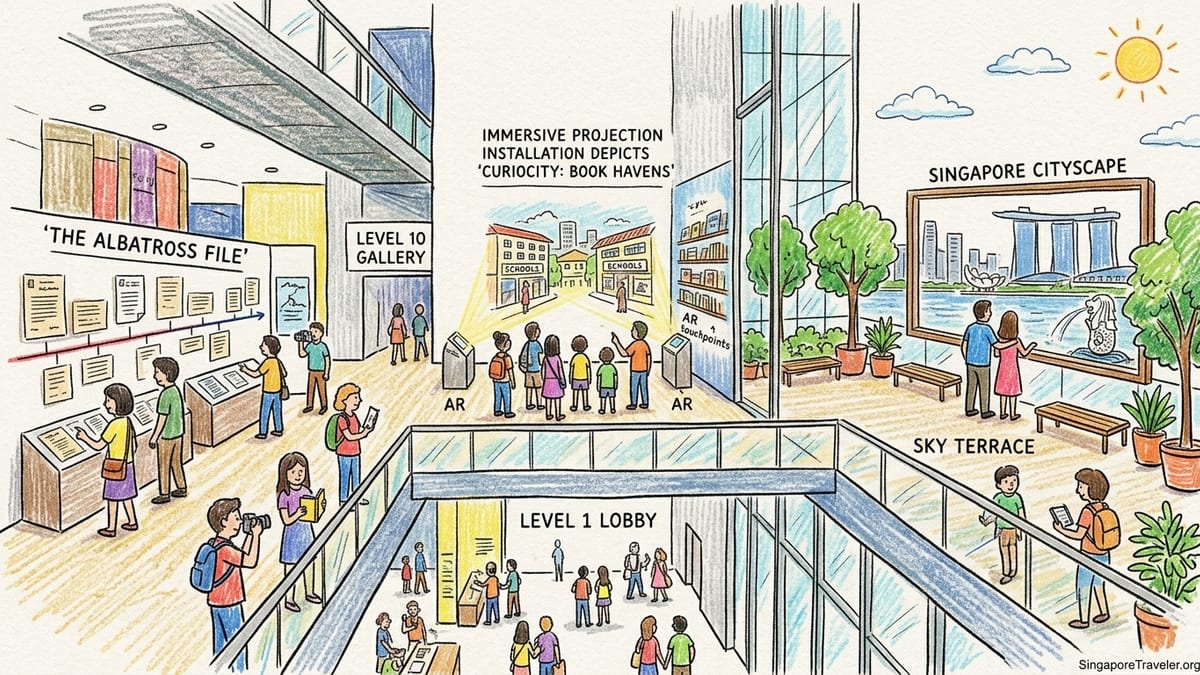
During my visit, the most clearly visitor-oriented anchor was The Albatross File: Singapore’s Independence Declassified, staged as a major free exhibition at the National Library Gallery on Level 10. It runs daily from 10:00 a.m. to 9:00 p.m., and it is explicitly free admission, which is rare for a high-production historical exhibition in a city where ticketed attractions add up quickly. The content is structured in digestible zones, and even if you are not deeply familiar with Singapore’s merger-to-separation era, the exhibition is designed to guide you through the story without requiring homework.
The exhibition’s strongest travel value is that it turns “Singapore history” into a physical experience rather than a paragraph in a guidebook. There are immersive narrative elements and interactive stations that encourage deeper digging. If you are the kind of traveler who enjoys visiting the National Museum but wants a sharper focus on political history and declassified records, this is a meaningful complement, especially because it costs nothing to enter.
Beyond that headline exhibition, the library’s public-facing spaces often host smaller free displays in common areas. What matters for tourists is not trying to memorize a calendar in advance, but checking what is actively installed on the day you go. Programming changes, pop-up displays come and go, and the building is used for community events. Treat these as bonuses: if you see a poster wall, photo show, or seasonal display in a plaza area, step in and take five minutes. Some of the best “found” travel moments come from exactly that kind of unplanned detour.
Book Havens of Bras Basah: Curiocity’s Nine-Minute Time Machine
If you only prioritize one “beyond the shelves” experience, make it Book Havens of Bras Basah: Curiocity. This installation is part of the National Library Board’s Curiocity storytelling work and is designed to show how the Bras Basah district developed through its schools, libraries, and bookshops. It is not a static poster exhibition; it is built around an immersive projection that runs about nine minutes, plus augmented reality touchpoints that extend the story.
What makes this installation feel unusually well-suited to tourists is that it explains the neighborhood you are standing in. Bras Basah and Bugis can feel like a blur of malls, art institutions, and traffic junctions when you first arrive. Book Havens gives the area a narrative spine. You are not just hearing that the precinct has an “arts and heritage vibe.” You are shown how the district’s learning culture took shape and why bookshops, printing, and education mattered here.
I recommend timing your visit so you can watch the full nine-minute projection from start to finish. Because it loops, travelers sometimes drift in halfway through and leave without realizing the strongest scenes come later. Give yourself at least 20 to 30 minutes in total so you can watch one full run, then try the AR elements afterward without feeling rushed. If you are traveling with teens, this is one of the rare heritage-focused installations that tends to hold their attention because it uses movement, scale, and digital layering rather than long text blocks.
In practical itinerary terms, Book Havens also pairs naturally with a short neighborhood walk: Bras Basah Complex for art supplies and bookish browsing, nearby arts venues, and the general museum corridor. The point is not that the library replaces those places. The point is that it makes the whole district easier to read, especially if you are the kind of traveler who wants context, not just check-ins.
Inside The Albatross File: A Free Exhibition That Feels Like a Museum
The Albatross File: Singapore’s Independence Declassified is a genuinely substantial free exhibition, and it does not feel like an afterthought squeezed into a hallway. It is positioned as a major narrative experience, taking visitors through key moments from merger to separation, with a particular focus on the months leading up to Singapore’s 1965 separation from Malaysia. If you have visited large national museums elsewhere, the production approach will feel familiar: themed zones, a clear storyline, and multiple media formats.
What surprised me most was how the exhibition blends archival material with modern presentation techniques. It is not just “documents behind glass.” The show is designed to make complex political history feel navigable even if you are not a specialist. For travelers who want to understand Singapore beyond the skyline and food courts, it is one of the most time-efficient context-builders you can do, especially because it is housed in a place you might already visit for architecture or cooling down.
Because it is open from 10:00 a.m. to 9:00 p.m., it also fits into awkward itinerary gaps. If you have a late afternoon lull before a dinner reservation or you get hit by a sudden downpour, you can pivot here without losing your day. That long operating window is a major practical advantage compared with attractions that close early or require timed tickets.
Allow about 60 to 90 minutes if you want to engage properly. You can speed-run it in 30 minutes, but you will miss the sections where the exhibition’s structure starts to pay off. If you are visiting with someone who loves political history, add time for lingering; if your travel companion is less interested, you can compromise by agreeing to one full loop and then moving on to views and architecture.
Architecture, Bridges, and Sky Terraces: The Building as an Attraction
The National Library Building is not just a container for collections. Its design encourages vertical exploration, with twin blocks linked by skybridges and a sense of layered public space. You notice it most when you move upward: the building opens into quieter levels, the light shifts, and the city reveals itself in framed angles rather than postcard panoramas.
Sky terraces are incorporated at multiple levels, and some are accessible to the public, with access indicated at the entrances leading into the gardens on the relevant levels. Even if you only step out briefly, the terraces change the experience from “I visited a library” to “I wandered a vertical public park.” If you are visiting Singapore during the wetter months or you simply want a break from the intensity of Orchard Road and Marina Bay, these outdoor pockets can feel like a calm exhale.
Views are not guaranteed in the way they are at a paid observation deck, and you should not treat the library as a replacement for a skyline attraction. What you get instead is a quieter, more grounded perspective, a look at the city as people actually live it: roads, rooftops, and the textured layers of an urban core. If you are a photographer, the appeal is not dramatic sunset spectacle. It is the candid city geometry and the way the building frames it.
From a travel-writing standpoint, this is where the National Library becomes “more than a rainy-day stop.” It becomes a place you can explore slowly, even if you do not read. The building rewards people who enjoy wandering for its own sake, noticing how a civic space can be both serious and welcoming.
Singapore Collections and the Joy of Browsing With Purpose
Even if you are not borrowing books, the National Library experience improves if you browse with a theme. Singapore is a city that can feel ultra-modern on the surface, and the library is one of the best places to meet the city on paper: through local writing, heritage material, and curated reading corners that reflect Singapore’s identity beyond tourism marketing.
For travelers, the most practical approach is to treat browsing like a targeted cultural activity. For example, if you are spending the next day exploring the Civic District, pick up a few minutes of context by looking for materials on Singapore’s architecture, planning, or neighborhood histories. If you are heading to hawker centers, browse for food culture titles or local essays that explain why hawker food is structured the way it is. This kind of reading does not require finishing a book. It is about sharpening your lens for what you will see outside.
Another advantage is that browsing here can be a “low-spend” activity in an expensive travel city. Singapore has plenty of attractions where the cost of admission is the price of doing anything. The library is different. You can be indoors, intellectually engaged, and comfortable without buying a ticket. That makes it especially valuable for longer trips where you want variety without constantly paying entry fees.
If you have limited time, focus on experiences that are clearly designed for public engagement: exhibitions, installations like Book Havens, and spaces that highlight Singapore culture and heritage. Leave the deep reference research for another day unless that is your passion.
The Takeaway: How Long to Spend, What to Skip, and When It Belongs on Your Itinerary
For most tourists, the sweet spot is 90 minutes to three hours. In 90 minutes, you can watch Book Havens of Bras Basah: Curiocity (including AR time), then head to The Albatross File exhibition for a purposeful walk-through. In two to three hours, you can add architectural wandering: bridges, terraces where accessible, and a slower look at public-facing displays.
The floors that tend to be genuinely interesting without a library membership are the ones tied to exhibitions and installations, plus any levels where you can access sky terraces and views. The Albatross File exhibition on Level 10 is a strong anchor because it is clearly structured, free, and open late. Book Havens is the other key stop because it connects the building to the surrounding district, turning your visit into a narrative experience rather than a generic “I went to a library.”
As a rainy-day plan, the value is excellent. You get reliable air-conditioning, indoor cultural content, and the kind of calm that can be hard to find in Singapore’s busiest malls. On a short itinerary, it deserves a planned stop if you care about history, design, or neighborhood storytelling, or if you want at least one high-quality attraction that does not revolve around shopping or ticketed entertainment. If your trip is only 48 hours and you are chasing icons, you might still only fit it in as a weather backup. But if you can spare an afternoon gap, the library has enough substance to justify going on purpose.
My practical recommendation is to treat the National Library Building as a flexible “culture buffer” between louder stops. Pair it with Bras Basah and Bugis exploration, a museum visit nearby, or a pre-dinner wander in the Civic District. Go for the exhibitions and architecture, stay for the calm, and leave with a better understanding of the city you are traveling through.
FAQ
Q1. Is the National Library Building in Singapore worth visiting as a tourist?
Yes, especially for free exhibitions, architecture, and immersive installations like Book Havens of Bras Basah: Curiocity, even if you are not borrowing books.
Q2. How long should I plan to spend at the National Library Singapore?
Plan 90 minutes to three hours: about 20 to 30 minutes for Book Havens, 60 to 90 minutes for The Albatross File, plus time for terraces and views.
Q3. What is Book Havens of Bras Basah: Curiocity and why is it special?
It is an immersive installation featuring a nine-minute projection and AR touchpoints that show how Bras Basah developed through schools, libraries, and bookshops.
Q4. Is The Albatross File: Singapore’s Independence Declassified free?
Yes, it is free admission and presented as a major exhibition at the National Library Gallery on Level 10.
Q5. What are the opening hours for The Albatross File exhibition?
It operates daily from 10:00 a.m. to 9:00 p.m., which makes it easy to fit into an afternoon gap or rainy-day plan.
Q6. Do I need a library membership to visit exhibitions at the National Library Building?
No. The main exhibitions and public areas are designed for visitors, and you can enjoy them without signing up for borrowing privileges.
Q7. Are there viewpoints or outdoor spaces inside the National Library Building?
Yes. The building includes sky terraces at various levels, and some terraces are accessible to the public where indicated at the entrances.
Q8. Is the National Library a good rainy-day attraction in Singapore?
Yes. It offers strong air-conditioning, quiet indoor space, and substantial free exhibitions, making it a practical and enjoyable weather backup.
Q9. Can I combine the National Library visit with other nearby attractions?
Yes. It pairs well with a walk around Bras Basah and Bugis, nearby museums in the Civic District, and bookish browsing at Bras Basah Complex.
Q10. Should I schedule it on a short Singapore itinerary?
If you care about history, architecture, or free cultural experiences, it is worth a planned stop; otherwise it is an excellent flexible backup for heat or rain.