


Bugis Street is loud, tempting, and relentlessly convenient. It is also where travelers often overpay for snacks that look better than they taste. One block away, Albert Centre Market and Food Centre on Queen Street offers a different proposition: a real hawker centre with about 86 cooked-food stalls, morning-only specialists, and a lunchtime rush that can either sharpen your appetite or test your patience. I spent a weekday going stall to stall, ordering across cuisines and price points, timing queues, and noting the unglamorous stuff that actually matters when you are hungry: portion size, table-hunting, heat, and whether you need cash or can get by with digital payment.
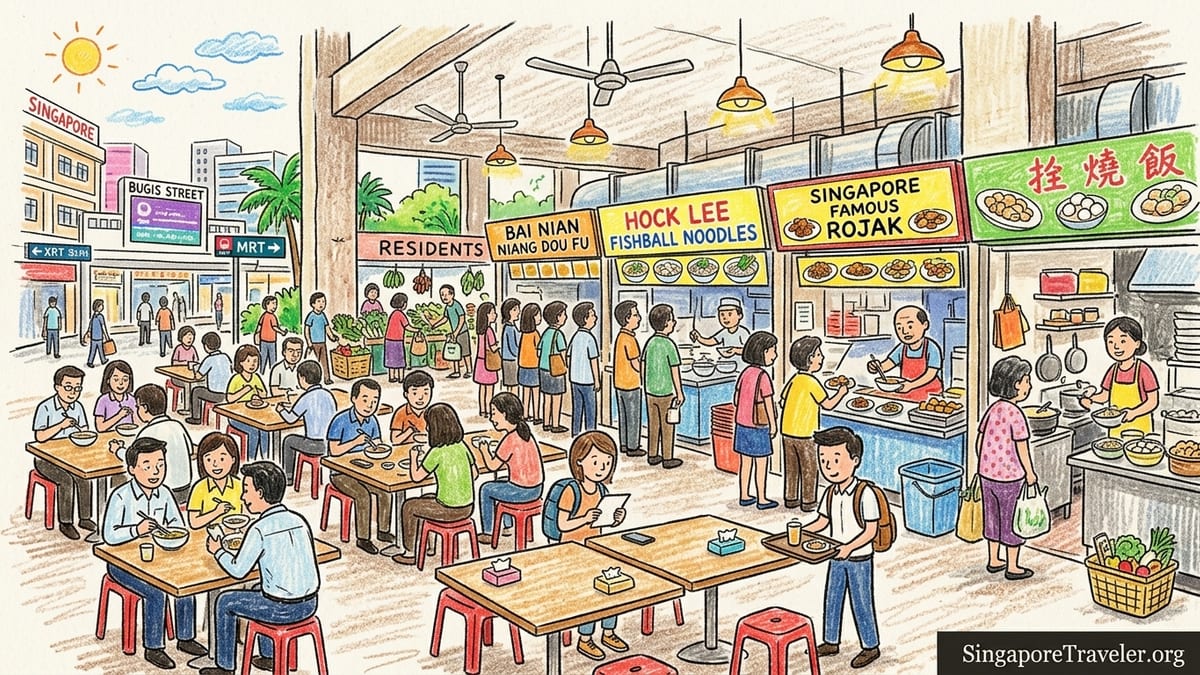
Where Albert Centre Fits In Bugis (And What It Actually Is)
Albert Centre Market and Food Centre sits at 270 Queen Street, right beside the Bugis shopping zone and a short walk from Bugis MRT. It is not a themed food hall, and it is not trying to be pretty in an Instagram way. It is a working hawker centre with a market section attached, so you will see residents buying groceries alongside office workers queuing for noodles. That mix matters because it keeps prices grounded in a neighborhood reality even though you are basically in the city center.
The headline number is its scale: roughly 86 cooked-food stalls. In practical terms, that means you can compare a few versions of “everyday Singapore” in one stop. If you want to taste fishball noodles, yong tau foo, rojak, satay, and dessert without crisscrossing the island, Albert Centre is one of the easiest places in the Bugis precinct to do it. The tradeoff is that you are sharing space with everyone who had the same idea, especially on weekday lunch.
One important planning note for travelers: Albert Centre is not a single restaurant with fixed hours. Each stall sets its own schedule, and the center’s feel changes dramatically depending on the time of day. Morning can feel calm and almost local-only. Weekday lunchtime can feel like a canteen for the whole Bugis and Rochor area. Late afternoon can be the sweet spot where you can sit down without scouting for a table like you are playing a game.
My Weekday Lunch Game Plan: Timing, Tables, Heat, And Payment Reality
I did this as a weekday visit because that is when most travelers will be in Bugis shopping, museum-hopping, or transiting between City Hall and Little India. The experience at lunchtime is defined by three things: queue behavior, table availability, and heat. Queues here are rarely chaotic, but they can be long, and the “peak” window feels tight. Arrive too close to noon and you will spend more time standing than eating.
Table-finding at weekday lunch is the main friction point. When the office crowd arrives, empty seats can become a currency. In my visit, the hardest moment was not ordering. It was landing a table after collecting food from two different stalls. The trick that locals use is to place a packet of tissues or a small personal item to reserve a seat, but travelers may not be comfortable doing that. If you are solo, you will likely have an easier time sliding into a shared table or taking a corner seat. If you are two or three people, send one person to hold a table first, then order.
Heat is manageable but real. The center is indoors and bright, but the lunchtime density adds body heat fast. If you are the kind of traveler who wilts in humid climates, Albert Centre at midday can feel heavy. If you can shift your meal to 11:00 a.m. or after 1:30 p.m., the same food feels less stressful because you are not eating it while also sweating and guarding your seat.
Payment is stall-by-stall. Many stalls still accept cash, and some accept digital payment, but you should not assume every vendor takes cards. For a food crawl, I recommend carrying small notes and coins, and also having a local QR payment method if you are set up for it. If you are visiting Singapore for a short stay and only have international cards, you can still eat well here, but cash will save you from awkward moments at the counter.
What I Ate First: Hock Lee Fishball Noodles (Worth The Effort, But It’s A Timing Trap)
If you want to understand why some Albert Centre stalls develop reputations, start with Hock Lee Fishball Noodle. This is a morning-leaning stall that draws a line early and can sell out before lunchtime. A bowl of fishball noodles is priced at S$5, which is a good reference point for “city-center hawker comfort” without crossing into tourist pricing. The portion is a proper single meal: noodles plus fishballs and fishcake, not a small tasting cup.
Queue time is the real cost. On a weekday, the line can look intimidating even in the morning because regulars treat it like a ritual. When I arrived in the late morning, I waited around 15 to 25 minutes, and the stall felt like it was operating with a “when it’s gone, it’s gone” momentum. If you show up after the lunch crowd has started building, you risk seeing the shutters come down right when you are ready to order.
Flavor-wise, it delivers what the line promises: bouncy fishballs, clean-tasting soup, and the familiar tang-and-heat balance if you order dry with chili and vinegar. The best part is not a fancy garnish. It is the texture. If you have had tourist-area fishball noodles that taste soft or bland, this is the correction.
Would I do it again on a shopping day? Only if I can treat it as breakfast or an early lunch. This is not the stall you “swing by” at 1 p.m. after browsing Bugis Junction. If you want it, plan for it first, then shop.
The Famous Stall That Disappointed Me: Bai Nian Niang Dou Fu (A Queue That Didn’t Match The Bowl)
Bai Nian Niang Dou Fu is one of the most visible queues in Albert Centre, and it is often treated as the default “you must try this” stall here. The yong tau foo set is typically priced in the S$4.50 to S$5.50 range, and it comes as a fixed set rather than the pick-your-pieces format you might expect elsewhere. That fixed-set setup helps the line move, but it also means the meal can feel less tailored to your appetite.
The wait during weekday lunch was the longest of my crawl, roughly 25 to 40 minutes depending on when you join. The counter is efficient, but the popularity is relentless. Portion size is fair for the price, especially if you consider how central Bugis is. But the eating experience did not justify the time investment on this particular visit.
What disappointed me was not that it tasted “bad.” It did not. The broth was light, the items were competent, and it is undeniably filling. The problem was that the bowl felt like a product of its own hype. When a stall becomes the center’s most famous queue, you expect a wow factor or at least a clear signature that lingers. Instead, the experience landed as “fine, familiar, and slightly rushed,” which is not what you want after investing nearly half an hour in line.
If you are a first-timer who has never tried yong tau foo, it is still an easy introduction. But if you are deciding where to spend your one precious queue of the day, I would not make this the headline act. Albert Centre has better ways to use your time.
The Low-Key Dish That Was Excellent: Singapore Famous Rojak (Small Price, Big Payoff)
My most satisfying bite per dollar came from Singapore Famous Rojak, a stall with a strong reputation and a calmer rhythm because it starts later in the day. The key detail travelers miss is timing: it opens at 1:00 p.m. and runs until 8:30 p.m. That alone changes your strategy. If you try to visit Albert Centre for an early lunch and you are specifically chasing rojak, you might find it simply not operating yet.
Price is one of the reasons rojak works so well as a traveler snack here. A plate is typically S$3 to S$4 depending on size, which makes it a low-risk order even if you are just curious. Portion size is snack-to-light-meal, and it is also one of the easiest dishes to share while you are still deciding what else to eat.
The plate I ate hit the sweet spot of texture and contrast: crisp cucumber, tangy fruit, dough stick that you should eat quickly before it softens, and a sauce that leans lighter and sweeter than some aggressively pungent versions elsewhere. It tasted like something that has been made the same way for a long time, which is exactly what you want from hawker food in a tourist-heavy neighborhood.
Queue time here was reasonable, roughly 5 to 15 minutes, and it moved predictably. If you are traveling solo, this is a particularly good order because it is quick, inexpensive, and satisfying without requiring you to hunt for a table for an hour-long meal. You can eat it as a mid-shopping break, then continue to Bugis Street without feeling weighed down.
Why Weekday Lunchtime Changes Everything (And Why Stalls Sell Out Or Open Limited Days)
Weekday lunchtime at Albert Centre is not just “busy.” It is a specific kind of busy driven by nearby offices, schools, and the Bugis commercial zone. The crowd arrives in waves, usually starting before noon and peaking around the standard lunch hour. During that window, even a stall that normally takes five minutes can stretch into a fifteen-minute wait. More importantly, the seating area becomes the real bottleneck, especially if you are ordering from multiple stalls.
Some popular stalls sell out because their output is tied to morning prep that cannot scale infinitely without changing what makes them good. Handmade components are the obvious example. A fishball noodle stall that forms fishballs daily has a natural ceiling. If they prepared a fixed amount and the morning crowd clears it out, the “sold out” sign is not marketing. It is the end of the day’s work.
Limited operating days are also part of hawker economics. Some stalls operate fewer days a week because of staffing, family schedules, or the simple reality of workload. A stall that specializes in a labor-intensive dish might choose to open only on the days when demand is reliably high, or to close on a slower weekday to recover. For travelers, the implication is clear: you cannot treat Albert Centre like a mall food court where everything is always open. You need a backup dish in mind.
Finally, quarterly cleaning closures can affect trip planning in a very real way. Hawker centres in Singapore can close for scheduled cleaning, and Albert Centre is listed for a cleaning closure from November 30 to December 1, 2026. If you are in Singapore on those dates, this is not a “maybe.” The stalls do not trade, and you will need another plan for budget food in Bugis.
The Takeaway
Albert Centre Food Centre is worth leaving Bugis Street for if your goal is a real hawker meal at real hawker prices in the immediate Bugis area. It is not a destination built for tourists, and that is its advantage. The food is affordable, the variety is strong, and you can taste multiple Singapore staples in one stop without committing to a single restaurant.
For breakfast, Albert Centre can be excellent, especially if you target morning-only specialists like fishball noodles before they sell out. For lunch, it becomes a test of timing and patience. If you can eat early or late, you will enjoy the same stalls with less heat, less table stress, and shorter lines. For budget eating, it performs well in a neighborhood where prices can climb quickly once you step into malls and cafes.
For solo dining, it is easier than it looks. Solo travelers can usually find a seat faster, eat quickly, and sample more dishes without coordinating a group. For couples or families, the key is to secure a table first and then order in turns. Do not treat table-finding as an afterthought during weekday lunch.
Should you eat here before or after shopping? If you want a calm meal and the best chance of getting what you came for, eat first, then shop. If you want a snack break that does not derail your day, come after shopping for an afternoon plate of rojak or a light dish when the lunch crush has thinned. Either way, Albert Centre is not “better” because it is basic. It is better because it is practical, local, and still priced like an everyday place in a tourist-adjacent district.
FAQ
Q1. Where is Albert Centre Food Centre in Singapore?
It is on Queen Street beside the Bugis shopping zone, at 270 Queen Street, Singapore 180270.
Q2. How many cooked-food stalls are at Albert Centre Food Centre?
The centre has around 86 cooked-food stalls, which makes it one of the larger one-stop hawker options in the Bugis precinct.
Q3. Is Albert Centre Food Centre worth it compared with eating on Bugis Street?
Yes if you want a proper hawker meal and better value. Bugis Street is convenient for snacks, but Albert Centre is stronger for full, affordable local dishes.
Q4. What is the best time to visit Albert Centre Food Centre on a weekday?
Aim for late morning before noon or mid-afternoon after about 1:30 p.m. Weekday lunch hour is the most crowded for queues and seating.
Q5. Why do some Albert Centre stalls sell out early?
Some stalls prep a fixed amount of ingredients, especially handmade items, and once that batch is finished they close rather than dilute quality.
Q6. Do stalls at Albert Centre accept cashless payment?
Payment is stall-by-stall. Many accept cash, and some accept digital methods, but travelers should carry cash to avoid being stuck at a cash-only counter.
Q7. What is a good first dish to try at Albert Centre?
If you can go early, fishball noodles are a strong introduction. If you arrive later, rojak is an easy, low-commitment dish that still feels distinctly local.
Q8. Is Albert Centre Food Centre good for solo travelers?
Yes. Solo diners usually find seating more easily, can eat quickly, and can sample more stalls without coordinating orders.
Q9. Is Albert Centre Food Centre air-conditioned?
It is an indoor hawker centre, but it can still feel warm at peak times because of the crowd and the cooking heat.
Q10. Are there any planned closure dates travelers should know?
Albert Centre is scheduled for a cleaning closure from November 30 to December 1, 2026, so plan an alternative meal spot in Bugis if you are visiting then.