


Bugis Street is one of those Singapore names that shows up in every “cheap shopping” search, usually paired with two promises: bargain prices and a chaotic, bazaar-like thrill. I went in expecting a fast souvenir sweep and maybe a couple of budget outfits. What I got instead was a more complicated (and more useful) answer: Bugis Street can be excellent value, but only if you shop it like a test, not like a victory lap. The first price you see is not the “Bugis price.” It is just one stall’s guess at what you will pay before you compare two more aisles and one more floor.
What I Expected
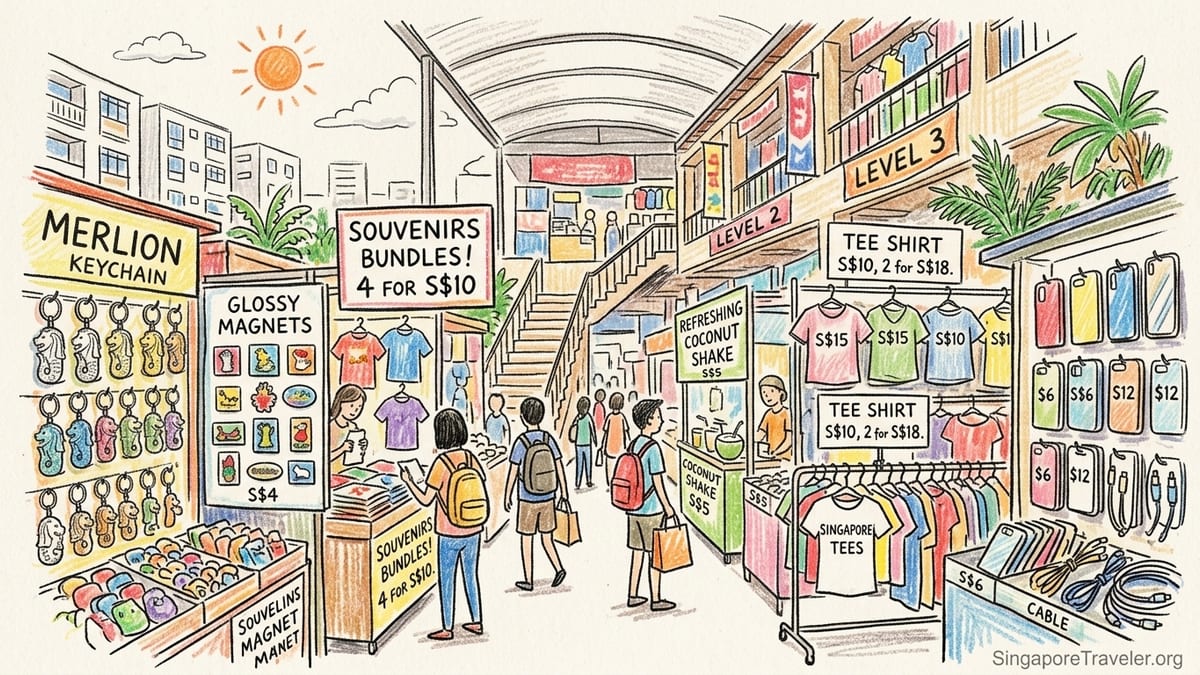
I expected Bugis Street to feel like a night market with open air lanes and easy browsing. In reality, it is a permanent, covered market complex at 3 New Bugis Street, packed with narrow corridors and tightly stacked stalls across multiple levels. It is loud, busy, and designed for volume: lots of small transactions, lots of impulse buys, and very little breathing room once the crowd swells.
I also expected everything to be obviously cheap. That part is only half true. There are plenty of low prices, but there are also plenty of “tourist-easy” prices where the margin is baked in, especially for the most photographed items (Merlion keychains, Singapore tees by the entrance, and display walls of phone cases). If you do not compare, you can absolutely pay mall-adjacent prices for market-grade quality.
Finally, I expected bargaining to be constant. What I found is that negotiation is situational. Some stalls have big fixed-price signs and will not move. Others will round down or do bundle pricing, but only if you ask calmly and only after you have demonstrated you are buying more than one thing.
What I Bought (With the First Price vs the Better Price)
I started on the most obvious loop: ground-level souvenir and accessory lanes. My first stop was a keychain display where the opening ask was S$3 per piece for basic Singapore icons (Merlion, “I Love SG,” and small acrylic charms). Two aisles later, another stall offered a simple bundle: 4 for S$10 for similar keychains, which changed the math immediately. That was my first reminder to treat Bugis like a comparison shop, not a one-and-done.
For magnets, the first stall I checked showed S$5 each for standard flat resin fridge magnets. I walked again and found a stall doing S$4 each, then another offering S$10 for 3 if you picked from a mixed tray. The quality across these was basically identical: glossy resin fronts, similar printing, and the same lightweight backing. The only difference was how quickly the seller wanted to close the sale.
For clothing, I deliberately tested the “first-price trap.” A basic cropped cotton top I liked was tagged at S$15 at one rack-heavy stall. I did not buy it. I kept moving and found a nearly identical top (same silhouette and fabric feel) for S$10 at another stall, and a clearance rack offering simple tops at S$8. That did not mean every clothing item was negotiable, but it did mean that walking 30 meters can cut the price by a third.
I also picked up a phone case and cable because those are the easiest items to compare. The first phone case wall I saw had generic cases around S$10 to S$12 depending on finish (clear, matte, printed). After comparing two more stalls, I found a bin with simpler cases at S$6 to S$8. The difference was not subtle: the cheaper ones were thinner and flimsier, but for a short trip or as a backup, they were the better deal. For charging cables, I saw pricing that ranged from “too good to be true” to “almost reputable,” and I avoided the cheapest options unless they were sealed and clearly labeled.
What Was Genuinely Good Value
The best value at Bugis Street was in items where “trend” matters more than long-term durability: lightweight summer pieces, hair accessories, costume jewelry, and easy souvenirs that you do not mind replacing. If you are shopping for a week of outfits in humid weather, a S$8 to S$12 basic top you wear twice can be a smart buy, especially compared with conventional mall pricing in Singapore.
Souvenir bundling was the clearest win. If you are buying for colleagues, classmates, or a big family group, Bugis is built for you. The value comes from mixing items and asking for a combined price. The moment I switched from “one item” shopping to “two or three items from one stall,” the deals improved. A single keychain at S$3 is fine. A bundle like 4 for S$10 is better, and it becomes very easy to hit your gift list without spending an afternoon.
Small bags and simple totes can be good value if you inspect the seams, zippers, and strap stitching before paying. I saw a range from bargain canvas totes to faux-leather crossbodies. The smart approach was to treat every bag like a quick quality check: tug the strap attachment points, run the zipper twice, and look inside for raw edges. The best finds were the “simple but honest” pieces: plain designs, fewer metal parts, and fewer glued-on decorations.
Snacks and cooling drinks were also worth it, not as “cheap Singapore,” but as “right here, right now.” Bugis Street is a place where heat and crowd density can wear you down. I used a coconut shake break as a reset. At the Bugis Street branch of Mr Coconut (inside the complex), a Signature Coconut Shake is listed from about S$5 for a medium and about S$6 for a large, with other flavors and add-ons priced higher. It is not a budget hawker snack, but it is a reliable, air-conditioned-adjacent cooldown that feels priced like modern Singapore rather than like a tourist surcharge.
What Felt Like Tourist Junk (And How to Spot It)
The most disposable category was ultra-cheap souvenirs that look fine on the rack but feel like they are one suitcase ride away from cracking: brittle plastic figurines, thin printed mugs, and anything painted that can chip with a fingernail. If the item is very light for its size, has a strong chemical odor, or shows uneven paint edges up close, I treated it as “hotel-room cute, long-term regret.”
Overly embellished accessories were another trap. Sparkly purses with glued-on rhinestones looked fun under the stall lights, but I watched a shopper lift one and a stone popped off. That is the Bugis lesson: if it is glued, assume heat and friction will test it. In Singapore humidity, glue fails faster than you want to admit.
Beauty items require the most caution. I saw shelves of inexpensive cosmetics and skincare packaged to look familiar. The price is tempting, but unless you can clearly identify the brand, labeling, and tamper seals, it is not a category I would treat as a bargain. If you do not recognize what you are buying, the “savings” can become clutter you never use, or worse, an item you should not put on your face at all.
Phone accessories were split: cases were mostly fine as short-term buys, but the absolute cheapest cables and chargers felt like false economy. If a cable looks thin, bends sharply at the connector, or is unbranded with no packaging, it is better to skip. A broken cable is not only annoying, it can cost you time hunting for a replacement when you should be sightseeing.
Cash, Cards, Bargaining, And What Actually Works
Payment acceptance varies stall by stall. I saw a mix of cash-only setups and digital payment signs, and it is common in Singapore for small merchants to accept QR-based payments, with NETS and PayNow widely used. As a visitor, you cannot assume your foreign card will be welcomed at every tiny stall, and you also cannot assume the seller wants to deal with card fees for a small purchase. The practical solution is simple: carry some cash in small notes for quick buys and for any moment where the line is behind you and you do not want to fumble with payment.
Bargaining, when it happened, was more like gentle discounting than aggressive haggling. The most natural line I heard (and used) was essentially: if I take two, can you do a better price? That approach felt culturally aligned: polite, quick, and based on volume. Asking for a small reduction or a bundle price worked better than trying to cut a single item dramatically.
Comparing first is the bargaining skill people skip. Before you ask for a deal, you need a reference point. Bugis rewards the shopper who checks two stalls selling similar items and then returns. Once you know a keychain can be found in a 4-for-S$10 bundle, it becomes easier to smile and ask for the same bundle price elsewhere if you prefer a specific design selection.
If a stall has clear fixed-price signage, I treated it as fixed. Bugis has enough stalls that there is no need to push. The real savings often come from choosing a different stall, not from winning a negotiation.
Heat, Narrow Aisles, And The Best Time To Go
Bugis Street can feel physically intense. Even though it is covered, the lanes can trap heat, and the foot traffic makes the air feel heavier. If you are coming from air-conditioned malls, the shift is noticeable. Dress for humidity, wear shoes you can stand in, and consider carrying water because the stop-and-go movement makes you thirstier than you expect.
The aisles are narrow enough that browsing becomes a social negotiation: one person stops, three people pile up behind them. If you hate shoulder-to-shoulder shopping, you will not be happy during peak periods. The simplest fix is timing. Weekday daytime visits tend to be calmer, and going earlier gives you more personal space to inspect items and compare prices without feeling rushed by the crowd behind you.
If your only free time is evenings or weekends, treat Bugis like an energetic experience rather than a relaxed shop. The market energy can be fun, but it is not a place where you will slowly deliberate over purchases. Make a short list (souvenirs, one clothing category, one accessory category), then work floor by floor with intention.
One more comfort tip that matters: plan a cool-down point. Bugis sits near conventional malls, and stepping into an air-conditioned space for 10 minutes can reset your mood and keep you from making heat-driven impulse buys. It is amazing how many “cheap” items end up in your bag when you are overheated and just want to feel like the trip is productive.
What I Would Skip Next Time (And Where I Would Shop Instead)
Next time, I would skip any “souvenir that becomes dust” category: fragile decor, novelty items with moving parts, and anything that feels like it will not survive the flight home. If I want something Singapore-specific that I will actually keep, I would buy fewer items and choose one that is sturdier: a better-made tote, a simple tee with good fabric, or a practical item I will use.
I would also skip mystery beauty products. If I am shopping for skincare, I would rather go to a conventional pharmacy chain or a known beauty retailer where labeling, storage, and authenticity are clearer. Bugis is great for fun accessories, but I do not think it is the best environment for products that touch your face, especially if you are sensitive to fragrances or ingredients.
For phone accessories, I would buy only cases and perhaps a spare cable if it is packaged and looks decent. Anything higher stakes, like chargers, would be a mall or specialist electronics purchase for peace of mind. The goal of cheap shopping is to save money, not to create friction on your trip.
The overall answer to the “is it worth it” question comes down to what kind of shopper you are. Bugis Street is worth visiting if you want souvenir bundles, trend-forward budget fashion, and the sensory buzz of a tightly packed market. If you prefer clean displays, predictable pricing, and a calmer experience, you will be happier in conventional malls nearby or in specialist shops where quality control is easier to judge.
The Takeaway
Bugis Street is worth visiting for travelers who shop like editors: compare first, buy second, and treat “cheap” as a claim you verify stall by stall. The wins are real, especially for souvenir bundles and casual, warm-weather clothing that does not need to last for years. The losses are also real if you buy the first thing you see, confuse low price with good value, or shop while overheated and rushed.
Make time for Bugis Street if you love browsing, want budget-friendly gifts, and enjoy the hunt across multiple floors and sections. Skip it, or limit it to a quick look, if you dislike crowds, want guaranteed materials and finishing, or prefer curated shopping environments where the price is the price and the aisle is wide enough to breathe.
FAQ
Q1. Is Bugis Street actually cheap compared with the rest of Singapore?
It can be, especially for souvenirs, accessories, and casual clothing, but you have to compare stalls because the first price you see is not always the best price.
Q2. How many floors should I visit to get the best value at Bugis Street?
Plan to cover multiple levels and different lanes because similar items appear in different pockets, and the better price is often one floor or one corridor away.
Q3. What are realistic souvenir prices at Bugis Street?
Expect common small souvenirs like keychains and magnets to be a few Singapore dollars each, with better value when you buy bundles such as multi-piece deals.
Q4. Do stalls at Bugis Street accept credit cards?
Some do, but acceptance varies by stall. Carry cash in small notes for quicker purchases and for stalls that prefer cash or QR payments.
Q5. Can you bargain at Bugis Street, or are prices fixed?
Both exist. Some stalls are fixed-price, while others will offer small discounts or bundle pricing, especially if you buy more than one item.
Q6. What is the best time of day to visit Bugis Street to avoid crowds?
Weekday daytime tends to be less crowded, giving you more space to browse, compare, and check quality without getting stuck in slow-moving aisles.
Q7. What should I avoid buying at Bugis Street?
Be cautious with fragile novelty souvenirs, overly glued-on accessories, and unverified beauty products, since those categories can feel disposable or uncertain.
Q8. Are phone accessories at Bugis Street good value?
Cases can be decent value if you compare prices and accept short-term durability, but very cheap cables and chargers can be a false economy if quality is poor.
Q9. Is Bugis Street comfortable to shop in?
It can feel hot and cramped because the aisles are narrow and crowds build quickly. Dress for humidity and plan short cool-down breaks.
Q10. Who will love Bugis Street and who should skip it?
Souvenir hunters and budget fashion browsers usually enjoy it. Travelers who prefer calm, curated shopping or guaranteed quality may prefer conventional malls or specialist shops.