


Singapore has no shortage of world-class museums, which is exactly why the MINT Museum of Toys triggers a very specific traveler question: is this a niche nostalgia stop, or a legitimately “worth it” attraction for S$30? I went in expecting a quick, cute detour near City Hall, but the reality is more layered: part collector’s vault, part pop-culture time capsule, and part visual archive of how brands marketed childhood across decades. If you’re deciding whether to buy that ticket rather than spend the same money on another paid museum, a rooftop drink, or simply more hawker food, here’s what stood out, what fell flat, and who actually gets real value out of MINT.
Ticket Expectations: What S$30 Should Get You
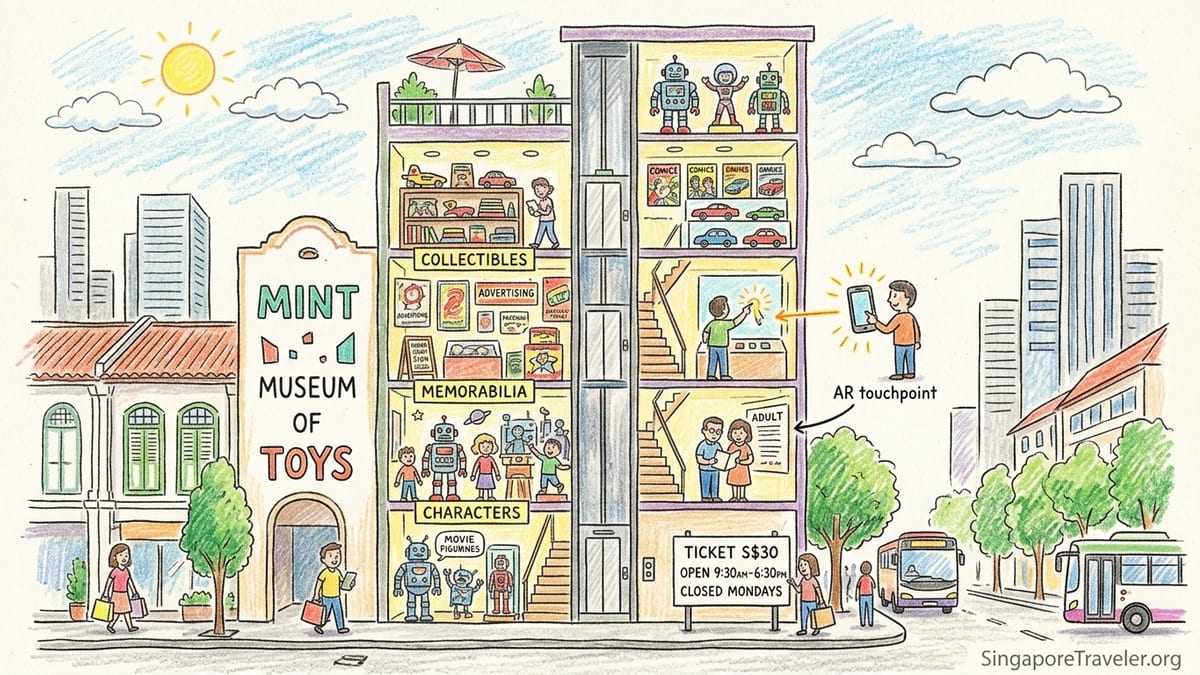
The most important practical detail: the MINT Museum of Toys is a paid, boutique-style museum experience, not a free pop-in gallery. The adult admission price is currently listed at S$30 through major ticket platforms, and the museum’s own visitor information lists opening hours as 9:30 am to 6:30 pm with last admission at 5:30 pm, and closure on Mondays. It’s positioned as a city-center attraction at 26 Seah Street, which matters because you’re paying Singapore CBD pricing for a compact, vertical museum.
The ticket expectation I brought in for S$30 was simple: (1) a dense and well-labeled collection that rewards slow looking, (2) comfort factors that make lingering feasible (air-conditioning, clear flow, places to pause), and (3) a “signature” element that distinguishes it from the kind of toy displays you might see in a mall pop-up or private collector showcase.
MINT largely delivers on density and variety. The museum is built around a founder’s private collection, and while claims about total holdings versus what’s on display vary by source, the consistent message is that this is a very large vintage-toy archive with material spanning many countries and decades. The question is whether the museum turns that abundance into interpretation, not just accumulation and that’s where your personal definition of “worth it” starts to matter.
The Best Collection: Where MINT Feels Like A Real Museum, Not Just A Toy Shelf
At its best, MINT is not really about toys. It’s about the idea of childhood as designed, sold, and exported. The strongest sections are the ones that show how characters, packaging, and trends moved across borders. MINT promotes its holdings as coming from dozens of countries, and in the galleries that lean into that international range, you can feel the difference between “I remember this” nostalgia and “this is what the world was consuming” historical context.
The vintage character material is a highlight for pop-culture fans. Even if you don’t have personal memories of a specific figure, you can still read it as an era marker: what styles of animation were popular, how toys mirrored film and TV, and how merchandising evolved. The museum also positions multiple thematic exhibitions, including areas framed around characters, childhood favorites, and collectibles, which helps give you a sense of structure rather than an endless visual pile-up.
What surprised me most were the moments where the museum quietly reveals a global supply chain of imagination. A familiar character rendered differently for different markets, or a product line that looks “standard” today but felt experimental in earlier decades, can be more interesting than any single rare item. Those are the displays that made me slow down and treat MINT less like a photo-op and more like a compact cultural archive.
Beyond Toys: Comics, Advertising Memorabilia, And The Collector’s-World Layer
If you only want toys, you can walk through and call it done. But MINT gets more compelling when you treat it as a broader collectibles museum that happens to be toy-led. The museum’s own materials frequently mention collectibles and memorabilia alongside toys, and that matters because the “worth it” calculus changes if you’re seeing not only playthings but also the commercial language around them.
Advertising memorabilia is the piece that can move the experience from nostalgia into interpretation. A toy alone can be read as cute or quaint. Add signage, brand materials, or period-style packaging and suddenly you’re looking at how companies pitched modernity, gender roles, heroism, domestic life, and aspiration to kids and parents. For travelers used to Singapore’s big national institutions, this is the part of MINT that can feel most museum-like: it’s a curated record of everyday culture, not just a display of valuable objects.
Comics and comic-adjacent pop culture items, when present in a toy museum context, also do important work. They show how narrative and character licensing supported the toy industry, and how kids’ entertainment became a cross-media ecosystem long before streaming or modern fandom culture. The effect is less “look at this old thing” and more “this is what an attention economy looked like before smartphones.”
Interactivity Check: AR Elements, What Worked, And What Felt Optional
MINT leans hard into augmented reality as its signature interactive layer. The museum promotes an AR journey designed to be used across multiple levels and stairwells, using app-based touchpoints to animate or narrate parts of the collection. In practical terms, this is the museum’s attempt to answer a common critique of object-heavy museums: that you’re passively looking at glass cases without enough context.
In the galleries, the AR component is most useful when it does one of two things: either it guides you to details you would have overlooked (a small object tucked into a crowded shelf), or it adds a storyline that helps you connect very different eras and countries in one coherent “walk.” When it works, it gives the museum a rhythm: look closely, scan, listen, then look again with new context. That loop can extend your visit time in a good way.
But it’s also optional in the sense that it introduces friction. You’re using your phone in a museum that already has a lot to visually process. If you’re traveling with limited battery, spotty roaming, or you just want a screen break, the AR may not become central to your enjoyment. My view: the AR is a genuine value-add for visitors who like guided narratives and interactive prompts, but it’s not a replacement for traditional labeling and interpretation. If you hate app-based museum experiences, you can still enjoy MINT, but you’ll be relying more on your own curiosity and less on the museum’s “storytelling rails.”
Comfort, Flow, Elevators And Stairs: What It Feels Like To Be Inside
MINT is a vertical museum experience. It’s the kind of place where the building’s layout affects your enjoyment, because you’re moving through multiple levels rather than sprawling halls. The museum’s AR materials explicitly reference exploring multiple levels and stairwells, which aligns with the feel on the ground: you’re climbing, pausing, and reorienting a lot. If you love wandering up and down compact city museums, it’s part of the charm. If you prefer wide, single-level galleries, it can feel cramped.
For accessibility and basic convenience, it is helpful that third-party descriptions and visitor accounts note a central lift connecting floors. In practice, that matters for anyone visiting with a stroller, with mobility limitations, or simply with tired feet after a day of walking around Bugis, City Hall, or the Civic District. The stairs, meanwhile, are not just functional. They’re part of the visual experience, with landings that can hold extra displays and “in-between” moments that encourage lingering.
Temperature and comfort are harder to generalize responsibly without pretending I personally measured the room with a thermometer on a specific date. Singapore is hot and humid year-round, and indoor attractions live or die by air-conditioning. On a normal visit, the museum environment is generally experienced as an indoor, air-conditioned setting suitable for an hour-plus stay, but you should still expect typical museum trade-offs: some tighter corners, some areas where crowds can bottleneck, and the fatigue factor of moving vertically.
How Long I Stayed (And How Long You Actually Need To Judge It)
A fair “worth it” verdict requires enough time for the museum to show you its range. If you speed-run, MINT can feel like a private collection behind glass. If you slow down, it starts to feel like a cross-section of global childhood culture, with vintage toys, comics, and brand artifacts forming a broader picture.
To judge it properly, I’d plan for about 90 minutes as a baseline. That gives you time to loop through core displays, pause for the sections that hook you personally, and experiment with at least some AR touchpoints rather than ignoring the museum’s main interactive offering. If you’re an adult collector type who wants to inspect condition, manufacturing detail, and variations across editions, two hours is not excessive.
Could you do it in 45 minutes? Yes, in the same way you can “do” a major museum by walking through it with your eyes half-focused. You’ll see a lot, you’ll take a few photos, and you’ll leave without having absorbed why some items matter. For S$30, I think the museum earns its price more convincingly when you give it the time it’s designed for.
Weakest Element: Where The Experience Stops Short Of A True Singapore-History Museum
The weakness is not the collection. It’s the gap between nostalgia and historical interpretation. MINT has the raw material to tell deeper stories: colonial-era trade routes influencing imported toys, wartime childhood, post-independence consumer culture, and how advertising in Asia adapted Western characters while creating local ones. But a toy museum has to make choices about tone. Lean too academic and you lose families and casual tourists. Lean too nostalgic and you become a photo-driven attraction with limited context.
At times, the museum feels closer to an exceptionally well-kept collector’s display than a fully contextualized history museum. You may find yourself wanting more “why this matters” framing: timelines, social context, and clearer links between global artifacts and Singapore’s own cultural shifts. The museum does offer tours and promotes guided components through ticketing partners, which can help bridge that interpretation gap, but it’s not the same as an institution built primarily as a national narrative museum.
This is why it’s important to separate expectations. If you’re visiting Singapore looking for big-picture national history in the style of the National Museum of Singapore or other major civic institutions, MINT is not a substitute. It’s a specialized lens: childhood, entertainment, and consumer culture seen through objects. When you judge it on that basis, it performs better.
The Takeaway: Who Gets S$30 Of Value (And Who Should Skip It)
If you’re an adult nostalgia collector, MINT is the clearest “yes” group. S$30 is a reasonable price to spend on a focused, object-dense museum where the pleasure is in recognition, comparison, and detail. Think of it like paying for access to a collector’s world, with the added benefit of being in a central Singapore location where you can pair it with other city stops.
If you’re a family with young kids, value depends on your child’s temperament. Kids who enjoy looking closely at displays, hearing short stories, and doing guided or AR-style prompts will get more out of it than kids who need hands-on play zones. For many families, S$30 per adult plus additional tickets can add up fast, so it’s worth treating this as a “special-interest museum day” rather than an automatic must-do.
If you’re a pop-culture fan, it’s also a strong contender, especially if your Singapore itinerary already includes character-heavy experiences like shopping streets, themed cafés, or toy stores. MINT’s character and collectibles emphasis makes it feel like a compact museum of global fandom before fandom had a name.
If you’re simply looking for a major Singapore-history museum, I would not make MINT your primary cultural anchor. You can still enjoy it as a side trip, but it should be framed as a niche museum with a cultural-history angle, not a comprehensive Singapore story. In other words: it’s worth it when you want toys, comics, advertising, and collectibles as a time machine. It’s less worth it if your goal is a broad national narrative told through large-scale, deeply contextual exhibits.
FAQ
Q1. Is the MINT Museum of Toys worth S$30?
It can be worth it if you enjoy vintage toys and collectibles and you plan to spend about 90 minutes or more, rather than rushing through in under an hour.
Q2. How long should I plan to spend at the MINT Museum of Toys?
Plan for around 90 minutes for a solid visit, or up to 2 hours if you want to use the AR elements and look closely at details.
Q3. Where is the MINT Museum of Toys located?
It is located at 26 Seah Street in central Singapore, within walking distance of City Hall and Bugis area attractions.
Q4. What are the opening hours and last admission time?
The museum lists hours of 9:30 am to 6:30 pm, with last admission at 5:30 pm, and it is closed on Mondays.
Q5. Does the museum have interactive or AR experiences?
Yes. The museum promotes an augmented reality journey that uses app-based touchpoints to add narration and animation across multiple levels.
Q6. Is there an elevator, or do you need to take stairs?
The museum is spread across multiple levels, and visitor accounts describe a central lift connecting floors, with stairwells also used as part of the experience.
Q7. Is it good for kids, or more for adults?
It often appeals most to adults and older kids who enjoy looking at display cases and pop-culture history; very active toddlers may find it less engaging.
Q8. What kinds of items are on display besides toys?
Expect a mix that can include collectibles and memorabilia such as character items and brand-related artifacts that feel like advertising and pop-culture history.
Q9. Will it satisfy someone looking for Singapore history?
Only partly. It offers a cultural lens on childhood and consumer history, but it is not a comprehensive Singapore-history museum in the traditional sense.
Q10. What’s the biggest reason to skip MINT Museum of Toys?
If you dislike object-dense displays behind glass or don’t care about vintage pop culture, S$30 may feel expensive compared with larger museums or other attractions.