


I arrived at CHIJMES with that familiar Singapore pre-evening glow still clinging to the white walls, when the day is not yet done but dinner is already being negotiated in people’s heads. From the street, the place reads like a clean, elegant cut-through between City Hall and Bugis. Step inside, though, and the mood changes fast. CHIJMES is not just a restaurant cluster with a photogenic chapel. It is a former convent and school complex that still carries the weight of what happened here, even as cocktails clink under fairy lights and servers weave through the courtyard with trays held high.
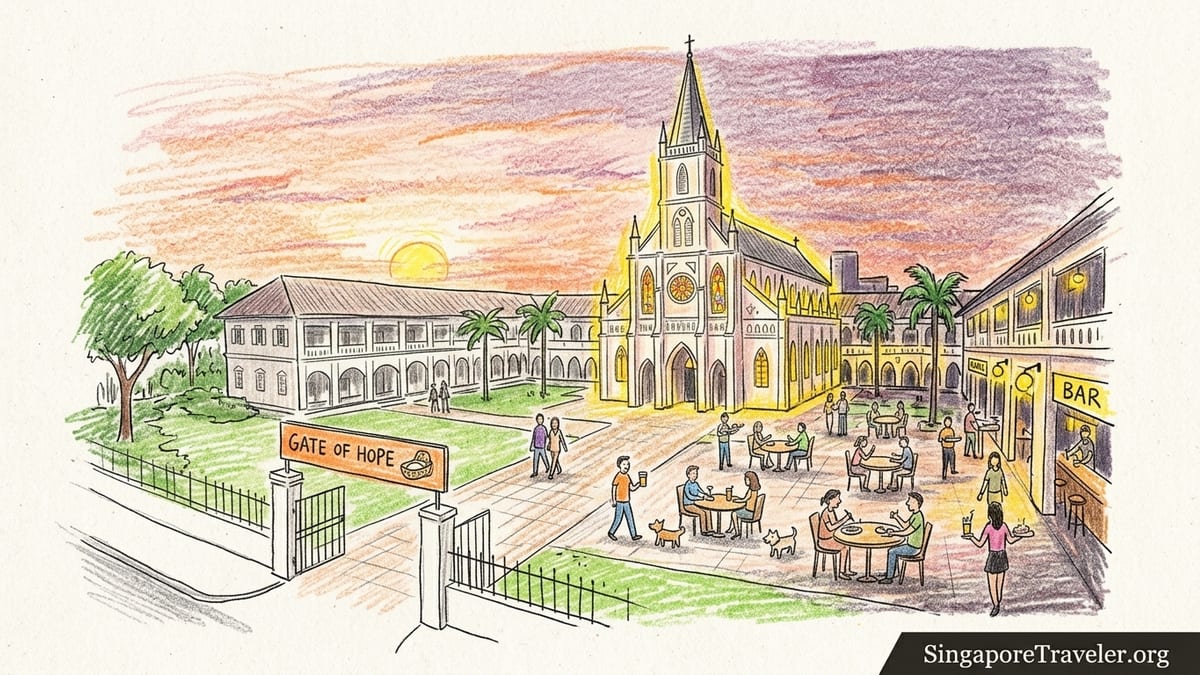
Before Sunset: Entering A Convent That Became A Night Out
I timed it deliberately to arrive before sunset, because CHIJMES is one of those Singapore places that can feel like two different destinations depending on the hour. In the late afternoon, you hear your own footsteps. Conversations are spaced out. The courtyard looks more like a heritage photograph than a nightlife precinct, and the pale buildings absorb the light in a way that makes even a casual phone photo look composed.
CHIJMES began as the Convent of the Holy Infant Jesus in the mid-19th century, with the convent established in 1854. Knowing that changes how you move through the space. You stop thinking of it as just “a dining complex near City Hall MRT” and start reading it as a campus: corridors, courtyards, old school blocks, a chapel that still dominates the sightlines, and a calm that feels almost intentional, as if the architecture is asking you to lower your voice.
That calm is also the first drawback. If you visit in the daytime expecting the buzz you see in night photos, it can feel surprisingly quiet. Some restaurants are open, but the energy is muted, especially between lunch and dinner. It is better for unhurried wandering and photography, but if you want CHIJMES to feel alive, you need to stay into the evening.
Caldwell House: The Oldest Survivor And The Start Of The Story
I began at Caldwell House, the oldest surviving building in the complex. Its presence is quieter than the chapel’s, but it is the detail that makes the bigger narrative click. You do not need to be an architecture obsessive to feel the shift: Caldwell House reads as restrained colonial-era design, while the rest of CHIJMES, especially the chapel, leans more dramatic and vertical.
There is something grounding about starting here before moving to the more famous facade. It reminds you that CHIJMES is not a single building with a single purpose preserved under glass. It is a cluster of structures that carried daily life, and later had to be adapted for new uses. That “adaptive reuse” phrase can sound like a planning document until you see it in practice: heritage exteriors and corridors feeding into menus, reservation systems, and bar seating.
In the early evening, the area around Caldwell House felt like an antechamber to the night. A few couples took photos. A small group lingered on benches checking dinner plans. It was quiet enough that the first sound of a bar’s background music felt like a cue, telling you the second act was on its way.
The Gate Of Hope: A Small Entrance With A Heavy Past
From there, I made a point to find the Gate of Hope on Victoria Street, because it is one of those details that can get lost when CHIJMES is treated purely as a lifestyle stop. In the old days, the convent complex included an orphanage, and unwanted babies were left at a side gate on Victoria Street, in the hope they would be taken in. The practice has long since stopped, but the idea of the gate remains, and once you know why it exists, it reframes the entire site.
It is not a dramatic, museum-style display. It does not perform grief for visitors. It is simply there, a piece of the complex’s lived history that sits uncomfortably beside the modern reality of people arriving for happy hour. That contrast is not a problem to smooth over. It is the point. CHIJMES is beautiful at night, but it is also a place where life in earlier Singapore came with hard edges.
Standing near the Gate of Hope while the sky softened into dusk, I felt the oddest collision: the stillness of heritage, the rush of traffic nearby, and the fact that inside the complex, staff were lighting up signs and pulling chairs into perfect alignment for dinner. CHIJMES does not let you forget that a single location can hold multiple identities, depending on who you are and what you came for.
The Chapel After Dusk: Exterior Drama And The Question Of Going Inside
As sunset gave way to evening, I walked toward the former chapel, now known as CHIJMES Hall. Even if you have never been here, you have probably seen it: pale Gothic styling, a tall spire, and the kind of symmetry that makes wedding photographers very busy. This is the visual center of CHIJMES, and after dark it becomes the emotional center too, because lighting changes everything. The chapel’s edges sharpen. The windows glow. The courtyard feels like a stage.
The former chapel’s stained glass is the fact everyone repeats for a reason. The windows contain roughly 30,000 individual pieces of Belgian stained glass, and while you may not be able to count them, you can feel the density and intricacy when you get close enough to study the panels. It is the kind of craftsmanship that does not translate as “old building” so much as “astonishing labor,” and it becomes even more striking when night lighting emphasizes color and pattern.
Here is the practical reality: CHIJMES Hall typically functions as an events and wedding venue, not an always-open museum interior. That means exterior access is reliable, but interior access depends on what is happening that day. If the doors are open due to a public event, concert, or an accessible function, the interior is a different world: soaring height, patterned details, and stained glass that reads less like decor and more like a signature. If it is closed, you still get a powerful experience from the courtyard, but you will need to accept that this is Singapore heritage operating in real estate and events logic, not in “open gallery hours” logic.
Even without stepping inside, the chapel exterior is worth an unhurried loop. I watched visitors do the same: a quick photo, then a slower second pass when they realized the first shot did not capture the scale. A few diners drifted out from nearby restaurants mid-meal to take pictures, proving how the chapel acts like a magnet even for people who came here primarily to eat.
The Lawns And The Restoration Story You Can Feel Under Your Feet
Between the monuments and the dining units, CHIJMES has lawns and open-air spaces that do more than provide seating overflow. They create breathing room, and they help explain why CHIJMES works at night. Many dining areas in Singapore are either fully indoor and air-conditioned or fully street-facing and chaotic. CHIJMES is different. It is an interior courtyard world, protected from the main road, with heritage walls forming the boundaries.
Walking the grounds in the last light, I noticed how the site’s restoration and upkeep show up in small ways: clean lines, maintained corridors, and the sense that you are moving through a space that was planned as a precinct, not just a row of shops. Singapore redevelopments can sometimes feel too polished, but at CHIJMES the polish works because the buildings are the point. It is an aesthetic that feels deliberate rather than accidental.
As the evening progressed, the lawns shifted from “quiet heritage pause” to “social spillover.” People took phone calls while waiting for tables. A couple shared a drink they carried out from a bar. Groups gathered for photos with the chapel behind them, using the lawn as a staging area. You can practically watch the complex learn how to be a nightlife spot, minute by minute.
If you are visiting with a pet, CHIJMES has also leaned into alfresco culture by allowing pets in selected outdoor dining areas under published guidelines. In practice, that means you will see people arrive with dogs as the evening warms up, especially around the courtyard tables where the vibe is more casual and the foot traffic makes the place feel like a neighborhood square rather than a mall.
Dinner And Drinks: What I Ordered, What It Cost, And How Busy It Got
Once the lights fully took over and the courtyard started to hum, I switched from heritage walk to dining mode. For a grounded evening, I kept my choices within CHIJMES itself rather than leaving the complex for a “better” meal elsewhere. Part of the point is judging CHIJMES as a complete experience: heritage, atmosphere, and food in the same night.
I started with a simple, reliable move: an early-evening drink to match the shift in mood. At Almost Famous, I ordered one of the entry-level lunch-and-daytime deals that is clearly advertised at CHIJMES, because it provides a concrete baseline for value. Their lunch sets are promoted from about $16, which is useful even if you are not here at lunchtime because it signals the venue’s price range and casual bar positioning. For an evening drink, I kept it straightforward with a beer rather than a cocktail, since cocktail pricing and recipes change often and I did not want to rely on a potentially outdated menu snapshot. The bill in the evening felt in line with what you would expect around City Hall: not cheap, not outrageous, but clearly “central Singapore” rather than neighborhood pricing.
For dinner, I leaned into a CHIJMES staple style: open-air courtyard seating and shareable plates. The Winery Tapas Bar is one of those spots that fits the architecture. You can order a few small plates, take your time, and the courtyard acts like part of the decor. CHIJMES actively promotes happy hour and early-day deals at multiple tenants, including The Winery’s afternoon promotions, and that deal culture shapes the crowd: after-work groups arrive early, linger, and then roll into dinner without relocating.
I also made a point to note a concrete example that travelers can actually use: CHIJMES publishes specific promotions and set-pricing at certain tenants, such as Coffeesmith offering a coffee-and-cake combo at $10.50 during advertised hours, and Daily Beer listing food sets from $9 for a “power lunch.” Even if you are not eating those exact deals at night, they help you understand that CHIJMES is not exclusively fine dining. You can have a relatively budget-friendly bite here if you time it right.
As for crowd levels, the change after dark was dramatic. In the late afternoon, CHIJMES felt almost hushed. By full night, the courtyard became a steady stream: diners arriving in waves, groups taking photos near the chapel, and the kind of background noise that signals a place is functioning as a social hub. It was not nightclub chaos, but it was unmistakably active. Tables filled up fast in the most scenic alfresco zones, especially those with direct chapel views. If you are aiming for prime outdoor seating on a Friday or Saturday night, booking ahead with your chosen tenant is the difference between strolling in confidently and standing around watching other people’s food arrive.
The Takeaway: History Stop, Dinner Destination, Or Both?
CHIJMES works best as a combination of both, but only if you commit to the full arc of the evening. Arrive before sunset, walk the complex while it is still quiet enough to hear the place, and let the heritage details land: Caldwell House’s age, the Gate of Hope’s story, the chapel’s exterior, and the stained glass legacy that defines the site’s identity even when you cannot always access the interior.
Then stay. Once the lights come on and the courtyard fills, CHIJMES becomes what modern Singapore does exceptionally well: a curated nightlife-and-dining environment that still feels outdoors and architectural rather than sealed and generic. The best moment of the night, for me, was not a single dish or drink. It was the shift itself: the same courtyard that felt almost contemplative in late afternoon became a living room for the city by 8 pm, with laughter bouncing off convent walls.
If you only want history, CHIJMES may frustrate you because the most famous interior, CHIJMES Hall, is event-driven access. You might come on a day when you can only view from outside. If you only want dinner, you could easily eat well elsewhere in Singapore without navigating a heritage site that draws crowds for photos. But if you want a place where heritage is not a side note and nightlife is not an afterthought, CHIJMES delivers a rare two-in-one experience, and it is precisely the contrast that makes it memorable.
FAQ
Q1. Is CHIJMES free to enter?
Yes. You can walk through the courtyards and public areas without paying. You only pay if you dine, drink, park, or attend a ticketed event.
Q2. What time should I arrive to experience CHIJMES before and after dark?
Arrive about 45 to 60 minutes before sunset so you can walk the heritage areas in daylight and then stay as the courtyard lights and dinner crowd build.
Q3. Where is the Gate of Hope at CHIJMES?
The Gate of Hope is on Victoria Street along the CHIJMES perimeter, historically linked to the former orphanage function of the convent complex.
Q4. Can visitors go inside the former chapel, CHIJMES Hall?
Sometimes, but not reliably. CHIJMES Hall is primarily an events and wedding venue, so interior access depends on whether it is open for a public event or function.
Q5. What is the key detail about the chapel’s stained glass?
The former chapel is known for stained-glass windows made up of roughly 30,000 individual pieces of Belgian stained glass.
Q6. What is Caldwell House, and why is it important?
Caldwell House is the complex’s oldest surviving building and a major heritage anchor within CHIJMES, predating the later chapel structure.
Q7. Is CHIJMES better in the daytime or at night?
Daytime is calmer and better for photos and quiet wandering, but the atmosphere becomes far livelier at night when restaurants and bars fill up.
Q8. Are there budget-friendly options at CHIJMES?
Yes. CHIJMES tenants frequently advertise set deals and promos, including a coffee-and-cake combo at Coffeesmith for $10.50 during stated hours and lunch sets at some outlets starting around the teens.
Q9. Is CHIJMES pet-friendly?
Pets are allowed in selected outdoor dining areas under published estate guidelines, so it is best to confirm that your chosen restaurant offers pet-friendly alfresco seating.
Q10. Does CHIJMES work best as a heritage stop or a dinner destination?
It is strongest as a combination: come for the history before sunset, then stay for dinner or drinks to experience how dramatically the site changes after dark.