


I started my Waterloo Street walk the way most people do in Singapore: by following the crowd. It was mid-morning near Bugis, the kind of humid city hour when you can hear traffic in one ear and prayer in the other. On this short stretch of road, devotion isn’t tucked away behind gates or hidden on upper floors. It spills out in queues, in bouquets of lotus and jasmine, in the soft crackle of incense, and in the way strangers instinctively lower their voices as they step from sidewalk into sanctuary.
Waterloo Street is unusually rich not because it has many temples, but because very different religious institutions developed almost shoulder to shoulder. Sri Krishnan Temple traces its origins to 1870, while Kwan Im Thong Hood Cho Temple was built in 1884, and they sit in striking proximity, separated by only a few steps of pavement. Nearby, Maghain Aboth Synagogue stands as Singapore’s oldest synagogue, but it is not a casual walk-in stop. Christian heritage is close too, with historic churches in the surrounding streets that still function as living places of worship, not museum pieces.
What I learned, walking it slowly with my phone in my pocket more often than not, is that Waterloo Street is less about ticking off “four religions in one morning” and more about observing how Singapore’s multicultural history still behaves in the present tense. People queue for blessings, pause at thresholds, buy flowers from the same vendors, and sometimes, quietly, cross between religious spaces in ways that surprised me.
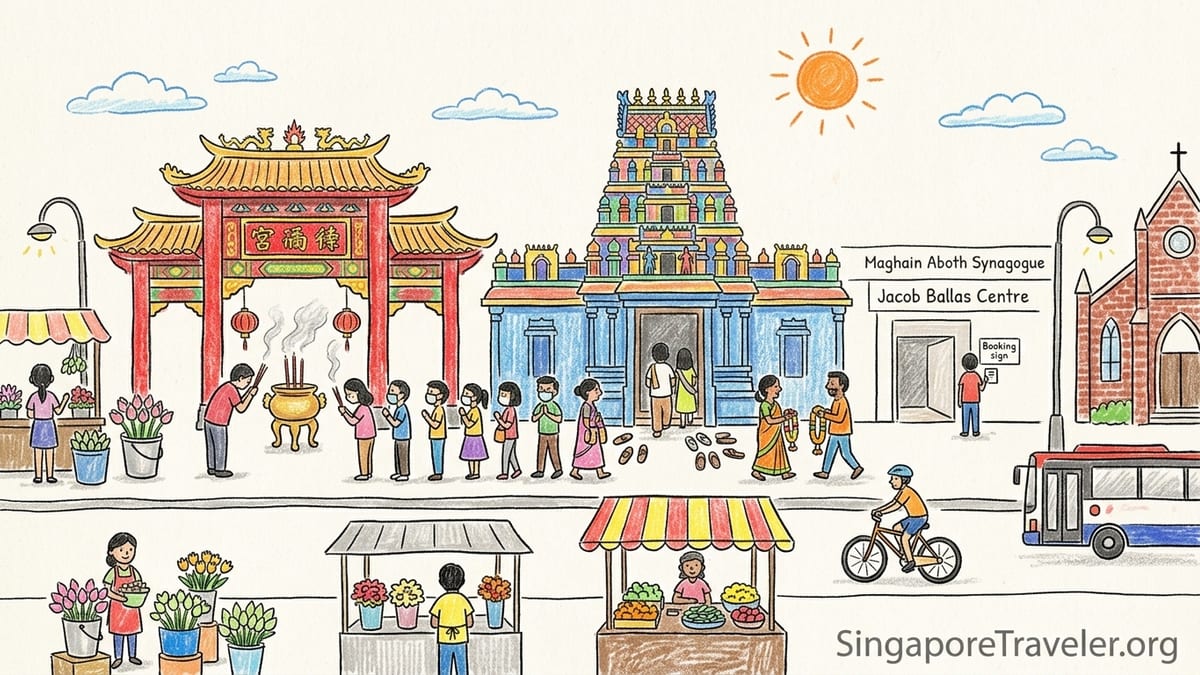
Starting The Walk: The Soundtrack Of A Sacred Street
I began at the Bugis end and let the street set the rhythm. Waterloo Street feels like a working corridor first and a heritage precinct second. Buses sigh at stops, delivery riders squeeze past, and the air changes in pulses as you pass doorways that smell of incense, then coffee, then rain-warmed stone. The religious landmarks aren’t isolated compounds. They are stitched into everyday Singapore.
Even before I reached the temples, the devotional economy was visible. Flower sellers arranged bright marigold garlands and neat bunches of lotus buds in white buckets. A few steps away, small stalls displayed incense and prayer items. What struck me was how these street-level transactions set the tone: you don’t need to understand every ritual to see that worship here is active, purchased in small increments, and carried in your hands.
Noise is part of the experience. On some mornings, the queue outside Kwan Im Thong Hood Cho Temple can stretch, and you can hear murmured prayers and the soft clatter of offering trays. Yet it rarely feels chaotic. People adjust their pace naturally, stepping aside for elders, threading through the crowd with a practiced patience that feels like its own kind of etiquette.
Kwan Im Thong Hood Cho Temple: Quiet Rules In A Crowded Room
Kwan Im Thong Hood Cho Temple sits at 178 Waterloo Street, and it has the gravitational pull of a place people return to, not just visit once. The temple’s official visitor guidance is unusually direct on one point: it requests that visitors respect the sanctity of the temple and refrain from videography and photography. In practice, that single rule shapes everything about how you move. You become more observant because you are not constantly composing shots.
Inside, the atmosphere felt both communal and intensely private. Devotees stood shoulder to shoulder, yet each seemed sealed in their own request. The room was dense with the particular hush of shared concentration: shuffling feet, the faint scrape of a tray, a whisper that disappears quickly. The sensation wasn’t of watching a ritual, but of passing through someone else’s lived relationship with the divine.
On ordinary days, some visitors come specifically for qian, the practice of drawing divination sticks for guidance. The temple itself notes that qian is not available on major festival days, including the 1st and 15th days of the lunar month, Vesak Day, Guan Yin’s celebration days on the 19th day of the 2nd, 6th, and 9th lunar months, and Chinese New Year. That detail matters if you are planning a short walk and expect to participate rather than just observe.
Dress here is less about a posted uniform and more about the social cue of respect: covered shoulders, longer bottoms, and a quiet presence. I noticed how quickly even tourists adapted, lowering voices and putting phones away. The temple’s crowd teaches you how to behave.
Sri Krishnan Temple: Shoes Off, Color On, And A Different Kind Of Stillness
Then comes the moment Waterloo Street is famous for: the short walk between Buddhist compassion and Hindu devotion that is so brief you can stand on the pavement and see both entrances. Sri Krishnan Temple is at 152 Waterloo Street, and the shift feels immediate. The palette changes to bright South Indian color, and the threshold changes your body language. Here, shoe removal is part of the ritual posture.
I watched the shoe area do its quiet work. Some visitors arrived in socks, others barefoot, a few carrying small plastic bags for footwear. If you are walking Waterloo Street in the rain season, this is the point where you will be glad you wore shoes that slip on and off easily, rather than complicated laces. The act of removing shoes is not a tourism quirk. It is a sign that the floor itself matters in Hindu worship, and you can feel the collective seriousness of that simple gesture.
Inside, the experience was less queue-driven and more spatial. Devotees moved between shrines with a sense of familiarity, pausing, stepping back, letting others pass. The air carried the sweet, thick smell of flowers layered over incense, different in character from the neighboring temple’s smoke. The temple is an active place of worship, and that means rules can shift depending on what is happening in the moment. The most respectful approach is to follow signage and, when uncertain, ask a staff member before photographing closer to inner shrines.
What surprised me most was not the contrast between the two temples, but the ease with which the street holds both. No buffer zone, no polite distance. Just a few steps and a different vocabulary of devotion.
The In-Between Space: Sellers, Fortune-Seeking, And Devotees Crossing Lines
The sidewalk between Sri Krishnan Temple and Kwan Im Thong Hood Cho Temple is where Waterloo Street reveals its human complexity. Offerings are sold in the open, and you can watch people decide, in real time, what kind of help they are seeking today. A bouquet of lotus buds for one doorway, a garland for another, incense for a third. The religious boundaries are clear inside each sacred space, but outside, daily life blurs them.
I noticed something that would be easy to miss if you were rushing: devotees crossing between the two temples. Not as a show, not as a social media stunt, but with the matter-of-fact practicality of people who live in a multi-faith city. Someone might finish a quiet prayer at one temple, step out, buy flowers, and drift toward the other. It did not feel like confusion. It felt like Singapore: layered identities, inherited habits, and a street that has made room for them for generations.
Fortune-seeking is present too, and it takes different forms. At Kwan Im Thong Hood Cho Temple, qian is one visible practice when it is available. On the street, you may also notice a general hum of people discussing luck, health, exams, and work. The tone isn’t theatrical. It’s everyday vulnerability. Waterloo Street is where the spiritual needs of a modern city come to the surface in public.
Photography etiquette becomes especially important in this in-between zone. Even if you are standing on public pavement, you are often facing people in prayer or people carrying offerings with deeply personal intentions. The most respectful posture I found was to photograph architecture from a distance and keep faces out of frame unless you have clear permission.
Maghain Aboth Synagogue: A Heritage Landmark You Cannot “Just Pop Into”
Maghain Aboth Synagogue sits at 24/26 Waterloo Street, and it changes the walking experience because it reminds you that not every heritage site is designed for casual tourism. The synagogue is a national monument and an active congregation, and the reality on the ground is simple: it is closed to walk-in visitors. If you want to go inside, you need permission and planning.
What you can do, however, is approach the Jewish heritage of the street responsibly. The Jews of Singapore Museum, located at the Jacob Ballas Centre at 24 Waterloo Street, offers a structured way to learn without assuming access to religious space. It is free of charge, but it is not a spontaneous drop-in. The museum requires visitors to book a slot at least three days in advance. Its published opening hours are Sunday to Thursday from 10am to 6pm, Friday from 10am to 12pm, closed on Saturdays and Jewish festivals, with the note that it opens at 2pm on Sundays.
That booking requirement shaped my own planning. Instead of treating the synagogue as a photo stop, I treated it as an appointment-based cultural visit. There is a difference between “heritage tourism” and “heritage respect,” and Waterloo Street makes you practice it. Even from outside, the presence of the synagogue in the same compact neighborhood as the temples is its own lesson in Singapore’s history: diverse communities built, stayed, and organized, sometimes in close proximity to one another.
If you are hoping for a synagogue tour, the synagogue community provides a clear channel: tours are arranged by request through the community, and you should expect security procedures and specific visitor expectations. The key is not to assume access. Arrange it properly, or treat the exterior and the museum as your responsible alternative.
Christian Heritage Nearby: Stepping Into Living Churches, Not Just Old Buildings
From Waterloo Street, Christian heritage is not far. The walk becomes a small radius rather than a single straight line. I headed toward Queen Street and Victoria Street, where churches continue to operate with regular services and open hours for quiet prayer. This is where the walk feels less like a “religions of Singapore” survey and more like a real neighborhood, with faith communities functioning side by side.
The Church of Saints Peter and Paul, at 225A Queen Street, is one of the easiest sacred interiors to enter respectfully during published opening hours. According to the church’s visitor information, the Chapel of the Incarnation is open Monday to Friday from 8am to 9pm and Saturday and Sunday from 8am to 6pm, with closures on public holidays. In practice, that means you can step in, sit at the back, and let the city noise drop away for a moment.
St Joseph’s Church on Victoria Street, at 143 Victoria Street, is another powerful stop, especially if you are interested in how colonial-era communities shaped the city. The church is a national monument and maintains published opening hours for visitors: Monday to Friday 10am to 7.30pm, Saturday 9am to 7pm, Sunday 9am to 7pm. I found the experience distinctly different from the temples: less queueing, more quiet space, and a different kind of visual focus, where stained glass, statues, and side chapels invite slow attention.
In both churches, the etiquette felt straightforward and consistent: dress modestly, keep voices low, avoid flash, do not walk up to the sanctuary area during prayer, and remember that even if the doors are open, it is still someone’s place of worship. The mood is not “come in and look around,” but “come in and be present without taking over the room.”
The Takeaway: What Waterloo Street Taught Me About Singapore’s Multicultural DNA
Waterloo Street doesn’t feel like a curated diversity showcase. It feels like the city got built by people who needed places to pray, and those places simply stayed. The result is not a perfect harmony postcard. It is something more convincing: functional coexistence. A Buddhist temple that asks you not to take photos. A Hindu temple that changes your posture the moment you remove your shoes. A synagogue that requires planning and permission. Churches that welcome quiet entry without turning worship into spectacle.
What surprised me most was how little the street asks you to “understand everything” and how much it asks you to behave respectfully anyway. You can be a visitor with limited knowledge and still do the right thing: cover your shoulders, lower your voice, don’t block pathways, don’t photograph private devotion, and don’t assume access to restricted sites. The details of etiquette are different across faiths, but the principle is the same.
If you want to do this walk in 90 minutes to two hours, this is the practical route that worked best for me, assuming you are not attending a full service or waiting through a long divination queue. Start at Kwan Im Thong Hood Cho Temple (178 Waterloo Street) first while your energy is fresh and you are most able to move slowly in a crowd. Then take the short steps to Sri Krishnan Temple (152 Waterloo Street) and plan for shoe removal. Next, continue along Waterloo Street to the Maghain Aboth Synagogue and Jacob Ballas Centre exterior, but only enter the Jews of Singapore Museum if you have booked at least three days in advance and are visiting during its opening hours. From there, walk toward Queen Street for the Church of Saints Peter and Paul, then finish at St Joseph’s Church on Victoria Street during its published opening hours.
Finally, the etiquette that matters most on this walk is practical, not theoretical. For the Buddhist temple: keep your phone away and follow the no-photo request. For the Hindu temple: dress modestly and be ready to remove your shoes and follow any staff guidance on photography near inner shrines. For Jewish heritage: do not expect walk-in access to the synagogue; book the museum in advance and treat security rules as non-negotiable. For churches: dress respectfully, speak softly, and remember that an open door is an invitation to pray quietly, not to perform tourism.
FAQ
Q1. How long does the Waterloo Street multi-faith walk take?
Most travelers can do it in 90 minutes to two hours, depending on crowds, how long you spend observing, and whether you have a pre-booked museum slot.
Q2. Are Sri Krishnan Temple and Kwan Im Thong Hood Cho Temple really next to each other?
Yes. They are separated by only a short stretch of pavement on Waterloo Street, and the proximity is one of the most striking parts of the walk.
Q3. Can I take photos inside Kwan Im Thong Hood Cho Temple?
The temple requests that visitors refrain from videography and photography. The most respectful approach is to keep your camera and phone put away inside.
Q4. Do I have to remove my shoes at Sri Krishnan Temple?
Yes, shoe removal is part of the expected etiquette when entering Hindu temple spaces. Wear footwear that is easy to take on and off.
Q5. Can tourists walk into Maghain Aboth Synagogue?
No. It is closed to walk-in visitors. Entry requires proper arrangement and permission rather than spontaneous tourist access.
Q6. What is the easiest way to experience Jewish heritage on Waterloo Street respectfully?
Book the free Jews of Singapore Museum at the Jacob Ballas Centre in advance, and treat it as your primary visitor-facing stop unless you have arranged a synagogue tour.
Q7. Do I need to book the Jews of Singapore Museum?
Yes. Bookings must be made at least three days in advance, and the museum keeps specific opening hours, including shorter hours on Fridays.
Q8. Are nearby churches open to visitors outside of Mass times?
Often, yes during posted opening hours, especially for quiet prayer, but hours can change for public holidays or events, so it is wise to verify before you go.
Q9. What should I wear for a respectful visit across all these faith sites?
Choose modest, breathable clothing that covers shoulders and mid-thigh, and avoid overly revealing outfits. Bring a light scarf if you want extra coverage flexibility.
Q10. What’s the single biggest etiquette mistake visitors make on Waterloo Street?
Assuming every heritage site works like a museum. These are living places of worship, and rules on photos, access, and behavior can be strict for good reasons.