


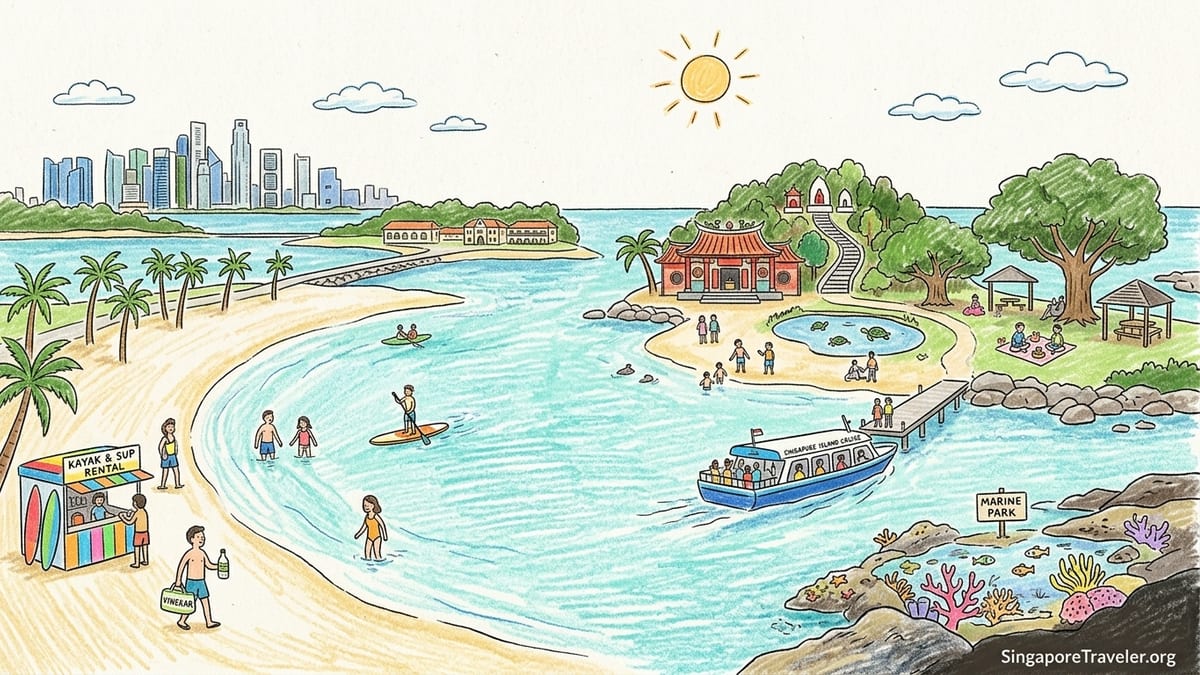
Just 30 minutes by ferry from Singapore’s skyscrapers, the Southern Islands offer a very different kind of city break: soft sand, rustic jetties, temple bells, and clear views across the Singapore Strait. Lazarus, St John’s, Kusu and Big Sister’s Islands all promise saltwater and sea breezes, but each feels distinct. This guide compares their beaches and lagoons in practical detail so you can decide which island best fits your day out, from lazy swims and SUP sessions to turtle ponds and hilltop shrines.
Understanding the Southern Islands at a Glance
Singapore’s Southern Islands sit just south of the mainland and are reached by public ferries from Marina South Pier. Most visitors use loop tickets with operators such as Singapore Island Cruise or Marina South Ferries, which typically cost in the range of 18 to 30 Singapore dollars per adult for a same-day round trip, with stops at St John’s and Kusu and occasional services to Big Sister’s. Ferries take about 30 minutes to St John’s, where you can walk to Lazarus via a short causeway, or continue on to Kusu and, on selected departures, to Big Sister’s Island.
These are not resort islands like Sentosa. You will not find chain cafes, beach clubs or shopping malls. St John’s and Lazarus have simple toilets, outdoor showers and a small convenience store on Lazarus that, according to the Singapore Land Authority, currently opens Friday to Sunday in the day. Kusu has landscaped gardens, shrines and a turtle pond but no big restaurants. Big Sister’s Island is part of Sisters’ Islands Marine Park and is managed primarily as a conservation and education area, with basic visitor facilities.
For planning, it helps to think of Lazarus as the benchmark classic beach day, St John’s as the heritage and nature complement, Kusu as the culture-and-children option, and Big Sister’s as the marine park outpost. All share similar tropical sea conditions and all require you to be self-sufficient with water, snacks, sun protection and basic first aid.
Before you decide where to swim, keep in mind that Singapore’s authorities acknowledge box jellyfish in local waters, including around the Southern Islands. The Animal and Veterinary Service advises swimmers not to assume any beach is free of jellyfish and recommends precautions such as not swimming alone, wearing more coverage like rash guards or long-sleeved swimwear, and carrying plain vinegar as a first-aid measure. Water here can be pleasant and inviting, but it is never risk free.
Lazarus Island: Benchmark Beach for Sand and Space
Lazarus Island is widely regarded as having one of Singapore’s nicest natural-style beaches. The main crescent of sand, on the side facing the open sea away from the causeway to St John’s, is broad and gently sloping. The sand is relatively fine and pale compared with East Coast Park or some of Sentosa’s more compact coves, and at mid tide the water often looks a soft turquoise under clear skies. You will still find bits of shell and the occasional pebble, but it is comfortable enough that many visitors walk barefoot from their mats to the shoreline.
Shade comes mostly from rows of tall coconut palms and beach she-oaks planted when the beach was created and later improved. If you arrive on the first ferries of the morning, around 9.30 to 10.30, you can usually secure a spot under natural shade without pitching a beach tent. By midday on weekends, especially when local families and groups of friends arrive with coolers and portable speakers, the shaded spots fill up quickly, although the length of the beach means you can almost always find open sand a little farther along.
For swimming, Lazarus offers an open-water feel with relatively calm conditions on many days, but there are no lifeguards, no cordoned-off swimming lanes and boat traffic in the wider channel. On a typical Saturday you might see two or three paddleboarders from the Lazarus sea sports kiosk, small groups wading chest-deep near shore and a few people swimming parallel to the beach with tow buoys. As with any unpatrolled beach, keep within your depth if you are not a confident swimmer, and remember that the same box jellyfish advisory that applies to mainland beaches applies here too.
Facilities are basic but adequate for a simple day out. Toilets and cold-water showers sit back from the sand, and the small convenience store on the island sells bottled drinks, ice cream, instant noodles and simple snacks during its opening hours. There are no big hawker-style food courts, so many day-trippers bring supermarket sushi, packed sandwiches or takeaway nasi lemak from hawker centres near Marina South Pier. Rubbish bins are provided, but it is wise to bring a few spare plastic bags because wind and macaques can scatter trash if bags are left open on the sand.
St John’s Island: Lagoons, Heritage and Quieter Corners
St John’s Island is your likely first landing point and offers a different beach experience from Lazarus. The main swimming lagoon area, about a 10 to 15 minute walk from the jetty, is a gently curved bay edged by a low seawall and grassy lawns. The sand here tends to be slightly coarser and more mixed with coral fragments than Lazarus, and the water is shallower for a longer distance, which many families with small children appreciate.
Shade is one of St John’s strengths. Several mature trees line the grassy fringes around the lagoon, and you will find fixed picnic tables and benches under some of them. This makes St John’s attractive for multi-generational outings where older family members prefer firm ground and seating over lying directly on the sand. Teenagers can swim or kick a ball nearby while grandparents sit under the trees with cold drinks and snacks brought from the mainland.
Beyond the beach, St John’s has a surprising amount of historical and nature interest. Information boards explain its past as a quarantine station and former penal settlement, and there are signposted walking routes through secondary forest to viewpoints with glimpses back to the city skyline. The nearby protected Bendera Bay is part of Sisters’ Islands Marine Park and only accessible through guided programmes, but even from the surrounding paths you may spot reef fish or corals at low tide. If you want a beach day with context and learning, St John’s is stronger in this respect than Lazarus.
Swimming conditions are generally calm in the lagoons, though again there are no lifeguards and currents can strengthen near the outer edges and at certain tides. Picnic suitability is high thanks to the lawn areas and shelters, and crowds tend to be more dispersed than on Lazarus. On weekday mornings you may share the lagoon with only a handful of other picnickers and perhaps an open-water swimmer or two using it as a training loop. For visitors who want some sand and sea but also a sense of Singapore’s maritime history, St John’s makes a solid alternative anchor point.
Kusu Island: Culture, Turtles and Family-Friendly Shallows
Kusu Island offers the strongest blend of beach time with culture and spirituality. The moment you step off the ferry you are in a landscaped park dotted with pavilions, tiled walkways and a small turtle sanctuary pond, overlooked by the brightly painted Tua Pek Kong Temple. A short climb up a wooded hill behind the temple leads to Malay shrines known as keramat, where pilgrims leave incense and offerings. During the annual Kusu pilgrimage season, usually around October, crowds of local devotees fill the island, but on ordinary weekends it feels peaceful and uncrowded.
The main beach area sits beyond the gardens. It is compact compared with Lazarus but visually appealing, with fine, pale sand and very shallow water that stays knee-deep for several metres at mid tide. This makes it popular with families with toddlers who are more comfortable paddling and digging than swimming. Parents often set up under the fixed shelters and let children alternate between the turtle pond, the temple courtyard and the shoreline. The atmosphere feels more like a waterfront park with a beach attached than a pure beach resort.
Shade and picnic infrastructure are stronger here than on both Lazarus and St John’s. Concrete shelters with tables, benches and nearby taps are scattered around the lawn behind the beach. Many families bring full picnic spreads, from rice cookers plugged into portable power banks to boxes of homemade curry puffs. Because there are no shops or cafes, you should treat Kusu as fully self-catered. Bring more water than you think you need, especially if you plan to climb the shrine steps in the afternoon heat.
Swimming is possible but secondary to the cultural experience. The shallow gradient and sheltered position mean waves are minimal, and when the tide is high older children and adults can wade out for a short swim. However, the same jellyfish precautions apply, and there is occasional boat traffic in the surrounding channel. If you are choosing a Southern Island where beach time can be combined with temple visits and an easy introduction to local religious traditions, Kusu clearly outperforms Lazarus and St John’s.
Big Sister’s Island: Marine Park Vibes and Wilder Shores
Big Sister’s Island is part of Sisters’ Islands Marine Park, Singapore’s first marine park, which also includes the western reefs of St John’s and Pulau Tekukor. Access, opening hours and activities here are managed by the National Parks Board with a focus on conservation and education rather than pure recreation. As of 2026, Big Sister’s is open to the public in the day, often from 7 am to 7 pm, but visitors are encouraged to check the latest park notices and ferry arrangements as these can change with programmes and restoration works.
The beaches and rocky shores on Big Sister’s feel wilder than those on Lazarus, St John’s or Kusu. You will find small sandy coves, tidal pools and stretches of coral rubble rather than one long, uniform swimming beach. The sand is patchier and coarser, and footwear such as reef shoes or sandals is strongly recommended if you plan to explore the intertidal zone at low tide. In return, the marine life is more visible. On guided intertidal walks organised by NParks or partner groups, visitors often spot seagrass beds, hard and soft corals, sea cucumbers and small reef fishes in the shallows.
Because of its marine park status, Big Sister’s is less about free swimming and more about controlled encounters with marine nature. Certain areas may be designated for swimming during higher tides, but others are zoned for conservation or research, and rangers will advise where you can safely enter the water. The box jellyfish advisory is taken seriously here, and guided activities include briefings on what to do if someone is stung and how to minimise risk. Stand-up paddleboarding and kayaking, where offered by approved operators, are typically kept near designated launch points to avoid sensitive reef patches.
Facilities are simpler than on Kusu or St John’s. There may be basic toilets, shelters and information boards but no shops. Visitors usually bring everything from drinking water to packed lunches in dry bags. Crowds are naturally limited by both ferry capacity and the park’s conservation rules, so even on weekends Big Sister’s tends to feel quieter and more nature-focused. For travellers who prefer a day of guided marine walks, coastal forest trails and conservation learning, Big Sister’s offers a very different experience from using Lazarus purely as a sun-and-sand destination.
Swimming, Sand and Sea Sports: How the Islands Compare
When comparing the four islands purely for swimming and sand quality, Lazarus generally comes out on top. Its long, crescent-shaped beach offers the softest, most consistently groomed sand and the most space to spread out compared with the smaller pockets on Kusu and Big Sister’s, or the lagoon-style coves on St John’s. The open aspect also means sea breezes reach the beach more readily, which can make afternoons feel a little less stifling than in enclosed lagoons.
St John’s excels for protected swimming lagoons where waves are minimal and the water is shallow near shore, ideal for cautious swimmers or those doing relaxed laps. However, the sand underfoot can feel slightly grainier, with more coral fragments, and visibility is often lower than on Lazarus because of the enclosed shape. Kusu’s beach is the shallowest and most child-friendly, but adults looking for longer swims may find themselves wading far out at higher tide just to reach waist depth. Big Sister’s is best approached with a snorkel or intertidal mindset rather than for freestyle training, although on some guided programmes you may have short windows to swim in designated areas.
For sea sports such as kayaking and stand-up paddleboarding, Lazarus currently has the most straightforward access for casual visitors, with a sea sports centre that rents kayaks and SUP boards by the hour and runs short introductory sessions. Prices fluctuate, but visitors can expect to pay somewhere in the range of 25 to 40 Singapore dollars for an hour on a stand-up paddleboard, including basic instruction and a personal flotation device. On busy weekend afternoons, slots may sell out, so it is wise to check availability earlier in the day or book ahead where possible.
Big Sister’s sometimes hosts marine-park-linked kayaking sessions or snorkel trails led by NParks or partner organisations, but these are usually pre-booked, small-group activities tied to specific dates and tides, not everyday rentals. St John’s and Kusu do not currently have pick-up-and-go sea sports kiosks aimed at walk-in visitors. If your priority is a day that mixes relaxed swimming with a first try at SUP in relatively calm water, Lazarus has the clear advantage.
Crowds, Ferries, Picnics and Families
Getting to any of the Southern Islands starts at Marina South Pier, where you buy or scan your ferry ticket and board at designated times. Ferries to St John’s and Kusu typically run several times a day on weekends and public holidays, but fewer times on weekdays. A common loop runs Marina South Pier to St John’s, then Kusu, then back to the mainland, with travel segments of roughly 15 to 20 minutes each. Some services or special charters continue to Big Sister’s, often aligned with marine park tours or programmes. Timetables can change with jetty works or weather, so it is important to check the latest schedule and jetty information before you go.
Crowd levels follow predictable patterns. Lazarus, being seen as the “Instagram beach,” draws the largest numbers of leisure visitors on sunny Saturdays and Sundays, especially from late morning to mid-afternoon. You may see large picnic groups with iceboxes, Bluetooth speakers and beach tents lining the central section of the bay. To enjoy it with fewer people, aim for the first ferry of the day or visit on a weekday. St John’s distributes visitors more widely between lagoons, picnic lawns and walking trails, so it rarely feels as concentrated, even when the same boatloads disembark.
Kusu is busiest during pilgrimage season, when thousands of devotees travel daily to visit the temple and hilltop shrines, but at other times it can feel almost sleepy, with just a few families exploring the turtle pond and beach. This makes it one of the more comfortable options for families with very young children or older relatives who may be overwhelmed by the noise on Lazarus. Big Sister’s, with its limited-capacity conservation focus, tends to have the smallest crowds but also the least flexibility in ferry timings, making it better suited to travellers who are comfortable committing to specific tour slots.
For picnics, Lazarus and St John’s offer the broadest choice of open grass and sand, but shade is more reliable on St John’s thanks to its mature trees and shelters. Kusu has the strongest built picnic infrastructure but less raw beach area. Families should note that there are no lifeguards and limited medical facilities on all islands, so parents of young children or non-swimmers should pack flotation aids, extra water and basic first-aid items as standard. If you prefer to be near a temple courtyard and turtle pond rather than a more exposed sea horizon, Kusu presents a more contained and reassuring environment.
Safety, Box Jellyfish and Practical Precautions
Singapore’s authorities explicitly recognise that box jellyfish are present in local waters. Guidance from the Animal and Veterinary Service highlights that these jellyfish have highly venomous stings that can cause severe pain and, in rare cases, be life-threatening. Sightings have been reported in multiple coastal areas over the years, and visitors to beaches, including those on the Southern Islands, are advised to remain alert. This means that even on calm, clear days when the water looks inviting, you should not assume it is automatically safe from jellyfish.
Practical precautions are straightforward and worth adopting. Avoid swimming alone and stay within sight of companions on shore. Reduce exposed skin with rash vests, long-sleeved swim tops or leggings, especially for children who may play for long periods in the shallows. Consider carrying a small bottle of plain vinegar in your beach bag. Vinegar is commonly used as a first response to inactivate jellyfish stingers on the skin before further medical treatment, though professional care is still necessary in serious cases. Avoid touching any jellyfish, even if washed up on the sand, and keep children from poking at tentacles with sticks.
More routine beach hazards also apply. Some stretches of sand on St John’s and Big Sister’s can hide broken shells, bits of driftwood or the occasional fishing hook, so reef shoes or sturdy sandals are sensible, particularly when exploring rocky or intertidal zones. Hydration is another key concern. With limited shade and humidity often above 80 percent, it is easy to underestimate how much water you need. A reasonable rule for a half-day visit is to carry at least 1.5 to 2 litres per person, more if you are hiking the trails on St John’s or climbing the steps on Kusu.
Lastly, keep an eye on weather and ferry notices. Sudden thunderstorms can roll in during the monsoon months, bringing strong gusts and choppy seas. Ferry operators sometimes delay or adjust sailings for safety. Arrive back at the jetty well before your intended ferry time, especially with children, so that you are not sprinting across piers in wet conditions. The Southern Islands are generally safe and welcoming, but they reward a little extra planning compared with a city park afternoon.
The Takeaway
If you picture yourself on a wide, sandy arc of beach, dropping your mat under a palm tree and perhaps renting a stand-up paddleboard for an hour, Lazarus Island remains the benchmark among Singapore’s Southern Islands. Its sand is the softest, its swimming the most expansive, and its vibe the closest thing Singapore has to a low-key tropical beach escape within a half-hour of downtown.
However, different travellers will find better fits elsewhere. St John’s Island suits those who like a mix of protected lagoon swimming, picnic lawns and short heritage or nature walks. Kusu Island is ideal for visitors who want to combine gentle paddling and sandcastles with visits to a Chinese temple, Malay shrines and a turtle pond, all within a compact, shaded setting. Big Sister’s Island is the choice for marine-park enthusiasts who would trade long swims for guided reef walks, coastal trails and quieter, conservation-focused shores.
Whichever island you choose, remember that Singapore’s waters, while generally calm, share the same regional risks of box jellyfish and other marine hazards. Think of the Southern Islands as outdoor spaces that reward prepared, respectful visitors. Bring your own supplies, keep an eye on the tide and weather, and treat every swim as a conscious decision rather than an automatic one. In return, you will see a side of Singapore that feels far removed from shopping malls and office towers, even as those skyscrapers shimmer on the horizon.
FAQ
Q1. Is Lazarus Island safe for swimming given the box jellyfish advisory?
Swimming at Lazarus is popular, but authorities in Singapore acknowledge that box jellyfish can be present in local waters, including around the Southern Islands. There are no lifeguards, so you should not assume conditions are automatically safe. Take precautions such as not swimming alone, wearing more covering swimwear, staying close to shore and carrying vinegar for first aid, and avoid entering the sea if you see jellyfish or if advisories specifically discourage swimming.
Q2. Which Southern Island is best for families with young children?
For toddlers and young children, Kusu Island and St John’s are often the easiest options. Kusu has very shallow, calm water, plenty of shade, concrete shelters and attractions like the turtle pond and temple. St John’s offers sheltered swimming lagoons, grassy picnic areas and trees for shade. Lazarus has great sand but less formal shelter, and the open-water setting may feel less controlled for parents of very young kids.
Q3. Can I rent kayaks or stand-up paddleboards on the Southern Islands?
Lazarus Island currently offers the most accessible rentals for casual visitors, with a sea sports centre that rents kayaks and SUP boards by the hour and provides basic instruction and flotation devices. Big Sister’s sometimes features guided kayak or snorkel activities as part of marine park programmes, but these normally require advance booking. St John’s and Kusu do not have walk-up sea sports rental kiosks aimed at day-trippers.
Q4. How crowded do the islands get on weekends?
On sunny weekends, Lazarus can become quite busy from late morning, with groups setting up large picnics and beach tents along the central arc of sand. St John’s spreads visitors across lagoons and trails, so it feels less concentrated. Kusu is quiet outside the annual pilgrimage season but can be very crowded during those weeks. Big Sister’s tends to remain relatively uncrowded because visitor numbers are naturally limited by ferry capacity and conservation rules.
Q5. Are there food and drink options on the islands?
Food and drink options are very limited. Lazarus has a small convenience store that usually opens Friday to Sunday in daytime, selling drinks and simple snacks. The other islands have no regular shops or cafes. You should bring your own water, meals and snacks from the mainland, treating any island purchases as a bonus rather than something to rely on.
Q6. Which island combines beach time with cultural or historical sights?
Kusu is the top choice for combining beach time with culture. You can spend part of the day at the temple, turtle pond and hilltop Malay shrines, then relax on the nearby beach and lawns. St John’s also offers heritage boards and walking routes that explain its past as a quarantine and penal island, adding context to a lagoon-and-picnic visit. Lazarus and Big Sister’s lean more toward nature and recreation than built heritage.
Q7. Do I need to book ferries in advance?
For typical weekend day trips to Lazarus, St John’s and Kusu, many travellers still buy tickets on the day, but ferries can fill up on public holidays and peak seasons. Booking online in advance is sensible if you are travelling in a group or have a tight schedule. Trips that include Big Sister’s Island as part of guided marine park activities almost always require advance booking, as slots and sailing times are more restricted.
Q8. Are there showers and toilets on the islands?
Yes, but facilities are basic. Lazarus and St John’s have public toilets and simple cold-water outdoor showers near the main beach and lagoon areas. Kusu provides toilets and taps near the temple and picnic shelters. Big Sister’s has limited facilities that focus more on basic needs than comfort. None of the islands offer resort-style changing rooms or locker rentals, so keep valuables to a minimum and pack a light towel and change of clothes in a waterproof bag.
Q9. Can I stay overnight on the Southern Islands?
The Southern Islands are mainly day-trip destinations. Most visitors return to the mainland on the last scheduled ferries in the late afternoon or early evening. There are some limited accommodation options, such as simple lodgings and tiny houses on or near St John’s and Lazarus operated by specific providers, but availability is tight and bookings must be made well in advance. Wild camping on the beaches is generally not allowed without explicit permission from the relevant authorities.
Q10. How should I choose between Lazarus, St John’s, Kusu and Big Sister’s for a one-day visit?
If you want classic beach time with soft sand and optional sea sports, choose Lazarus as your base. For lagoon swimming and easy walks with heritage context, St John’s works well. If combining gentle paddling with temples, shrines and a turtle pond appeals, pick Kusu. For a nature-education day focused on marine life, coastal trails and quieter coves, opt for Big Sister’s, ideally through a guided marine park programme. All can be visited in one loop on some ferry routes, but focusing on one or two islands usually makes for a more relaxed trip.