


Few city skylines are as instantly recognisable as Singapore’s Marina Bay. Glass towers, an iconic ship-shaped hotel, a lotus-shaped museum and a waterfront promenade encircling calm waters all sit within a compact area that is surprisingly easy to explore. For first-time visitors, understanding how Marina Bay fits together on foot and by MRT will help you see the big sights in a logical loop instead of zigzagging in the tropical heat.
How Marina Bay Fits Together
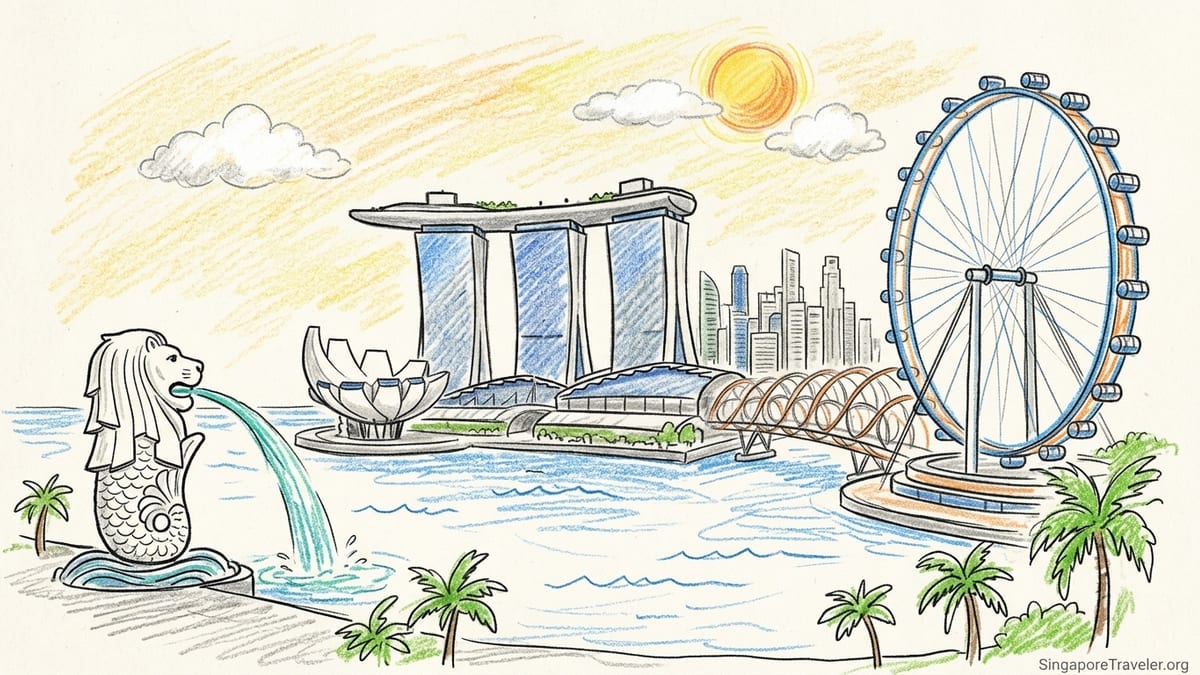
Marina Bay is a man-made bay encircled by a 3.5 kilometre waterfront promenade that connects most of the area’s big-name sights. On the northern side, you find Merlion Park, the historic Fullerton hotel area and the Esplanade performing arts complex. On the eastern edge are the Singapore Flyer and Marina Promenade park. Cross to the southern and western sides and you reach Marina Bay Sands, the ArtScience Museum, the Helix Bridge and, just beyond, Gardens by the Bay. In practice, you can start almost anywhere around the water and walk a full loop in 45 to 60 minutes of steady walking, not counting photo stops and museum visits.
Several MRT stations ring the bay and make it simple to drop into different sides of the waterfront. Bayfront station sits beneath Marina Bay Sands and is the best starting point for the hotel, SkyPark and Gardens by the Bay. Esplanade and Promenade stations serve the northern and eastern sides, close to the Esplanade theatres, Suntec City malls and the route to the Singapore Flyer. Raffles Place and Marina Bay stations sit on the opposite side near the financial district, handy for reaching Merlion Park on foot in about 10 minutes. Because trains run roughly from early morning until around midnight, most visitors combine a few short MRT hops with waterfront walks rather than trying to drive or take taxis between every stop.
For a first-time visitor, a practical way to picture Marina Bay is to split it into three walkable clusters. The “classic skyline” cluster runs from Merlion Park across Jubilee Bridge to the Esplanade. The “Flyer and Promenade” cluster stretches along the eastern shore from Esplanade towards the Singapore Flyer. On the opposite side sits the “MBS and Helix” cluster, covering the ArtScience Museum, Marina Bay Sands and the Helix Bridge with the entrance to Gardens by the Bay just beyond Bayfront. Planning your day around these clusters will keep backtracking to a minimum.
Getting There and Around: MRT, Walking and Practical Tips
Most international visitors will arrive via Changi Airport and take either a taxi or MRT into town. Getting from the airport to Marina Bay by taxi usually takes about 20 to 25 minutes in light traffic, while riding the MRT involves changing lines but costs a fraction of the price and deposits you near the bay at stations such as Bayfront, Raffles Place or Promenade. Many first-time visitors choose to stay at hotels in the Marina Bay or City Hall areas because this allows them to walk directly to the waterfront in 10 to 15 minutes rather than commuting in from further neighbourhoods each evening.
On the ground, Marina Bay is designed for pedestrians with wide, mostly step-free paths, frequent ramps and underpasses connecting malls, MRT stations and the promenade. A popular introductory route for first-timers is to start at Raffles Place MRT, walk to Merlion Park, cross Jubilee Bridge to the Esplanade, then continue along the waterfront to the Helix Bridge and on to Marina Bay Sands. This one-way walk usually takes around 45 minutes at a sightseeing pace and gives you classic views of the skyline, the lotus-shaped ArtScience Museum and the “durian” spikes of the Esplanade theatres, without needing a single vehicle.
In Singapore’s heat and humidity, timing and pacing are important. During the middle of the day, streets can feel significantly hotter due to reflected heat from glass and concrete, so many travellers plan indoor breaks inside the Shoppes at Marina Bay Sands, Marina Square or Suntec City. All of these malls are directly connected to MRT stations and tunnels, and they open into the waterfront promenade in multiple places. It is common, for example, to walk outside in the early evening for sunset photos, then cut back indoors through a mall’s air conditioning if a sudden tropical downpour begins.
Merlion Park and the Northern Waterfront
For most first-time visitors, Merlion Park is the obvious starting point. The Merlion statue, with the head of a lion and the body of a fish spouting water into the bay, sits at the mouth of the Singapore River opposite Marina Bay Sands. The park is completely free to enter and open at all hours, though the best times to visit are early morning around sunrise or in the late afternoon towards sunset. Those time slots offer softer light for photography and slightly cooler temperatures. Many travellers arrive via Raffles Place MRT, follow signs to the Fullerton hotel and then continue under or across Esplanade Bridge for their first unobstructed view of the bay.
From Merlion Park, one of the most rewarding short walks in Marina Bay is the crossing of Jubilee Bridge, a wide pedestrian bridge that arcs gently across the water to the Esplanade theatres. This route takes only about five minutes on foot and gives you elevated views back towards the Merlion and Singapore’s financial district towers. Because the bridge is fully pedestrianised and wide, families with strollers and travellers with luggage find it easier than trying to share narrower sidewalks alongside busy traffic. Late afternoon and early evening are especially atmospheric, as the lights start to come on in Marina Bay Sands opposite.
North of Jubilee Bridge, the Esplanade complex itself is easy to recognise by its twin spiky domes, often compared to a pair of durians. The outdoor waterfront terrace outside the Esplanade is free to access and sometimes hosts buskers or free performances in the evening. If you are starting your Marina Bay exploration here, Esplanade MRT station deposits you within a few minutes’ walk of the theatres and the waterfront, and you can choose to turn right towards Merlion Park or left towards the Singapore Flyer and Helix Bridge. For first-time visitors on tight schedules, a common pattern is to combine Merlion Park, Jubilee Bridge and the Esplanade in one compact 60 to 90 minute window either early in the morning or before dinner.
Singapore Flyer, Marina Promenade and the Eastern Side
Continuing clockwise from the Esplanade, the promenade curves towards the Singapore Flyer, a 165 metre observation wheel that once held the title of tallest in the world. The walk from the Esplanade waterfront to the Flyer usually takes 15 to 20 minutes at a leisurely pace. An alternative is to ride the MRT to Promenade station, which sits between Suntec City and the northern edge of Marina Bay and has underground exits leading towards both the Esplanade and the Flyer area. On the surface, you will pass Marina Promenade park, a strip of greenery that runs under highway flyovers with views of the Flyer and, further along, the Helix Bridge.
Visiting the Singapore Flyer involves a paid ticket for a 30 minute rotation in one of its air-conditioned capsules. Prices vary by time of day and promotions, but travellers can expect to pay a premium compared with many other city viewpoints, especially for sunset or night-time slots. For budget-conscious visitors, simply walking around the base of the Flyer and along the adjacent waterfront can be enough. From ground level, you still enjoy wide views of the bay, including the Marina Bay Sands towers across the water, as well as less crowded angles on the Helix Bridge for photography.
In terms of timing, the eastern side of Marina Bay tends to work best from late afternoon into the evening. During the heat of midday, the exposed sections of the promenade can feel intense, and there are fewer large indoor attractions on this stretch compared with the Marina Bay Sands side. Many visitors plan a route that starts at Merlion Park and the Esplanade, then reaches the Flyer area around late afternoon. After a ride or photo stop, they cross towards Marina Bay Sands using the Helix Bridge as the sun goes down.
Helix Bridge, Marina Bay Sands and the Waterfront Promenade
The Helix Bridge is one of Marina Bay’s most distinctive structures, a double-helix design of stainless steel that curls above the water between the Singapore Flyer side and Marina Bay Sands. Crossing the bridge on foot is free and takes roughly five to ten minutes at an easy pace, longer if you stop at the viewing pods that jut out over the water. These viewing areas offer some of the bay’s best low-level photo opportunities, including direct sightlines to the ArtScience Museum, Marina Bay Sands and back towards the Esplanade. At night, the bridge is illuminated, adding to the futuristic feel of the skyline.
On the Marina Bay Sands side, you step off the Helix Bridge directly into a cluster of major attractions. To your right lies the Shoppes at Marina Bay Sands, a luxury mall with international brands, indoor canals, and food courts. Straight ahead are the curving paths of the waterfront promenade, where visitors gather in the evening for bay breezes and skyline views. To the left rises the triple-tower Marina Bay Sands hotel topped by the SkyPark. At ground level, a free and popular result of this layout is that you can wander the waterfront promenades, browse the mall or visit the independently accessible Apple and Louis Vuitton pavilion stores without paying for a specific attraction ticket.
The SkyPark Observation Deck atop Marina Bay Sands is a ticketed viewpoint with some of the most comprehensive views in Singapore. Ticket prices fluctuate with demand but are typically at the higher end of local attraction costs, and separate fees apply for hotel guest-only facilities such as the famous infinity pool. For first-timers who want a sweeping view without staying at Marina Bay Sands, buying a timed slot up to the deck around sunset is often worth the investment. Those who prefer to save money can focus on free ground-level terraces instead, particularly the area around the ArtScience Museum and the public spaces in front of the hotel that look back toward Merlion Park and the financial district.
ArtScience Museum and How It Connects Across the Bay
Shaped like an open lotus flower, the ArtScience Museum sits on its own platform along the waterfront just outside Marina Bay Sands. Reaching it on foot is straightforward from the Helix Bridge, the Shoppes or the Marina Bay Sands hotel lobbies, with covered walkways for much of the distance. The museum building itself and the outdoor terrace around it are free to approach, with ticket checks occurring only at the entrances to specific exhibition galleries. This means that even visitors who do not plan to visit an exhibition can still walk the perimeter, enjoy the reflecting ponds and use the terrace to capture panoramic photos across the bay towards the Singapore Flyer and Merlion Park.
Inside, the museum typically hosts a mix of long-running and temporary exhibitions on topics that sit at the intersection of art, science and technology. Entry is ticketed, with prices varying according to the number of exhibitions you choose to see and whether you qualify for concessions. Families with children often prioritise interactive, digital-heavy shows that are popular for their immersive light installations. Because exhibition content and pricing change regularly, first-time visitors are better off checking current details closer to their travel dates and deciding whether to dedicate one to two hours indoors here or simply enjoy the free exterior spaces.
A useful feature of the ArtScience Museum location is its role as a practical mid-point between different sides of the bay. From its waterfront terrace, you can walk to Merlion Park in around 10 to 15 minutes by following the promenade past the Event Plaza and continuing along the edge of the water. Another direction leads you across the Dragonfly Bridge or through Bayfront MRT towards Gardens by the Bay in a similar timeframe. Many visitors make use of this connectivity by combining a late-afternoon stroll from Merlion Park to the ArtScience Museum, followed by a sunset session on the SkyPark or dinner in the Shoppes and an evening walk to Gardens by the Bay for its light show.
Gardens by the Bay and Day vs Night Planning
Gardens by the Bay, located just behind Marina Bay Sands across Bayfront Avenue, is technically a separate attraction, but in practical terms it forms an essential extension of any Marina Bay itinerary. From the Marina Bay Sands promenade, you can reach the main garden entrances in about 10 to 15 minutes on foot by crossing elevated pedestrian bridges or following signs through the Bayfront MRT underpasses. The most recognisable features, including the Supertree Grove, sit relatively close to the Bayfront side, so it is entirely possible to combine a Marina Bay walkthrough with a few focused hours in the gardens.
In terms of cost, large portions of the outdoor gardens at Gardens by the Bay are free to enter, including the main paths and viewing areas around most Supertrees. Individual conservatories and certain aerial walkways require separate paid tickets, and prices can vary depending on residency, package deals and promotions. Because there are multiple distinct ticket types and experiences, first-time visitors are better served by consulting a dedicated Gardens by the Bay guide that breaks down options in detail. For the purposes of a Marina Bay visit, it is enough to note that you can enjoy a meaningful taste of the gardens, including the evening Supertree light show, without committing to every paid attraction.
Daylight and night-time offer very different moods around Marina Bay and Gardens by the Bay. During the day, the pale surfaces of the ArtScience Museum and the white arcs of the Helix Bridge stand out crisply under the sun, while the three towers of Marina Bay Sands rise sharply against the sky. This is the time to appreciate architectural details and long-distance views, but visitors should be prepared with sun protection and water. After dark, the focus shifts to illumination: Marina Bay Sands, the Helix Bridge and the financial district towers glow, the ArtScience Museum often hosts projection shows, and both the Gardens by the Bay Supertrees and Marina Bay Sands’ own Spectra light and water show draw crowds. Many first-timers plan one substantial evening dedicated almost entirely to moving between these light-focused experiences.
Free vs Ticketed Experiences and How to Group Them
One of Marina Bay’s strengths is the mix of entirely free waterfront experiences and high-impact paid attractions, which allows first-time visitors to tailor their spending. Free experiences include walking the entire waterfront promenade, visiting Merlion Park, crossing Jubilee Bridge and the Helix Bridge, exploring the outdoor terraces of the Esplanade and ArtScience Museum, and enjoying much of Gardens by the Bay’s open-air sections. Simply following the curve of the promenade from Merlion Park to Marina Bay Sands at sunset costs nothing beyond the MRT fare to get there, yet delivers the postcard views that define Singapore in many travellers’ minds.
Ticketed highlights in the Marina Bay area include the Singapore Flyer, the SkyPark Observation Deck at Marina Bay Sands, exhibitions inside the ArtScience Museum and specific paid experiences within Gardens by the Bay such as its conservatories or aerial walkways. Because each of these can require at least an hour or two, grouping them geographically makes a big difference to how enjoyable your day feels. For example, you might dedicate one half-day to indoor, ticketed experiences by pairing the ArtScience Museum with the SkyPark and then finishing with dinner in the Shoppes. Another half-day or evening might focus on outdoor, primarily free experiences, starting at Merlion Park, strolling the promenade and ending with an evening light show.
Geographically, first-time visitors often find it useful to structure Marina Bay in two main segments. The first segment runs from Raffles Place or City Hall MRT to Merlion Park, across Jubilee Bridge to the Esplanade and onwards to the Singapore Flyer. This segment can be comfortably explored in half a day, combining free waterfront time with an optional paid ride on the Flyer. The second segment centres on Bayfront MRT, Marina Bay Sands, the ArtScience Museum and Gardens by the Bay. This area rewards a longer stay, especially if you add paid entries to the SkyPark or garden conservatories. Linking both segments in one very full day is possible, but many travellers prefer to spread them across two evenings to avoid fatigue.
The Takeaway
For a first-time visitor, Marina Bay is both a postcard backdrop and a highly walkable district where most of Singapore’s most recognisable landmarks are condensed into a single compact loop. Understanding how the bay’s three main clusters fit together, and how MRT stations like Bayfront, Esplanade, Promenade and Raffles Place feed into the waterfront, will help you move smoothly from Merlion Park’s classic skyline view to the futuristic curves of the Helix Bridge and the vertical gardens of nearby Gardens by the Bay.
Because many of the most satisfying experiences around the bay are free, such as walkway crossings, waterfront promenades and light shows viewed from public spaces, you can calibrate your spending by selectively adding ticketed highlights such as the SkyPark Observation Deck or a major exhibition at the ArtScience Museum. Daytime is best for appreciating architecture and sweeping views, while after dark the focus shifts to reflections, coloured lights and choreographed shows that turn the bay into an open-air theatre. With a little planning around clusters, daylight vs night-time and air-conditioned breaks, Marina Bay becomes not just a must-see photo stop but a comfortable base for discovering modern Singapore.
FAQ
Q1. How long does it take to walk around Marina Bay?
At a steady pace without entering attractions, walking a full loop of the waterfront promenade typically takes 45 to 60 minutes. Allow extra time for photo stops, museum visits and breaks.
Q2. Which MRT station is best for starting a Marina Bay visit?
Bayfront MRT is ideal for Marina Bay Sands, the ArtScience Museum and Gardens by the Bay, while Raffles Place is best for Merlion Park and Esplanade or Promenade stations work well for the Esplanade theatres and Singapore Flyer side.
Q3. Is Marina Bay worth visiting if I am only in Singapore for one day?
Yes. In a single afternoon and evening you can see Merlion Park, walk the waterfront, cross the Helix Bridge and enjoy at least one major paid attraction such as the SkyPark or the Singapore Flyer.
Q4. Are there free things to do in Marina Bay at night?
Many night experiences are free, including strolling the illuminated Helix Bridge, watching the skyline reflections from the promenade and enjoying outdoor views of Gardens by the Bay and the ArtScience Museum.
Q5. Should I visit the Singapore Flyer or the Marina Bay Sands SkyPark?
The Singapore Flyer offers a gentle 30 minute ride with views from a capsule, while the SkyPark Observation Deck provides an open-air platform and closer views of the city. First-time visitors often choose the SkyPark if they want a single paid viewpoint.
Q6. How do I get from Merlion Park to Marina Bay Sands on foot?
From Merlion Park, cross Jubilee Bridge to the Esplanade, follow the waterfront past the Esplanade terraces and continue towards the Helix Bridge. Cross the Helix Bridge and you arrive directly at the Marina Bay Sands promenade.
Q7. Is Marina Bay suitable for families with children and strollers?
Yes. The promenade is mostly step-free and wide, MRT stations have lifts and there are many indoor spaces for cooling off. Families often combine shorter walks with air-conditioned breaks in the Shoppes or nearby malls.
Q8. What is the best time of day to photograph Marina Bay?
Early morning around sunrise offers softer light and fewer crowds, while late afternoon into sunset and the blue hour provides dramatic colours, reflections and city lights.
Q9. Can I see Gardens by the Bay and Marina Bay in one visit?
Yes. Many travellers spend the late afternoon around Marina Bay Sands and the waterfront, then cross into Gardens by the Bay for evening views and the Supertree light show before returning via Bayfront MRT.
Q10. Do I need to book tickets for Marina Bay attractions in advance?
While the waterfront and bridges are free and unticketed, advance booking is advisable for popular paid attractions like the SkyPark, the Singapore Flyer and major exhibitions at the ArtScience Museum, especially on weekends and public holidays.