


Just 30 minutes by ferry from mainland Singapore, the Southern Islands feel a world away from the city’s glass towers. Lazarus Beach, St John’s Island, Kusu Island and Big Sister’s Island now form an easy, low-stress day trip or weekend escape, with calm lagoons, new boardwalks, heritage temples and a surprising range of sea sports. This guide focuses on real, on-the-ground experiences and what you actually need to book in advance, so you can spend less time planning and more time in the water or on the sand.
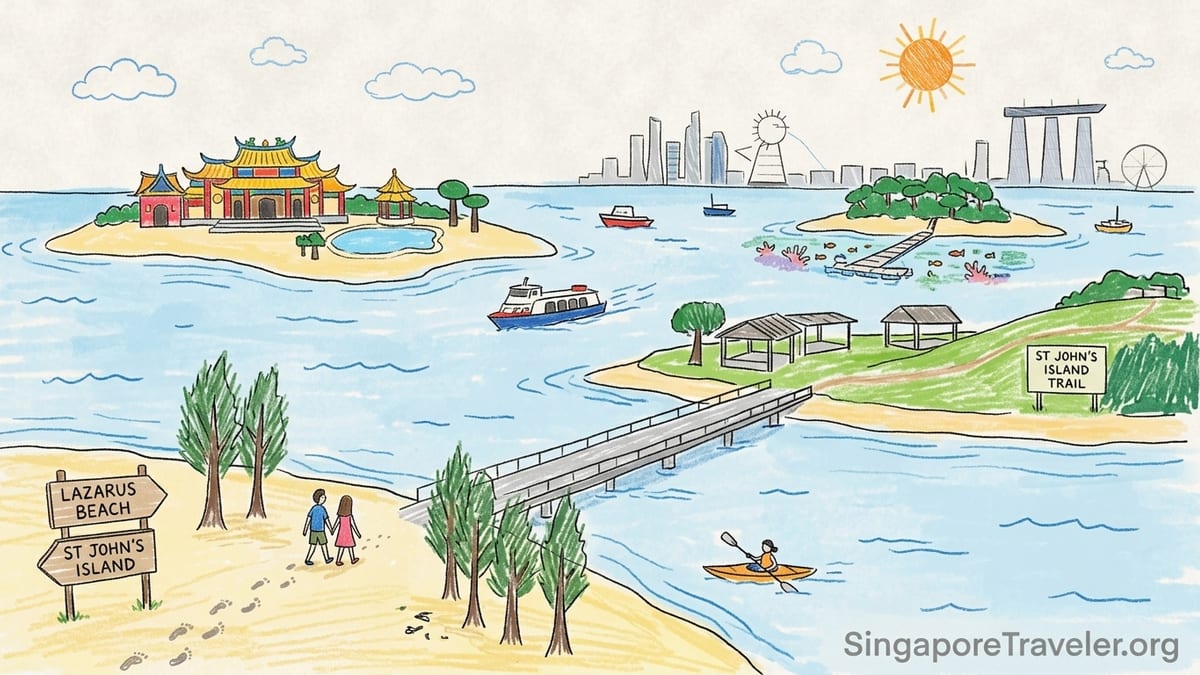
Orientation: How the Southern Islands Fit Together
The core Southern Islands for most visitors are St John’s, Lazarus, Kusu and Sisters’ Islands, all reached by public ferries from Marina South Pier. A typical loop starts at St John’s, continues on foot to Lazarus, then returns to St John’s for an onward ferry to Kusu Island. Big Sister’s Island, part of Sisters’ Islands Marine Park, is usually visited on special trips or guided programmes, often bookable through nature or dive operators rather than as a standard hop-on hop-off stop.
St John’s and Lazarus are physically linked by a reclaimed causeway, so you can walk between them in around 15 to 20 minutes on paved paths. St John’s offers open lawns, shady trees, basic shelters and the St John’s Island Trail with interpretive markers, while Lazarus is where you find the famous crescent of white sand and the newer Lazarus Sea Sports Centre. Kusu sits separately, a compact island known for its Chinese temple, Malay kramats and sheltered swimming lagoon. Big Sister’s Island houses part of Sisters’ Islands Marine Park, with a 1 kilometre nature trail, lagoon tidal pool and Singapore’s first floating boardwalk that doubles as a coral habitat.
In practice, most independent travellers buy a timed island-hopping ticket with either Singapore Island Cruise or Marina South Ferries at Marina South Pier. These tickets usually include stops at St John’s/Lazarus and Kusu on a fixed timetable, for about the price of a casual restaurant meal in downtown Singapore. Specialty operators, including dive schools and eco-tour companies, run separate boats for guided snorkel, kayak or marine-education trips that may include Big Sister’s. Check departure times carefully: last ferries back typically leave by late afternoon, and there are no overnight public boats.
There are no hotels, ATMs or big restaurants on these islands. You will find toilets, basic shower facilities and shelters on St John’s and Kusu, plus a small convenience-style shop and sea sports centre on Lazarus. Otherwise, treat this as a day in relatively undeveloped nature: bring drinking water, sun protection, snacks or a picnic, and be prepared to carry your rubbish back to the mainland if bins are full.
Beach Time: Lazarus Beach and Family-Friendly Swimming Spots
Lazarus Beach is the star attraction for many visitors. Shaped like a gentle horseshoe around Eagle’s Bay, it offers one of Singapore’s widest sweeps of relatively undeveloped sand, with clear, aquamarine water on calm days. Walk over from St John’s jetty via the causeway, then follow the paved path and sandy tracks until the trees open up to the main beach. There are no high-rise buildings in sight, just low vegetation, casuarina trees and anchored boats offshore, which is why locals often describe it as feeling “overseas” even though the Central Business District skyline is just across the water.
The swimming here is generally gentle for adults and older children on normal-weather days, though there are no lifeguards and no roped-off zones. Depth drops off gradually from the shoreline, but currents and jellyfish can appear, so you should stay close to shore, keep an eye on children and avoid swimming alone. Box jellyfish advisories have been posted across the Southern Islands in recent years, and you may see warning signs on the beaches. Many families bring long-sleeved swim tops, basic first-aid gel for stings, and even thin surf leggings to reduce exposed skin.
If you prefer calmer, more contained water, consider the lagoons on St John’s and Kusu. St John’s has small man-made lagoons near the jetty framed by rock walls and lawns, convenient for picnics where children can wade in shallow water. Kusu Island offers an even more sheltered lagoon and sandy beach right beside the main temple complex. It is especially popular during weekends and public holidays, when local families set up on the grass with foldable tables, coolers and beach mats that they have brought from home or rented from operators like Gogreen on St John’s.
Shade is limited directly on Lazarus Beach, so arriving on an earlier ferry pays off. Many island regulars pack a beach tent or compact sun shelter, which are permitted as long as you do not stake them into sensitive vegetation. Camping overnight is only allowed in designated areas on St John’s with a pre-approved camping permit arranged at least two weeks in advance, so do not assume you can simply pitch a tent and stay after dark on Lazarus.
Nature & Trails: St John’s Island Trail and Big Sister’s Island
For a dose of green with your blue water, start with the St John’s Island Trail. This self-guided walking route loops past mangroves, coastal forest and heritage trees, with numbered markers that correspond to a downloadable trail guide from the National Parks Board. You will pass viewpoints back toward the Singapore skyline, remnants of the island’s past as a quarantine and rehabilitation station, and signboards explaining topics like intertidal zones, coral reefs and the role of St John’s in marine research. The trail is mostly on paved or firm paths and suits families with school-age children who are comfortable walking for about an hour in tropical heat.
St John’s also hosts the Marine Park Outreach and Education Centre, near the St John’s Island National Marine Laboratory. The centre normally offers exhibits on local marine life, interactive displays and occasional guided programmes or open houses. Because it is tied to a working research facility, opening hours and public access can vary. It is wise to check the latest information with official sources or programme organisers before planning your day around going inside, and to assume that any special tours or workshops will require advance registration rather than walk-up entry.
The most dramatic new addition to the Southern Islands is on Big Sister’s Island, part of Sisters’ Islands Marine Park. Reopened after extensive restoration, Big Sister’s now features a 1 kilometre interpretive nature trail that winds through coastal forest, offering views across the lagoon and back to Singapore’s main island. Sections of the trail include stairs and gentle slopes, but it is graded as easy to moderate and takes roughly an hour to complete at a relaxed pace. Information panels highlight coastal trees like Tembusu and mangrove fan palms, as well as birdlife such as Brahminy kites and white-bellied sea eagles.
Big Sister’s Island is also where you find Singapore’s first floating boardwalk, a roughly 220 metre structure designed not just for people but also as a habitat and research platform for corals. Glass panels and open sides allow visitors to peer directly into the water to look for fish, seagrass and even the occasional hawksbill turtle in the shallows. Because Big Sister’s sits within a marine protected area and visitor numbers are controlled, access is typically via guided tours run by NParks or approved partners. These guided walks and marine programmes require advance booking, often released online about a month before each date and snapped up quickly, especially on school holidays and weekends.
Cultural Discoveries: Kusu Island Temples and Kramats
Kusu Island adds a strong cultural and spiritual dimension to a Southern Islands itinerary. According to local legend, the island was created by a giant tortoise that transformed itself into land to save shipwrecked sailors. Today, the story lives on in turtle motifs at the main Chinese temple near the jetty and in the island’s name itself, which means “tortoise” or “turtle” in Hokkien. The central Da Bo Gong temple complex is dedicated to the God of Prosperity and the Goddess of Mercy, and many visitors come to light incense, offer prayers or simply admire the vivid architecture against a backdrop of sea and sky.
Behind the main temple buildings, stone steps lead up a hill to three Malay kramats, shrines said to commemorate a 19th-century Muslim family. The walk is short but can feel steep in the midday heat, so take your time and carry water. At the top, the bright-yellow shrines are often surrounded by colourful ribbons and offerings. Some visitors, including non-Muslims, make wishes related to health, fertility and good fortune, following long-standing local customs. Dress modestly if you intend to enter the temple compound or climb to the kramats: covered shoulders and knees are appreciated, and bring a light scarf or shawl if your outfit is borderline.
The island is especially busy during the annual Kusu pilgrimage season, typically in the ninth lunar month, when tens of thousands of devotees arrive by special ferries. Outside that period, Kusu can feel remarkably tranquil, with sea breezes rustling the trees and only a handful of day trippers wandering between the temple, shrines and beach. There is no need to book the temple visit itself, but you must still purchase ferry tickets in advance, particularly during the pilgrimage weeks when extra services operate on a fixed schedule.
As on the other Southern Islands, amenities on Kusu are basic but adequate for a half-day visit. Simple changing rooms and toilets sit near the jetty, and there are open lawns suitable for a picnic after you visit the temple. Vendors sometimes appear during busy periods to sell drinks and snacks, but you should not rely on them. If you are planning a full day of island hopping that includes Kusu, pick up extra water and something substantial to eat on the mainland or at Marina South Pier before you sail.
Water Sports: Kayaking, SUP and Marine Experiences
In the past, the Southern Islands were mainly about swimming and picnics. Today, they are also an accessible playground for non-motorised water sports. The Lazarus Sea Sports Centre, close to the main Lazarus beach area, rents kayaks, stand up paddleboards and water bikes. Options usually range from single kayaks and regular SUPs to Mega SUP boards big enough for groups of friends or families. Expect to pay in the same ballpark as a half-day bicycle rental in downtown Singapore for an hour on the water, with discounts for longer sessions or weekday bookings common in low season.
Because equipment is limited and demand spikes on weekends, it is strongly recommended to book Lazarus Sea Sports Centre sessions in advance via online booking platforms or the operator’s own reservation system. Walk-in rentals may still be possible on quieter weekdays, but there is no guarantee. In concrete terms, if you are visiting on a Saturday and want a 10 am double kayak for two hours, you should secure a slot several days beforehand, especially during local school holidays or long weekends.
Several operators also run guided kayak trails connecting St John’s, Lazarus and nearby islets, typically lasting around three hours and combining beach briefings with open-water paddling. These trips are designed for beginners who can swim and are comfortable in the sea with a life jacket. They almost always require advance booking and prepayment, as the operator must arrange boats, guides, safety staff and permits. Prices tend to be similar to a mid-range half-day city tour in Singapore, but you gain the bonus of learning about coastal ecology, spotting marine life and navigating channels you would never attempt alone.
For those more interested in what lies beneath the surface, Sisters’ Islands Marine Park has been used for guided intertidal walks and even dive trails, where licensed divers follow underwater routes at different depths to see giant clams, sponges and reef fish. These specialist activities are strictly controlled for conservation reasons and are typically run on limited dates tied to optimal tides or visibility. Bookings open in advance and fill quickly, particularly with local nature groups and dive clubs. If you are keen on this side of the Southern Islands, plan several months ahead and be prepared to show certification for scuba sessions.
Easy Adventures for Families and Casual Cyclists
The Southern Islands are surprisingly manageable with children, as long as you pace the day carefully and plan around the heat. St John’s is the most family-friendly base, with broad lawns right off the jetty where kids can run, kick a ball or chase bubbles under shady trees. The walk to Lazarus Beach is stroller-friendly for most of the way, although the final stretch across sand will require carrying very small children or buggies. Many families set up a “base camp” on St John’s near the lagoons, then take shorter excursions to Lazarus for an hour or two of beach time before returning to the relative calm of the lawns and toilets.
Bicycles and kick scooters add another dimension. Rental companies such as Gogreen have introduced simple bicycles and mobility devices on St John’s, typically bookable in advance online, with two-hour or half-day packages. This allows you to pedal across the causeway to Lazarus instead of walking, and to explore quieter corners of St John’s that most day trippers never reach. The paths are paved but not entirely flat, so younger children may prefer smaller bikes or child seats. Helmets are usually included or rentable for a small additional fee; in the strong equatorial sun, they also double as sun protection.
Island hopping itself becomes part of the adventure for kids. The public ferries from Marina South Pier feel like a short “cruise,” with open decks where you can watch the skyline recede and snap photos of passing container ships. On a typical day, you might board a morning ferry that stops first at St John’s, spend a few hours exploring and swimming, then catch an onward connection to Kusu Island for the temple visit and lagoon, finally returning to Marina South Pier by late afternoon. Operators publish sample itineraries, but with children it is wise to build in extra buffer time between connections in case little legs move more slowly than timetables assume.
There are no playgrounds or amusement rides here, so think of the Southern Islands as an old-fashioned day out in nature. Pack simple toys like beach spades, a frisbee or a football, along with plenty of water, snacks and a light change of clothes. Remember that there are no formal medical services on these islands; carry basic first aid, including band-aids, antiseptic wipes and something for minor stings or scrapes. If anyone in your group has allergies or medical conditions, bring what they might need, because returning to the mainland in a hurry is not always straightforward.
Planning, Bookings and Practical Tips
The most important piece of advance planning for the Southern Islands is your ferry ticket. For the standard loop covering St John’s/Lazarus and Kusu, you should buy tickets ahead of time through one of the two main operators that run from Marina South Pier. Same-day tickets are sometimes available at the pier ticket counters on weekdays, but weekends and public holidays often sell out, particularly for the first morning sailings that beach-goers favour. Factor in around 30 to 45 minutes at Marina South Pier before departure to collect tickets if needed and buy last-minute drinks or snacks.
Anything tied to Sisters’ Islands Marine Park, especially guided walks on Big Sister’s Island, almost always requires advance booking through NParks or an affiliated nature group. These programmes are free or modestly priced but operate on strict caps, often around a few dozen participants per session. Registration typically opens online and closes once full, with confirmation emails and detailed instructions sent to successful applicants. If your dates are fixed and visiting Big Sister’s is a priority, make this the anchor of your Southern Islands plan and work the rest of your ferry and beach time around it.
Water sports such as kayaking, stand up paddling and water biking at Lazarus also benefit from pre-booking, especially on weekends. Look for slots in the late morning or mid-afternoon when the sun is slightly less fierce than at noon, and keep in mind that sessions may be rescheduled or cancelled if thunderstorms or strong winds roll in. While you can usually rent bicycles or kick scooters on St John’s on a walk-up basis, booking ahead during peak times ensures the right sizes and enough units for your group.
On the packing front, think of this as a self-contained field trip. Bring at least one large bottle of water per person, high-SPF reef-safe sunscreen, a hat, sunglasses and insect repellent for the forested sections of St John’s and Big Sister’s. Light, quick-drying clothing works best, and slip-on sandals that can handle water make transitions between beach and paths easier. Finally, respect the fragile environment: follow signs about staying off seagrass, do not feed monkeys or other wildlife, and carry your rubbish out with you if bins are full, so that the Southern Islands remain a clean, calm escape for everyone.
The Takeaway
In a city famous for air-conditioned malls and rooftop bars, Singapore’s Southern Islands offer a refreshing counterpoint: quiet beaches, coastal forests and shrines that have drawn pilgrims for generations. Lazarus Beach gives you that rare sense of open horizon, while St John’s Island Trail and the Marine Park Outreach and Education Centre turn the day into a low-key nature lesson. Kusu Island adds incense, temple bells and hilltop kramats to the mix, and Big Sister’s Island showcases how carefully designed trails and a floating boardwalk can bring people close to coral ecosystems without overwhelming them.
With thoughtful planning, you can combine beach time, gentle hikes, cultural stops and water sports in a single day, or stretch them over a slower weekend with an overnight stay on mainland Singapore. Book your ferries and key activities ahead of time, arrive early to beat the heat and crowds, and treat the islands with the same care locals do. The reward is a side of Singapore that feels intimate and unexpectedly wild, where the skyline recedes and the sound of waves and cicadas takes its place.
FAQ
Q1. How do I get to St John’s and Lazarus Islands from mainland Singapore?
Public ferries run from Marina South Pier to St John’s Island on fixed schedules, often with combined tickets that also include Kusu Island. You should buy tickets in advance, especially for weekend mornings, but boarding is straightforward once you arrive at the pier.
Q2. Do I need to book in advance to visit Lazarus Beach?
You do not need a separate booking for Lazarus Beach itself, but you do need a ferry ticket to St John’s. If you plan to rent kayaks, stand up paddleboards or water bikes at Lazarus Sea Sports Centre, advance online reservation is strongly recommended.
Q3. Can I camp overnight on St John’s or Lazarus Island?
Overnight camping is only allowed at designated campsites on St John’s Island with prior approval from the authorities. Applications must usually be submitted at least two weeks in advance, and casual camping on Lazarus Beach without a permit is not allowed.
Q4. How difficult is the St John’s Island Trail?
The St John’s Island Trail is an easy to moderate walk on mostly paved or firm paths, suitable for reasonably fit adults and school-age children. Expect to spend about an hour or so, and avoid the midday heat by starting in the morning or late afternoon.
Q5. How can I visit Big Sister’s Island and its floating boardwalk?
Big Sister’s Island is part of a marine protected area, so access is usually via guided tours or special programmes organised by NParks or partner organisations. These require advance booking, and places are limited, so you should secure a spot before finalising other plans.
Q6. Is Kusu Island worth a stop if I am not religious?
Yes. Even if you are not religious, Kusu Island offers an interesting mix of legend, colourful temple architecture, hilltop kramats and a sheltered swimming lagoon. It makes a varied cultural and scenic stop between beach time on St John’s and Lazarus.
Q7. Are there food and drinks available on the Southern Islands?
Choices are limited. You may find a small convenience-style outlet and simple snacks near Lazarus and occasional vendors on Kusu during busy periods, but it is safest to bring your own water, snacks or picnic from the mainland.
Q8. Is it safe for children to swim at Lazarus Beach?
The water at Lazarus Beach is usually calm enough for confident swimmers and supervised children on normal days, but there are no lifeguards. Parents should keep kids close to shore, watch for jellyfish advisories and avoid swimming during rough weather.
Q9. Do I need to be experienced to try kayaking or SUP on Lazarus?
No prior experience is required for basic kayaking or stand up paddling sessions, and operators provide life jackets and a safety briefing. However, you should be able to swim and be comfortable in open water while wearing a flotation device.
Q10. What should I pack for a day of island hopping?
Bring plenty of drinking water, reef-safe sunscreen, a hat, sunglasses, insect repellent, swimwear, a change of clothes, light snacks or a picnic, and a small first-aid kit. A beach mat or compact tent is helpful for shade, and remember to carry all rubbish back with you.