


Sentosa Island is Singapore’s dedicated playground, a compact resort island packed with theme parks, beaches, cable cars and waterfront hotels just off the southern coast of the city. For first-time visitors it can feel like a lot to take in, especially if you are trying to decide between a quick day trip or an overnight stay. This guide explains how Sentosa fits together, how to get there, and what to do in each main zone so you can plan your time with confidence.
Where Sentosa Is and How the Island Fits Together
Sentosa is a small resort island south of Singapore’s main island, connected to the HarbourFront district by road, monorail, pedestrian boardwalk and the Singapore Cable Car Sky Network. From downtown areas such as Marina Bay or Orchard Road, taxis or ride-hailing services typically take 15 to 25 minutes in light traffic, making Sentosa easy to visit as a day trip yet substantial enough for a short resort stay.
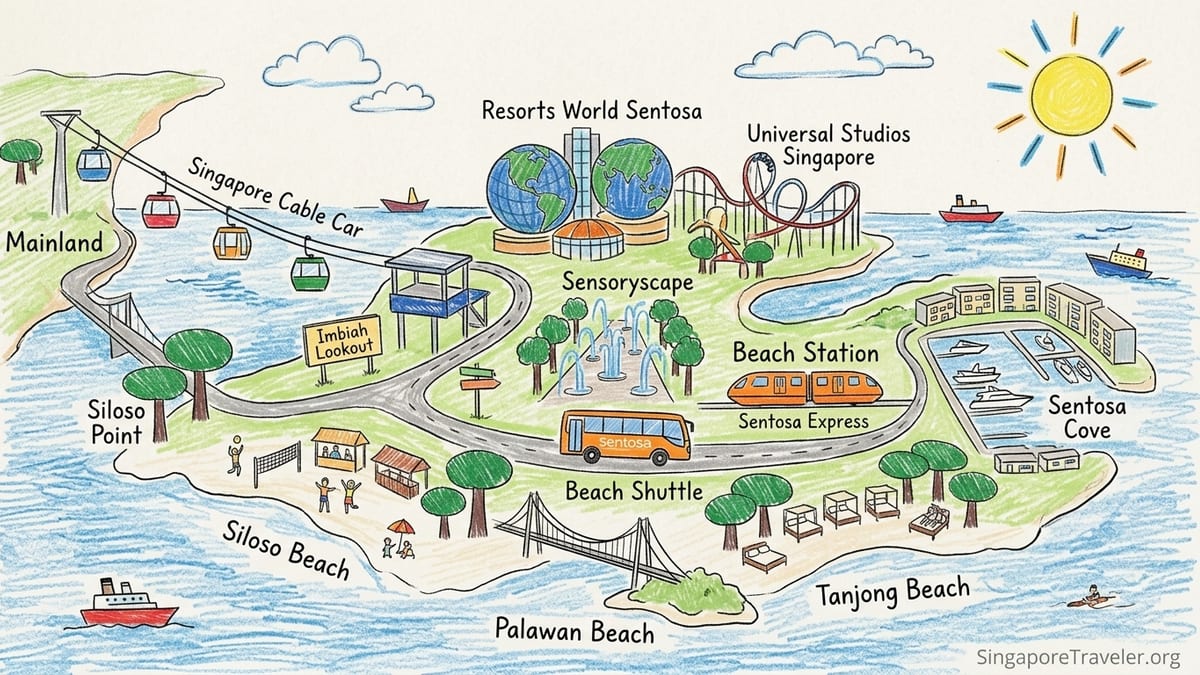
The island is roughly shaped like a crescent, with three main beaches along the southern shore and most major attractions clustered along a central spine that runs from Resorts World Sentosa in the north down to Beach Station. From there, smaller roads and trams fan out to Siloso Beach in the west, Palawan Beach in the middle and quieter Tanjong Beach in the east. Sentosa Cove, a separate marina and residential enclave, sits on the far eastern side, facing a sheltered waterway lined with yachts and low-rise condos.
Sentosa is usually described in zones: Resorts World Sentosa and the northern gateway, the Imbiah and Sensoryscape ridge in the island’s center, the three beach areas on the south coast, and the standalone waterfront district at Sentosa Cove. The Singapore Cable Car, Sentosa Express monorail, internal buses and free beach shuttles knit these zones together, so you can realistically cover two or three areas in a single day if you plan your route.
For most first-time visitors, the natural starting point is Resorts World Sentosa, especially if you plan to visit Universal Studios Singapore or the Singapore Oceanarium. From there, you can move south via Sensoryscape toward the beaches, or hop on the monorail, bus or cable car to reach specific areas like Siloso or Palawan depending on whether your priority is thrill rides, family activities, or beach clubs.
Getting to Sentosa and Getting Around the Island
There are four main ways to get to Sentosa: by monorail, cable car, taxi or ride-hail, and on foot via the Sentosa Boardwalk. The most common route for visitors arriving by public transport is to take the MRT to HarbourFront station, which connects directly to VivoCity mall. From level 3 of VivoCity you can board the Sentosa Express monorail, which runs to Resorts World Station, Imbiah Station and Beach Station. At the time of writing, entry to Sentosa Island itself is free, but separate transport charges or attraction tickets still apply, and there are ongoing plans to replace the Sentosa Express with a new tram-based people mover under the Greater Sentosa Master Plan in coming years.
The Singapore Cable Car offers the most scenic approach. From Mount Faber or HarbourFront Tower 2 on the mainland, cabins glide over the harbor to Sentosa Station and continue along a separate line down toward the western side of the island near Siloso Point. Cable car tickets are typically sold as all-day “sky passes” and can cost in the region of several tens of Singapore dollars per adult, so many travelers treat this as an attraction in itself rather than regular transport, timing their ride for late afternoon or sunset to enjoy views over the port and city skyline.
Arriving by taxi or ride-hail is straightforward. Drivers use the Sentosa Gateway bridge and pass an entry control point where an island admission levy for vehicles applies. In practice, if you are staying at a Sentosa hotel, the property will often absorb or waive this levy, and some hotels explicitly advertise complimentary island entry for in-house guests when you show a booking confirmation or room key at the gantry. This can make private car travel cost-effective for families carrying beach gear or luggage, especially during Singapore’s frequent tropical downpours.
Once on the island, getting around is simple and usually free. Sentosa operates internal buses, the Sentosa Express between island stations, and a dedicated Beach Shuttle that circulates between major stops such as Siloso Point, Beach Station, Palawan and Tanjong Beach. These services are free for visitors and run from morning until late evening, with frequencies often under 15 minutes. In the central spine, it is practical to walk: for example, the Sensoryscape pedestrian route connects Resorts World Sentosa to Beach Station under a sheltered, landscaped corridor, which is useful in both strong sun and sudden rain.
Resorts World Sentosa: Theme Parks, Oceanarium and Hotels
Resorts World Sentosa is the island’s largest integrated resort, occupying the northern gateway closest to the mainland. It brings together Universal Studios Singapore, the Singapore Oceanarium, Adventure Cove Waterpark, several deluxe hotels and a casino around a compact central plaza. For first-time visitors with limited time, spending most of a day in this zone is a practical choice, particularly with children or during the wet season, when indoor attractions are an advantage.
Universal Studios Singapore is a full-scale theme park with zones themed to Hollywood, New York, Sci-Fi City, Ancient Egypt, The Lost World, Far Far Away and Madagascar. Signature rides include a high-speed roller coaster, a Transformers 3D dark ride and Jurassic Park water attractions. On peak weekends and local school holidays, queues for headline rides can easily stretch to 45 minutes or more, so many travelers consider Express passes that allow access to shorter priority lines. Buying Express passes in advance from official ticket sellers is prudent for fixed travel dates, but some visitors prefer to assess crowds on the day and upgrade inside the park if lines are long.
Next door, the Singapore Oceanarium, which opened in July 2025 as the transformed successor to the former S.E.A. Aquarium, is one of the resort’s flagship indoor experiences. Spread over multiple thematic zones, it features large viewing panels, immersive galleries and exhibits that explore regional marine ecosystems. Tickets are generally sold in timed-entry slots during busy periods, with adult prices broadly in the range of other major indoor attractions in Singapore, and advance booking is recommended for weekends or public holidays. The Oceanarium is a particularly good option for the hottest part of the afternoon, when visitors might appreciate air conditioning after outdoor rides.
Adventure Cove Waterpark is the third major attraction within Resorts World Sentosa. Featuring high-speed water slides, a lazy river and a snorkel lagoon where guests can swim above colorful fish, it appeals to both teenagers and younger children. A practical approach for many families is to alternate between waterpark time and either Universal Studios or the Oceanarium on separate days, rather than trying to cover all three in one visit. Resorts World Sentosa’s hotels, such as family-friendly properties clustered around the central lake and waterfront, make this easier by allowing midday breaks back at the room before returning to the parks in the evening.
Imbiah, Sensoryscape and Skyline Luge
South of Resorts World Sentosa, the Imbiah / Sensoryscape area acts as the island’s central ridge, connecting the northern gateway to the beaches at the southern shore. Sensoryscape is a landscaped pedestrian corridor with water features, light art and shaded walkways that runs between Imbiah Station and Beach Station. It is designed to be experienced both by day and at night, when subtle lighting, soundscapes and mist effects create a different mood. For first-time visitors, walking at least part of Sensoryscape is worthwhile to understand how the island’s spine fits together.
Just off this central link you will find attractions such as the Skyline Luge Sentosa, a popular gravity-powered go-kart ride that descends from the hillside down toward Siloso Beach on specially built tracks. Riders take an open-air chairlift from the lower station up to the start, then steer individual luges downhill at their own pace. Tickets are sold in packages that include multiple luge rides plus chairlift rides, with prices that tend to be more economical per ride when you buy several in one go. Evening rides are particularly atmospheric, with cooler temperatures and the track illuminated by colorful lights.
The Imbiah area also connects to the Sentosa Line of the Singapore Cable Car, which runs between Mount Faber or HarbourFront on the mainland and several stations across the island. One of these is perched on the ridge near Imbiah Lookout, making it easy to arrive in the center of the island and then walk downhill via Sensoryscape to the beaches. Families with strollers or travelers who prefer to avoid steep slopes will appreciate the combination of cable car access and escalators built into parts of the walkway.
Cafes and casual dining options dot the Imbiah and Sensoryscape corridor, often inside small pavilions or attached to attractions. Prices reflect resort standards, so a coffee or soft drink will usually cost more than in a typical neighborhood mall on the mainland. For better value meals, many visitors either eat at the extensive food court and casual restaurants at Resorts World Sentosa or head down to the cluster of eateries around Beach Station, which offers quick-service Asian dishes, snacks and ice cream a short walk from both Palawan and Siloso Beach.
Siloso, Palawan and Tanjong: Choosing the Right Beach
Sentosa’s three main beaches run along its southern shoreline, each with a slightly different personality. All are man-made with imported sand and sheltered waters looking out toward Singapore’s busy shipping lanes, so you should expect anchored cargo ships on the horizon rather than untouched ocean. Lifeguards patrol key sections, and shower facilities, changing rooms and convenience stores are available at or near each beach, making them user-friendly for visitors who did not plan ahead with towels or snacks.
Siloso Beach, at the western end, is the most active and commercial. It lines up beach volleyball courts, casual bars, family-friendly restaurants and activities such as stand-up paddle rentals and ziplines. In the evenings, Siloso’s beachfront venues often host happy hours, live music or sports broadcasts, so this is where you go if you want a social, beach-club atmosphere without leaving Singapore. Resorts and hotels sit just behind the sand, and the cable car line passes overhead, adding to the energetic vibe.
In the center, Palawan Beach is particularly popular with families. The lagoon here is shallow and relatively calm, making it suitable for children to paddle under supervision. A short suspension bridge leads to a small offshore islet sometimes promoted as one of the southernmost points of continental Asia, a fun photo stop for first-time visitors. The Palawan area has been further developed with The Palawan at Sentosa, a family entertainment hub that includes a mini-golf course, beach club spaces and activities tailored to younger visitors. Beach trams shuttle frequently between Palawan stops and Beach Station, so you can move around without long walks in the heat.
Tanjong Beach, at the eastern end, is the quietest and most laid-back of the three. The shoreline curves around a sheltered bay, with fewer public facilities but a generally calmer feel. A well-known beach club operates here, attracting both locals and travelers who want a more exclusive loungy experience with daybeds, pools and DJs, especially on weekends. If your priority is reading, light swimming and a long, relaxed lunch rather than activities, Tanjong is usually the best choice. The Beach Shuttle and buses link Tanjong to Beach Station and onwards to Resorts World Sentosa and Imbiah, so you can enjoy the tranquility without feeling cut off from the rest of the island.
Fort Siloso, Cable Cars and Other Classic Sentosa Experiences
Beyond the beaches and theme parks, Sentosa offers a number of experiences that connect visitors with the island’s history and landscape. Fort Siloso, near the western tip close to Siloso Point, is a preserved coastal artillery fort dating back to the late 19th century. Today it has been restored as a heritage attraction, with original gun batteries, underground tunnels and interpretive displays explaining the fort’s role during World War II and its broader context in Singapore’s maritime defenses. Entry has traditionally been free or low-cost, making it one of the better-value activities on the island, and the elevated Skywalk leading to the fort provides panoramic views of the harbor and beaches.
The Singapore Cable Car remains one of Sentosa’s signature experiences and a practical way to link various zones. Many visitors start at Mount Faber, a hilltop park on the mainland with viewing platforms, and ride across to HarbourFront and then onward to Sentosa Station. From there, the Sentosa Line continues across the island, stopping near Siloso Point, Imbiah ridge and Merlion or beachfront areas depending on current station naming and configuration. Cabins are enclosed and air conditioned, and they operate in most weather other than severe electrical storms, although downpours can reduce visibility.
Other classic Sentosa experiences include watching the sunset from a beachfront bar at Siloso or Tanjong, booking a beginner stand-up paddle session in the calm waters off Palawan, or simply walking the Sentosa Boardwalk at night. The Boardwalk, a pedestrian bridge with covered sections and travelators, connects VivoCity on the mainland to Resorts World Sentosa. Entry to the island on foot has at times been free or subject to a small fee, and policies can change, so it is worth checking current details just before your visit. In practice, many visitors appreciate the Boardwalk as a relaxed way to leave the island in the evening when queues for monorails can be longer.
While Sentosa is heavily developed, pockets of greenery remain, particularly around Imbiah and on the slopes above the beaches. Short walking paths and nature trails let you step briefly away from the resort infrastructure, though trails are generally modest in length and elevation. As humidity on Sentosa is high year-round, with daytime temperatures often hovering above 30 degrees Celsius, carrying water, sunscreen and a hat is advisable even for short strolls between attractions.
Sentosa Cove, Hotels, Dining and Free Island Transport
Sentosa Cove is the island’s easternmost district, built around a marina that houses both private yachts and visiting vessels. It is primarily a residential area with high-end condominiums, but it also includes lifestyle components such as a waterfront shopping and dining village and a luxury hotel with direct access to the marina. Visitors come here for a quieter, upscale atmosphere compared with the busier resort core. Cafes and restaurants along the quayside tend to offer brunch menus, seafood and international cuisine, at prices that are on the higher side even by Singapore standards.
Accommodation on Sentosa ranges from large integrated-resort hotels within Resorts World Sentosa to standalone beachfront properties and the marina hotel at Sentosa Cove. Typical nightly rates are higher than similarly rated hotels on the mainland, reflecting the island’s resort setting and limited supply, but promotions outside peak school holiday periods can narrow the gap. Many hotels position themselves as family-friendly, with kids’ pools, activity clubs or family rooms; others lean toward couples and adults, offering spa facilities and beachfront bars. When comparing prices, remember to factor in the convenience of complimentary internal transport and, in some cases, waived island entry levies for hotel guests.
Dining options run from quick-service counters and food courts to destination restaurants. Resorts World Sentosa alone contains casual Asian eateries, bakeries, Western chains and fine-dining concepts from well-known chefs. Around Beach Station and along Siloso Beach you will find casual seafood places, burger spots and beach bars serving everything from satay and fried rice to pizzas and cocktails. At Palawan and Tanjong, beach clubs combine pool access with restaurant service; some require reservations, especially on weekends, and may have minimum spend requirements for premium daybeds or cabanas.
Throughout the island, internal transport remains one of Sentosa’s strongest conveniences. The Sentosa Express monorail is free to ride within the island between stations, while Sentosa Buses and the Beach Shuttle loop around key attractions and beach stops without charge. Frequency and operating hours can vary slightly across seasons, but services generally run from around 7 am until late at night, coordinating with the operating hours of major attractions such as Universal Studios Singapore and the Singapore Oceanarium. For first-time visitors, an effective strategy is to choose a base zone for the day, then use these free services only for one or two targeted transfers rather than hopping back and forth repeatedly.
How Long to Spend on Sentosa and Day Trip vs Overnight Stay
Deciding how long to spend on Sentosa depends largely on your interests and travel pace. If your main goal is to see a couple of headline attractions, a focused day trip can work. For example, a common one-day plan is to arrive mid-morning, spend six to eight hours in Universal Studios Singapore, then have dinner at Resorts World Sentosa or along Siloso Beach before heading back to the city. Another popular variant is to combine the Singapore Oceanarium in the late morning with an afternoon at Palawan Beach, then ride the cable car at sunset.
However, many travelers find that a single day feels rushed once they factor in heat, crowds and the number of things to do. An overnight stay on the island allows a more relaxed schedule: you might spend the first afternoon at the pool or beach, have a leisurely dinner, and then tackle Universal Studios or Adventure Cove early the next morning before day-tripper crowds build. Families with young children, in particular, often appreciate being able to return to the room for naps or to escape afternoon thunderstorms instead of pushing through a full day of activities.
As a rule of thumb, if you want to experience at least one major theme park (Universal Studios, Adventure Cove or Singapore Oceanarium), enjoy some time on the beach and perhaps ride the cable car and visit Fort Siloso, plan for two days and one or two nights on Sentosa. This allows you to spread out high-energy activities and keep backup options for wet weather. If you have limited time in Singapore overall and simply want a taste of Sentosa’s resort side, a single afternoon and evening focused on one park or one beach is still worthwhile.
Budget is another deciding factor. Staying on Sentosa usually costs more per night than staying on the mainland and commuting for the day. If your priority is to stretch your budget while still enjoying the island’s highlights, one approach is to base yourself in a hotel near an MRT station in the city, then visit Sentosa for a long day, combining a key attraction and a beach. You can still ride the cable car or enjoy sunset drinks on the island before catching the monorail or walking the Boardwalk back to HarbourFront.
FAQ
Q1. Where exactly is Sentosa Island and how do I get there from central Singapore?
Sentosa lies just south of Singapore’s main island, opposite the HarbourFront district. From central areas like Orchard Road or Marina Bay, you can take the MRT to HarbourFront station, then transfer inside VivoCity mall to the Sentosa Express monorail, walk across the Sentosa Boardwalk, ride the Singapore Cable Car from Mount Faber or HarbourFront Tower 2, or take a taxi or ride-hail via the Sentosa Gateway bridge.
Q2. Is entry to Sentosa Island free, and what extra costs should I expect?
At the time of writing, entry to Sentosa for pedestrians and most public transport users is free, although policies can change. You should still budget for transport such as cable car tickets if you choose that option, attraction admission for places like Universal Studios Singapore, the Singapore Oceanarium or Adventure Cove Waterpark, food and drinks that are generally priced above city averages, and any vehicle admission levy if you arrive by private car or taxi.
Q3. How much time do I need to visit Universal Studios Singapore properly?
Most visitors should plan at least a full day at Universal Studios Singapore to experience the main rides, shows and parades without feeling rushed. On quieter weekdays outside public holidays, a long half day may be enough if you focus on selected attractions, but during weekends and school holidays queues are longer and an Express pass can be useful to reduce waiting times.
Q4. What is the difference between Siloso, Palawan and Tanjong Beach?
Siloso Beach is lively and activity-focused, with beach bars, restaurants and sports facilities. Palawan Beach is more family-oriented, with shallow lagoons and kid-friendly attractions such as The Palawan at Sentosa. Tanjong Beach is quieter and more laid-back, with a more secluded bay and a popular beach club that attracts adults and couples looking for a relaxed lounge atmosphere.
Q5. Is the Singapore Oceanarium worth visiting if I have already seen other big aquariums?
The Singapore Oceanarium is a modern, reimagined successor to the former S.E.A. Aquarium and emphasizes immersive storytelling about regional marine ecosystems. If you enjoy aquariums, it is a strong indoor attraction with large viewing galleries, and its location inside Resorts World Sentosa makes it easy to combine with nearby dining and shopping. Visitors with limited time who are more interested in rides might prioritize Universal Studios Singapore instead.
Q6. How do I move between different zones on Sentosa without paying extra?
Once you are on Sentosa, you can use the island’s internal buses, the Beach Shuttle and the Sentosa Express between island stations free of charge. These routes link Resorts World Sentosa, Imbiah and Sensoryscape, Beach Station, the three main beaches and Sentosa Cove. Services run frequently throughout the day and into the evening, so you rarely need to wait long, although they may be busier around park opening and closing times.
Q7. Should I visit Sentosa as a day trip or stay overnight on the island?
If you only want to sample one major attraction or spend a few hours on the beach, a day trip is sufficient and more economical, especially if you stay at a hotel on the mainland near an MRT line. If you plan to visit multiple parks, enjoy the beaches and perhaps explore historical sites like Fort Siloso and ride the cable car, staying one or two nights on Sentosa allows a more relaxed pace and easier breaks during hot or rainy parts of the day.
Q8. Are Sentosa’s beaches suitable for swimming and families with children?
Sentosa’s beaches are man-made and front sheltered lagoons with generally calm waters, making them suitable for light swimming and paddling. Lifeguards oversee key sections, and facilities such as showers and changing rooms are available. Families often prefer Palawan Beach for its shallow lagoons and easy access to family attractions, while Siloso appeals to older children and teens who enjoy sports and water activities.
Q9. What should I wear and bring for a day on Sentosa?
Given Singapore’s heat and humidity, lightweight breathable clothing, comfortable walking shoes or sandals, a hat, sunglasses and sunscreen are essential. If you plan to swim or visit Adventure Cove Waterpark, pack swimwear and a change of clothes. Refillable water bottles help you stay hydrated, and a light rain jacket or compact umbrella can be useful during sudden tropical showers, especially if you are walking between zones.
Q10. Is Sentosa suitable for travelers on a tighter budget?
Sentosa can be enjoyed on a modest budget if you focus on free or low-cost experiences like the beaches, Fort Siloso, walking Sensoryscape and the Boardwalk, and using free internal transport. You can limit spending by eating at more affordable food courts on the mainland before or after your visit, choosing one paid attraction rather than several, and skipping premium options like beach-club cabanas or cable car rides if needed.