


Orchard Road is often described as Singapore’s shopping belt, but for first-time visitors it can feel more like a maze of glass and air conditioning than a clear, walkable neighborhood. This guide breaks the 2.2-kilometre stretch into its three official sections – Tanglin, Orchard and Somerset – and explains where to start, where the most useful corridor really ends, and what to do here beyond browsing endless international brands.
Understanding Orchard Road’s Layout
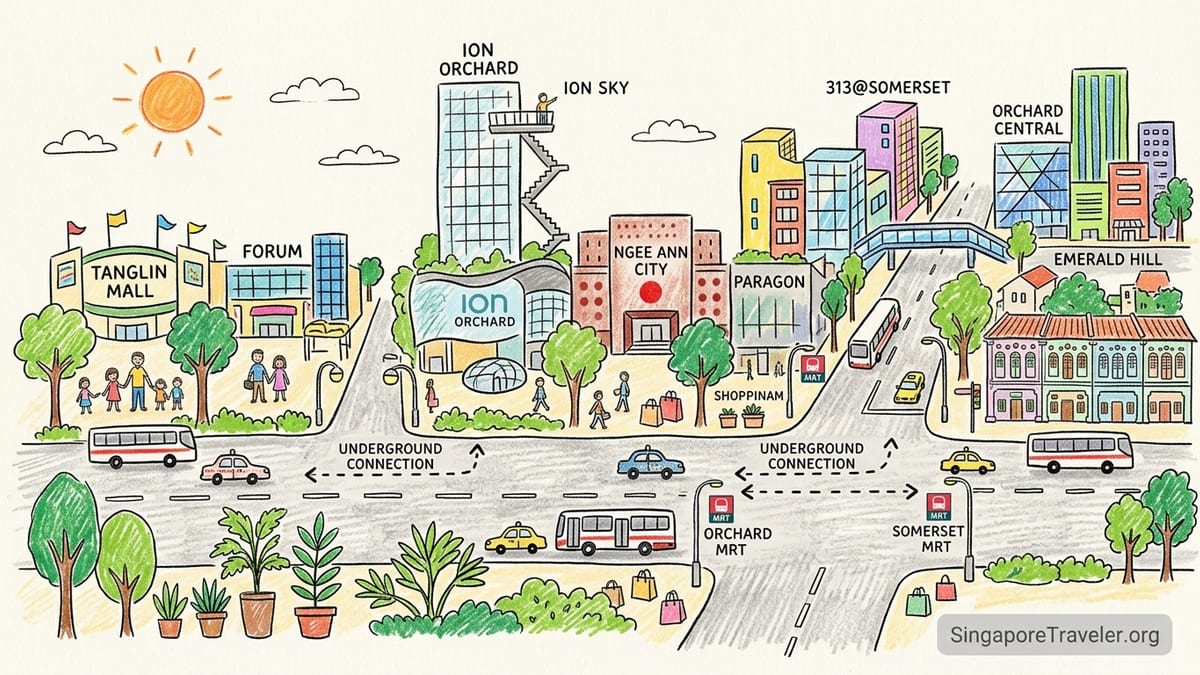
Orchard Road runs roughly west to east from the quieter Tanglin junction near the UNESCO-listed Botanic Gardens down to the livelier Somerset area, ending near Dhoby Ghaut. The Singapore Tourism Board now organizes the district into three sections: Tanglin at the western gateway, Orchard at the central heart, and Somerset towards the eastern end. For most visitors, the core experience is a simple walk between Orchard and Somerset MRT stations, with occasional detours into side streets and malls.
As a first timer, it is helpful to picture Orchard Road as a single long boulevard with layers built above and below it. Underground walkways connect major malls directly to MRT stations like Orchard and Somerset, so you can move between ION Orchard, Wisma Atria, Ngee Ann City and 313@Somerset without crossing busy traffic. Elevated walkways and covered sidewalks mean you can stay mostly sheltered from the tropical heat and sudden rain. Once you understand that you are really roaming one continuous corridor, not dozens of separate buildings, Orchard starts to feel manageable rather than overwhelming.
Geographically, a sensible way to approach the area is to begin near Tanglin if you prefer a slower start, walk towards the Orchard section for the densest cluster of malls and dining, then continue as far as Somerset if you still have energy for youth-oriented fashion, casual eateries and nightlife. Beyond Somerset, the feel gradually shifts away from pure shopping towards residential and smaller-scale businesses, so for most visitors Somerset marks a practical endpoint before turning back or hopping onto the MRT.
Tanglin: The Green Gateway to Orchard
The Tanglin end of Orchard Road is the calmest section, set closest to the Singapore Botanic Gardens. This is where you will find family-friendly malls such as Tanglin Mall and the Forum The Shopping Mall, as well as a number of embassies and upscale residences tucked behind the main road. If you are staying in hotels like St. Regis Singapore, Regent Singapore or JEN Singapore Tanglin by Shangri-La, you will be based in this quieter precinct with Orchard’s main action a 10 to 15 minute walk or one MRT stop away.
Tanglin Mall caters to everyday needs more than luxury labels. Inside you are more likely to find a well-stocked supermarket, children’s clothing stores, pharmacies and casual cafes than flagship designer boutiques. Prices at cafes here tend to be typical for central Singapore: expect to pay roughly 6 to 8 Singapore dollars for a latte and around 15 to 20 dollars for a light lunch like pasta or a salad. This makes Tanglin convenient if you are traveling with family or staying in a serviced apartment and need groceries, baby supplies or simple meals.
Forum The Shopping Mall, a short walk closer towards the Orchard section, has long been known for children’s education centers, toy shops and child-focused services. Visitors may not need to spend much time here unless traveling with young children, but it is a useful landmark when walking from the Tanglin hotels into the thicker part of Orchard. From this point, the skyline begins to change: glass towers housing malls like Wheelock Place and Scotts Square come into view, signalling that you are leaving the residential-feeling Tanglin zone and entering the central Orchard section.
Orchard: Flagship Malls, Hotels and ION Sky
The Orchard section is the heart of the district and is anchored by Orchard MRT station. If you only have half a day in the area, this is where you should focus. Major malls here include ION Orchard, Wisma Atria, Ngee Ann City, Paragon, Shaw House and Wheelock Place, all packed into a short, walkable stretch. Above and around these malls rise many of Orchard’s best-known hotels, such as the Hilton Singapore Orchard, Mandarin Orchard Singapore and Marriott Tang Plaza, giving you a sense of how central this node is to the city’s commercial life.
ION Orchard is often a first stop for visitors emerging from Orchard MRT. Its lower levels house popular brands and an underground food hall with everything from bubble tea to local-style snacks, while upper floors carry luxury names alongside mid-range labels. ION Sky, the building’s observation deck, sits on the 55th and 56th floors, around 218 meters above street level, and offers panoramic views over Orchard, Marina Bay and the central business district. Access details and promotions change from time to time, but a common pattern is for entry to be tied to a minimum spend in the mall or to special packages with the rooftop lounge. It is worth checking at the concierge desk on arrival to see what the current requirements are.
Across the road from ION, Wisma Atria and Ngee Ann City offer a mix of international brands and strong Japanese and local representation. Ngee Ann City is home to the Takashimaya department store, which anchors a mall filled with boutiques, a large bookstore and regular atrium events such as pop-up fairs or seasonal markets. It is not unusual to stumble upon a food fair selling regional snacks or a cosmetic brand’s roadshow in the central atrium space. Paragon, a little further along, skews more upscale with designer fashion, medical clinics and polished cafes, attracting a mix of affluent locals, regional visitors and medical tourists. Window shopping here can feel more like strolling through a luxury brand catalog than a traditional mall experience.
One useful aspect of the Orchard section is how seamlessly the malls connect. Underground passages link ION to Wisma Atria and Ngee Ann City, and overhead crossings move you between TANGS, Shaw House and Wheelock Place. In practical terms, this means you can start at Orchard MRT, walk through ION, drift into Wisma and Ngee Ann City, then cross towards Paragon without needing to step into the sun more than a few minutes at a time. For first-time visitors, this connected network makes it easy to orient yourself: Orchard MRT and ION serve as your anchor point, and everything else radiates out from there.
Somerset: Youthful Energy, Emerald Hill and the Practical End Point
As you continue east from Ngee Ann City and Paragon, the tone of Orchard Road shifts towards a younger, more casual vibe anchored by Somerset MRT station. Here you will find malls like 313@Somerset, Orchard Gateway, Orchard Central and The Centrepoint, each stacked with fast fashion, lifestyle brands, sportswear and mid-priced dining. This is where Singapore’s teenagers and young adults often meet friends, browse the latest streetwear drops or gather for bubble tea and dessert cafes after school or work.
313@Somerset has a strong concentration of global high-street brands, sneaker stores and wallet-friendly eateries. Typical prices for a meal in the food courts or chain restaurants here range from about 8 to 15 Singapore dollars per person, making it easier on the budget than dining inside the luxury malls near Orchard MRT. Orchard Central and Orchard Gateway, connected by a glass bridge over Orchard Road, offer a mix of international and local fashion labels, casual rooftop dining and one of the larger Don Don Donki Japanese discount supermarkets in the area. Many visitors find this side of Orchard more relaxed and approachable than the polished central section.
Just steps from Somerset MRT lies Emerald Hill, a short side street that feels worlds away from the main road’s neon and traffic. Lined with conserved Peranakan shophouses from the early 20th century, Emerald Hill has been designated a conservation area and is one of the best places in central Singapore to see traditional Straits Chinese architecture up close. During the day, the pastel facades, shuttered windows and ornate tiles make this a popular photo stop. In the evenings, several of the shophouses operate as bars and lounges where office workers and visitors unwind with cocktails or beer in a setting that blends heritage details with modern interiors.
For most travelers, Somerset marks the realistic end of the Orchard Road shopping corridor. Beyond this point, as you walk towards Dhoby Ghaut, malls become less concentrated and the focus gradually shifts towards offices and smaller shops. If you have limited time, a good strategy is to walk from Orchard MRT down to Somerset MRT, exploring malls and side streets as you go, then either return the same way on foot or hop onto the North South Line from Somerset back to your hotel or next stop.
Local Brands, Dining and Experiences Beyond Shopping
While Orchard is dominated by familiar international names, there are still plenty of chances to discover local and regional brands, as well as experiences that go beyond pure retail. In the Orchard section, large department stores and multi-brand boutiques often stock Singapore labels alongside global ones. You might find local fashion designers offering tropical-weight office wear, or homegrown skincare brands that focus on humidity-friendly formulas. Exploring the smaller units on upper floors rather than only the ground-level flagship stores can reveal independent boutiques selling everything from minimalist jewelry to batik-inspired clothing.
Dining is a major part of Orchard’s appeal. Malls across Tanglin, Orchard and Somerset have large food courts where you can taste local dishes like chicken rice, laksa and char kway teow at prices that are generally lower than standalone restaurants. A typical hawker-style meal in a mall food court might cost around 6 to 10 Singapore dollars, with an additional 2 to 4 dollars for a drink. At the same time, Orchard is dotted with hotel restaurants, Japanese izakaya, Korean barbecue, European bistros and dessert bars, so you can easily mix casual lunches with more polished dinners. International coffee chains sit alongside local cafes that serve kaya toast, kopi and traditional snacks if you prefer a Singapore-style breakfast or afternoon break.
Experiences beyond shopping and dining include visits to ION Sky for city views, catching a film in one of the area’s cinemas, or booking a treatment at a spa within the larger hotels or malls. Many visitors also use Orchard as a base for nightlife, especially in the Somerset and Emerald Hill area where bars offer happy-hour promotions in the early evening. Cocktail prices in sit-down bars typically range from about 20 to 30 Singapore dollars, while a draft beer might cost roughly 12 to 18 dollars depending on the venue. Dress codes are generally smart casual in hotel lounges and more relaxed in shophouse bars, but it is advisable to avoid beachwear or activewear when planning a night out.
Families can find kid-friendly attractions such as small indoor play areas and activity centers inside certain malls, especially in Tanglin and the Orchard section. It is common to see weekend events in atrium spaces, from themed exhibitions to character meet-and-greets tied to popular animation franchises. Even if you are not focused on shopping, spending a few hours wandering between malls, stopping for snacks, and exploring heritage side streets like Emerald Hill can give you a good feel for contemporary Singaporean urban life.
Getting There, MRT Stations and How Long You Really Need
Reaching Orchard Road is straightforward by public transport. Orchard and Somerset stations sit on the North South MRT Line, with Orchard positioned in the central section and Somerset closer to the eastern end. Many bus routes also travel along Orchard Road, stopping at points in front of major malls such as ION Orchard, Plaza Singapura and 313@Somerset. If you are staying in central areas like Marina Bay, Clarke Quay or Bugis, expect an MRT journey of about 10 to 20 minutes to reach Orchard or Somerset with one simple train change if needed.
Taxis and ride-hailing services are widely available and convenient if you are carrying shopping bags or traveling with children. However, traffic along Orchard Road can be congested on weekend afternoons and evenings, especially when shopping promotions or holiday events are underway. A balanced approach is to take the MRT into Orchard Road, use the underground walkways to cover ground on foot, then call a taxi or ride-hail from a quieter side street or taxi stand once you are ready to move on.
For first-time visitors, a realistic amount of time to allocate to Orchard Road is half a day to a full day, depending on your interest in shopping. If you mainly want to get a feel for the area, ride up to ION Sky for the view, see Emerald Hill and have one or two meals, six to eight hours is usually sufficient. Dedicated shoppers who plan to browse multiple malls, compare prices on electronics or cosmetics, and perhaps claim tax refunds may easily spend two days here, especially during major sale seasons when promotions and limited-time offers draw crowds.
When planning your route, a practical starting point is Orchard MRT station. Begin inside ION Orchard, follow the connected malls along the road towards Ngee Ann City and Paragon, then continue on foot to 313@Somerset and Orchard Gateway. From there, detour briefly into Emerald Hill to see the conserved shophouses and, if time permits, stop for a drink or early dinner. Finish at Somerset MRT for an easy onward journey. Travelers based in Tanglin hotels can reverse this route, starting from Tanglin Mall and walking into the Orchard core before looping back by train or taxi.
Best Time to Visit and Seasonal Considerations
Singapore’s climate is warm and humid year-round, with daytime temperatures typically around the low 30s Celsius and frequent short bursts of rain. As a result, the best time to visit Orchard Road is less about specific months and more about time of day and your tolerance for crowds. Malls usually open around 10 or 11 in the morning and stay open until around 9 or 10 at night. For a more relaxed experience, aim to arrive before lunchtime on weekdays, when corridors are quieter and it is easier to get seats at popular cafes without a wait.
Afternoons can feel busiest, particularly on weekends when local families and regional tourists flock to the area. If you are planning to photograph Emerald Hill’s architecture or the Orchard streetscape, early morning or late afternoon offers softer light and slightly cooler temperatures, with fewer people in your frame. Evenings are attractive for their energy: window displays are fully lit, buskers sometimes perform along wider pavements, and rooftop bars and hotel lounges begin to fill with after-work and pre-dinner crowds. However, expect more competition for restaurant tables and longer lines at taxi stands.
In terms of the calendar, Orchard Road is especially atmospheric during the year-end festive period when elaborate light displays, Christmas trees and themed installations brighten the entire stretch. This is a popular time for both locals and tourists, so hotel rates and crowd levels rise accordingly. Mid-year sale periods, sometimes branded as the Great Singapore Sale or similar campaigns, also draw bargain hunters as shops offer discounts across fashion, accessories and home goods. Even outside these periods, visitors can usually find smaller in-store promotions or clearance racks; Singapore’s competitive retail environment means retailers often run some form of deal.
Regardless of season, plan for air-conditioning that can feel cool after walking in the heat. Carrying a light layer such as a thin cardigan or shawl can be surprisingly useful, especially if you are spending extended time in cinemas, restaurants or hotel lobbies. Comfortable walking shoes are essential, as it is easy to underestimate the distance once you start wandering through multiple interconnected malls. Hydration is simple: convenience stores and supermarket sections in malls sell bottled water and drinks at modest markups, and drinking fountains are occasionally available in larger complexes.
The Takeaway
For a first-time visitor, Orchard Road is best understood as a sequence: start in laid-back Tanglin if you are based there, immerse yourself in the dense malls and hotels of the central Orchard section, then continue to youthful Somerset and the heritage pocket of Emerald Hill. The practical shopping corridor most visitors need runs from roughly Tanglin Mall through Orchard MRT to 313@Somerset, with Somerset serving as a natural endpoint before the area thins out towards Dhoby Ghaut.
Beyond its reputation as a shopping belt, Orchard Road offers a snapshot of modern Singaporean life: locals meeting for coffee in mall atriums, families running errands in Tanglin, office workers relaxing in Emerald Hill’s shophouse bars, and visitors gazing over the skyline from ION Sky. Whether you devote just an afternoon or build several days around it, approaching Orchard with a clear sense of its geography and character will help you navigate efficiently, discover pockets of local flavor, and enjoy the district as more than just a string of air-conditioned storefronts.
FAQ
Q1. Where exactly does Orchard Road start and end for visitors?
For most travelers, Orchard Road effectively runs from the Tanglin end near Tanglin Mall through the central Orchard MRT cluster to Somerset MRT, where the useful shopping corridor naturally tapers off.
Q2. Which MRT station is best for a first visit to Orchard Road?
Orchard MRT is the most convenient starting point, as it connects directly to ION Orchard and sits at the heart of the main mall cluster, making it easy to orient yourself and walk in either direction.
Q3. How long should I plan to spend on Orchard Road?
If you mainly want to look around, visit ION Sky, see Emerald Hill and have a meal, half a day is usually enough. Serious shoppers comparing multiple malls and brands may want a full day or even two shorter visits.
Q4. Is Orchard Road worth visiting if I am not a big shopper?
Yes. You can enjoy city views from ION Sky, explore Peranakan shophouses on Emerald Hill, sample local dishes in mall food courts and people-watch in the air-conditioned atriums without committing to major purchases.
Q5. What is the difference between Tanglin, Orchard and Somerset?
Tanglin is quieter and more residential with practical malls and several hotels, Orchard is the central luxury and flagship mall zone, and Somerset has a younger, more casual atmosphere with streetwear, mid-range dining and nightlife around Emerald Hill.
Q6. When is the best time of day to walk along Orchard Road?
Late morning on weekdays offers fewer crowds and gentler heat, while evenings bring more atmosphere with lights and nightlife. Midday weekends are the busiest and can feel crowded inside and outside the malls.
Q7. How expensive is eating on Orchard Road?
Food courts inside malls offer local dishes from roughly 6 to 10 Singapore dollars per meal, while sit-down restaurants range more widely. Hotel restaurants and cocktail bars are at the higher end, closer to international big-city prices.
Q8. Where can I see local or regional brands instead of only global chains?
Look inside larger department stores, upper-level units in malls and specialty lifestyle or fashion boutiques, particularly in the Orchard and Somerset sections, where local designers, skincare labels and homeware brands often share space with international names.
Q9. Is Orchard Road family-friendly?
Yes. Malls across Tanglin, Orchard and Somerset have stroller-accessible paths, baby-changing facilities, indoor play corners and plenty of casual dining options, making it relatively easy for families with young children.
Q10. Can I walk between all the main Orchard Road malls without going outside much?
In the central section you can move between many major malls using underground passages and covered walkways linked to Orchard and Somerset MRT stations, which keeps you mostly sheltered from sun and rain while you explore.